Unit 8 · Topic 8.2 Beta

Motion with Integrals

Integrate velocity for displacement, x(b) − x(a) ; integrate speed |v| for total distance.

Practice 1: Implementing Mathematical ProcessesPractice 3: Justification

Question set for this topic

Part 1 · Hook

Why this matters

A runner jogs 3 km out along a trail and 3 km back. Her watch says she ran 6 km; her displacement is zero, because she ended where she started. Both numbers come from the same velocity graph. Integrate velocity and you get the change in position; integrate speed and you get the distance covered.

Part 2 · Before you start

What this builds on

Part 3 · Prerequisite check

Quick check before you start

1. A particle has velocity v(t)v(t). Its speed is

  1. |v(t)||v(t)|
  2. v′(t)v'(t)
  3. −v(t)-v(t)
  4. v(t)2v(t)^2
Show the answer

Speed is the size of the velocity, without its direction.

  • Correct: |v(t)||v(t)|:
  • v′(t)v'(t):
  • −v(t)-v(t):
  • v(t)2v(t)^2:

2. If F′=fF' = f is continuous, then ∫abf(t)dt\int_a^b f(t)\,dt==

  1. F(b)−F(a)F(b) - F(a)
  2. F(a)−F(b)F(a) - F(b)
  3. f(b)−f(a)f(b) - f(a)
  4. F(b)F(b)
Show the answer

The integral of a rate of change is the net change.

  • Correct: F(b)−F(a)F(b) - F(a):
  • F(a)−F(b)F(a) - F(b):
  • f(b)−f(a)f(b) - f(a):
  • F(b)F(b):

Part 4 · See it

See it first

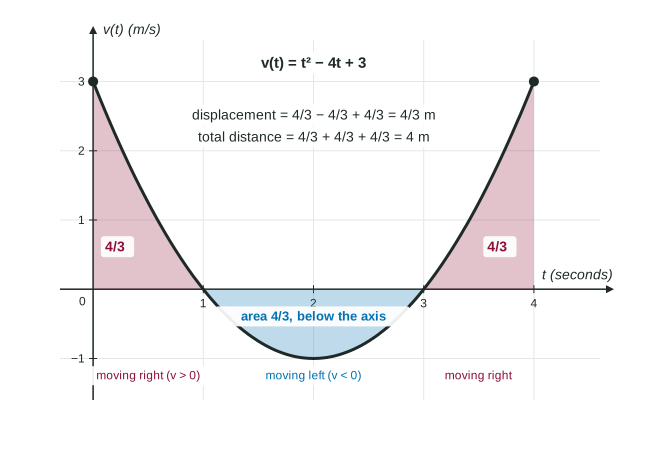
The velocity v(t) = t² − 4t + 3 m/s for 0 ≤ t ≤ 4 s. It is positive on (0, 1) and (3, 4), where the region between the graph and the t-axis is shaded crimson with area 4/3 each, and negative on (1, 3), where the region below the axis is shaded blue with area 4/3. Displacement adds signed areas: 4/3 m. Total distance adds the areas: 4 m.
v(t)=t2−4t+3v(t) = t^2 - 4t + 3 on [0,4][0, 4]. Signed areas give the displacement, 43\frac{4}{3} m; the areas themselves give the total distance, 4 m. LevlPrep original diagram.

Part 5 · Step by step

How it works, step by step

  1. v(t)=x′(t)v(t) = x'(t)∫abv(t)dt\int_a^b v(t)\,dt=x(b)−x(a)= x(b) - x(a), the displacement
  2. Area below the t-axis counts as negative in that integralmotion to the left cancels motion to the right
  3. Speed is |v(t)||v(t)|∫ab|v(t)|dt\int_a^b |v(t)|\,dt counts every stretch as positive: the total distance
  4. The position at one time x(a)x(a) is knownx(t)x(t)=x(a)= x(a)+∫atv(s)ds+ \int_a^t v(s)\,ds gives the position at any time

Part 6 · Key ideas

Key ideas

  • Displacement on [a,b][a, b]: ∫abv(t)dt\int_a^b v(t)\,dt=x(b)−x(a)= x(b) - x(a). Its sign gives the direction of the net change.
  • Total distance traveled: ∫ab|v(t)|dt\int_a^b |v(t)|\,dt. Without a calculator, split at the zeros of vv and add the sizes of the pieces.
  • Position: x(t)x(t)=x(t0)= x(t_0)+∫t0tv(s)ds+ \int_{t_0}^{t} v(s)\,ds. The initial position is not optional.
  • Velocity from acceleration works the same way: v(t)v(t)=v(t0)= v(t_0)+∫t0ta(s)ds+ \int_{t_0}^{t} a(s)\,ds.
  • Units: integrating meters per second over seconds gives meters.

Part 7 · Misconception

A common mistake

The wrong idea: The total distance on [0,4][0, 4] for v(t)=t2−4t+3v(t) = t^2 - 4t + 3 is ∫04v(t)dt\int_0^4 v(t)\,dt=43= \frac{4}{3} m.

What actually happens: That is the displacement. v<0v < 0 on (1,3)(1, 3), so the particle moves left and that stretch subtracts. Total distance: ∫04|v(t)|dt\int_0^4 |v(t)|\,dt=43= \frac{4}{3}+43+ \frac{4}{3}+43+ \frac{4}{3}=4= 4 m.

Part 8 · Check yourself

Check yourself

Exam-style questions. Anything you miss goes into your review queue.

Graph

The velocity v(t)v(t) of a particle

12345678910−3−2−112345t (seconds)v(t) (m/s)

1. Find the displacement of the particle from t=0t = 0 to t=10t = 10 seconds. Include units.

No calculator. Type the exact value (a fraction, π, e or a root is fine), then its unit.

Show the answer

∫010v(t)dt\int_0^{10} v(t)\,dt=4= 4+12+ 12+4−1−4+ 4 - 1 - 4=15= 15 meters.

  • Answer: 15 meters

2. Find the total distance the particle travels from t=0t = 0 to t=10t = 10 seconds. Include units.

No calculator. Type the exact value (a fraction, π, e or a root is fine), then its unit.

Show the answer

∫010|v(t)|dt\int_0^{10} |v(t)|\,dt=4= 4+12+ 12+4+ 4+1+ 1+4+ 4=25= 25 meters.

  • Answer: 25 meters

3. The particle is at x=−3x = -3 meters at t=0t = 0. Find its position at t=10t = 10.

No calculator. Type the exact value (a fraction, π, e or a root is fine), in meters.

Show the answer

x(10)x(10)=x(0)= x(0)+∫010v(t)dt+ \int_0^{10} v(t)\,dt=−3= -3+15+ 15=12= 12 meters.

  • Answer: 12 meters

4. Which expression gives the total distance a particle with velocity v(t)v(t) travels from t=1t = 1 to t=4t = 4?

  1. |∫14v(t)dt|\left|\int_1^4 v(t)\,dt\right|
  2. ∫14v(t)dt\int_1^4 v(t)\,dt
  3. ∫14v′(t)dt\int_1^4 v'(t)\,dt
  4. ∫14|v(t)|dt\int_1^4 |v(t)|\,dt
Show the answer

Total distance =∫14|v(t)|dt= \int_1^4 |v(t)|\,dt; the absolute value goes inside the integral.

  • |∫14v(t)dt|\left|\int_1^4 v(t)\,dt\right|: That is the size of the displacement; back-and-forth motion cancels inside.
  • ∫14v(t)dt\int_1^4 v(t)\,dt: That is the displacement.
  • ∫14v′(t)dt\int_1^4 v'(t)\,dt: That is v(4)−v(1)v(4) - v(1), a change in velocity.
  • Correct: ∫14|v(t)|dt\int_1^4 |v(t)|\,dt: The integral of speed counts every stretch as positive.

5. A particle has velocity v(t)=3t2−2v(t) = 3t^2 - 2 and position x(1)=4x(1) = 4. Find x(t)x(t).

Type an expression for x(t)=x(t) =.

Show the answer

x(t)x(t)=x(1)= x(1)+∫1t(3s2−2)ds+ \int_1^t (3s^2 - 2)\,ds=4= 4+(t3−2t)−(1−2)+ (t^3 - 2t) - (1 - 2)=t3−2t= t^3 - 2t+5+ 5.

  • Answer: x(t)=x(t) = t3−2t+5t^{3} - 2t + 5

6. A particle moves with v(t)=t2−4t+3v(t) = t^2 - 4t + 3 m/s. Find the total distance it travels on 0≤t≤40 \le t \le 4, without a calculator.

No calculator. Type the exact value (a fraction, π, e or a root is fine), in meters.

Show the answer

v=(t−1)(t−3)v = (t - 1)(t - 3) changes sign at 1 and 3. ∫01v=43\int_0^1 v = \frac{4}{3}, ∫13v\int_1^3 v=−43= -\frac{4}{3}, ∫34v=43\int_3^4 v = \frac{4}{3}. Total distance =4= 4 m.

  • Answer: 4 meters

Part 9 · Summary

Summary

Integrate velocity for displacement, x(b)−x(a)x(b) - x(a); integrate speed |v||v| for total distance. To find a position, start from a known position and add the integral of velocity. Split at the zeros of vv when working by hand, and always state units.

Part 10 · Up next

What comes next

Part 11 · Connections

Connections