Justifying a Claim Based on a Confidence Interval for the Difference Between Two Population Proportions
To judge a claim with an interval for p_1 − p_2 , look at where 0, or the claimed value, sits.
Part 1 · Hook
Why this matters
Part 2 · Before you start
What this builds on
Part 3 · Prerequisite check
Quick check before you start
1. A 95% interval for is from 0.44 to 0.52. Is 0.5 a plausible value of ?
- Yes, it is inside the interval
- No, it is above the center
- No, the interval is too wide
- Only at 99% confidence
Show the answer
Values inside the interval are plausible.
- Correct: Yes, it is inside the interval:
- No, it is above the center:
- No, the interval is too wide:
- Only at 99% confidence:
2. What does the interval estimate?
- the standard error
Show the answer
An interval estimates a parameter: the true difference.
- Correct: :
- :
- :
- the standard error:
Part 4 · See it
See it first
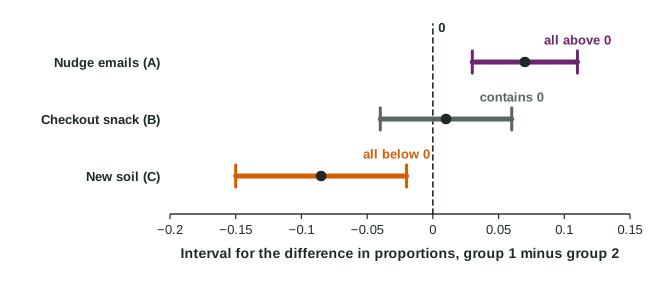
Part 5 · Step by step
How it works, step by step
- A difference of 0 means ask whether 0 is a plausible value of , that is, whether it is inside the interval
- Every value in the interval is greater than 0the interval gives convincing evidence that (less than 0: that )
- The interval contains 0equal proportions are plausible, so there is not convincing evidence of a difference, and the interval does not prove there is none
- A claim names a value such as "15 points more"check that value the same way: inside the interval means plausible, outside means convincing evidence against it
Part 6 · Key ideas
Key ideas
- Entirely above 0: convincing evidence . Entirely below 0: convincing evidence . Contains 0: no convincing evidence of a difference.
- Write the claim with the reason first: "Because every value in the interval is greater than 0, the interval gives convincing evidence that ..."
- A 95% interval and a two-sided test at nearly always agree about whether 0 is plausible.
- Containing 0 never proves the proportions are equal; very large samples can make even tiny differences convincing.
Part 7 · Misconception
A common mistake
The wrong idea: If the interval contains 0, the study proved that the two proportions are the same.
What actually happens: Containing 0 only means a difference of 0 is plausible. Other values in the interval are plausible too, so the right wording is "not convincing evidence of a difference".
Part 8 · Check yourself
Check yourself
Exam-style questions. Anything you miss goes into your review queue.
Table
Three studies, three 95% intervals
| Study | Group 1 | Group 2 | Proportion of | 95% interval |
|---|---|---|---|---|
| A | students sent weekly nudge emails | students sent no emails | students who finish the online course | from 0.03 to 0.11 |
| B | shoppers at store 1 | shoppers at store 2 | shoppers who buy a snack at checkout | from to 0.06 |
| C | seedlings in new soil | seedlings in old soil | seedlings that survive a month | from to |
1. Which study gives convincing evidence that is greater than ?
- Studies A and B
- Study A
- Study B
- Study C
Show the answer
An interval entirely above 0 is convincing evidence that .
- Studies A and B: Study B's interval reaches below 0, so it does not give convincing evidence of a positive difference.
- Correct: Study A: Right: every value from 0.03 to 0.11 is positive, so every plausible difference has group 1 higher.
- Study B: Study B's interval contains 0, so equal proportions are plausible.
- Study C: Study C's interval is entirely negative: it suggests group 2 is higher, the other direction.
2. What does Study B's interval let you conclude?
- Store 1 has the higher proportion, since most of the interval is positive
- There is not convincing evidence of a difference: 0 is a plausible value
- The two stores have exactly the same proportion of snack buyers
- The study made an error, since an interval should not cross 0
Show the answer
Containing 0 means equal proportions are plausible: no convincing evidence of a difference, and no proof of equality.
- Store 1 has the higher proportion, since most of the interval is positive: More of the interval lies above 0, but 0 is still inside it, so a difference of 0 is plausible.
- Correct: There is not convincing evidence of a difference: 0 is a plausible value: Right: the interval holds negative values, 0 and positive values, so it cannot rule out equal proportions.
- The two stores have exactly the same proportion of snack buyers: An interval that contains 0 does not show the difference is 0; it shows 0 cannot be ruled out. Values up to 0.06 are plausible too.
- The study made an error, since an interval should not cross 0: Intervals cross 0 often. It means the data are consistent with no difference.
3. Complete the claim about Study C in context.
Write the conclusion in context.
Show the answer
An interval entirely below 0 is convincing evidence that .
- A full-credit answer: Because every value in the interval from -0.15 to -0.02 is less than 0, the interval gives convincing evidence that the true proportion of seedlings that survive a month is lower in new soil than in old soil.
4. Study A's team also computes a 99% interval from the same data. What would it show?
- About 0.01 to 0.09, with both ends above 0
- About 0.017 to 0.123, with both ends above 0
- The same interval, from 0.03 to 0.11
- About to 0.15, now containing 0
Show the answer
Same center, larger : the 99% interval is wider but here still excludes 0.
- About 0.01 to 0.09, with both ends above 0: A higher confidence level makes the interval wider, not narrower.
- Correct: About 0.017 to 0.123, with both ends above 0: Right: the 95% margin, 0.04, means ; the 99% margin is , and the lower end is still positive.
- The same interval, from 0.03 to 0.11: The level changes from 1.96 to 2.576, so the interval widens.
- About to 0.15, now containing 0: The 99% margin is about 0.053, not 0.08. The lower end stays above 0.
5. A 95% interval for is from 0.01 to 0.08. What does this say about a two-sided test of at with the same data?
- The test would fail to reject , because the interval is narrow
- The test would reject at as well
- Nothing, because tests and intervals answer different questions
- The test would reject , because 0 is not a plausible value
Show the answer
A interval and a two-sided test at give matching answers about a null value, except in rare borderline cases.
- The test would fail to reject , because the interval is narrow: Width is not the point. What matters is that 0 lies outside the interval.
- The test would reject at as well: A 99% interval would be needed for that, and it might reach 0. You cannot tell from the 95% interval.
- Nothing, because tests and intervals answer different questions: They are closely linked: a 95% interval holds, nearly exactly, the values a two-sided test at 0.05 would not reject.
- Correct: The test would reject , because 0 is not a plausible value: Right: a two-sided test at and a 95% interval nearly always agree; an interval well clear of 0 matches a p-value below 0.05.
6. A 95% interval for is from 0.07 to 0.19. Does it give convincing evidence for the claim that is more than 5 percentage points above ?
- No: you would need a test, not an interval
- Yes: every value in the interval is greater than 0.05
- No: the interval does not contain 0.05
- Yes: the sample difference, 0.13, is greater than 0.05
Show the answer
Compare the claimed value with the whole interval, not with the estimate.
- No: you would need a test, not an interval: An interval can judge a claim about a value: check where the value sits relative to the interval.
- Correct: Yes: every value in the interval is greater than 0.05: Right: the claim is , and every plausible value is above 0.05.
- No: the interval does not contain 0.05: Not containing 0.05 is exactly what supports the claim here, because the whole interval is above it.
- Yes: the sample difference, 0.13, is greater than 0.05: The sample difference alone could be chance. The whole interval being above 0.05 is the evidence.
Part 9 · Summary
Summary
Part 10 · Up next
What comes next
Part 11 · Connections