The Binomial Distribution
When a yes-or-no trial repeats n times independently with the same success probability p, the number of successes is binomial: P(X = k) = (nCk)p^k(1 − p)^(n − k) , with mean np and standard deviation √(np(1 − p)) .
Part 1 · Hook
Why this matters
Part 2 · Before you start
What this builds on
Part 3 · Prerequisite check
Quick check before you start
1. What is ?
- 10
- 20
- 7
- 5
Show the answer
- Correct: 10:
- 20:
- 7:
- 5:
2. Events are independent when
- knowing one happened does not change the probability of the other
- they cannot happen together
- their probabilities add to 1
- they have the same probability
Show the answer
That is the definition: .
- Correct: knowing one happened does not change the probability of the other:
- they cannot happen together:
- their probabilities add to 1:
- they have the same probability:
Part 4 · See it
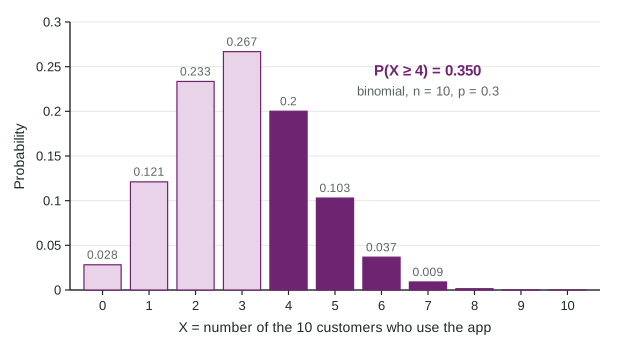
See it first
Part 5 · Step by step
How it works, step by step
- A trial has two outcomes and repeats a fixed number of times, independently, with the same pthe count of successes X is binomial with parameters n and p
- One order of k successes and n − k failures has probability and there are such orders, so
- An event like "at least 4" covers several valuesadd them, or use the complement:
- The probability of a result as extreme as the one seen is very small under a claimthe result gives reason to doubt the claim
Part 6 · Key ideas
Key ideas
- A binomial setting: two outcomes per trial, independent trials, a fixed number n of trials, the same success probability p on every trial.
- The binomial distribution:
for . - Show work: name the distribution and parameters, the boundary and the direction: "X is binomial, , ;
." - Mean and standard deviation .
- Translate carefully: "fewer than 3" is , "at least 4" is .
Part 7 · Misconception
A common mistake
The wrong idea: is .
What actually happens: The complement of "4 or more" is "3 or fewer", so . Subtracting throws away the value 4 itself.
Part 8 · Check yourself
Check yourself
Exam-style questions. Anything you miss goes into your review queue.
Diagram
Guessing on a quiz
1. What is the probability that the student gets exactly 3 questions right?
- 0.25
- 0.649
- 0.258
- 0.001
Show the answer
X is binomial with and .
- 0.25: That is the chance of guessing one question right, not of exactly 3 right out of 12.
- 0.649: That is , the probability of 3 or fewer.
- Correct: 0.258: Right: the binomial formula with n = 12, p = 0.25, k = 3.
- 0.001: That is one arrangement of 3 right and 9 wrong. Multiply by arrangements.
2. What is the probability that the student gets at least 6 questions right?
- 0.1576
- 0.0401
- 0.9456
- 0.0544
Show the answer
- 0.1576: That is : subtracting leaves 5 in.
- 0.0401: That is alone. At least 6 includes 7 through 12.
- 0.9456: That is , the complement.
- Correct: 0.0544: Right: 1 minus the cumulative probability up to 5.
3. What are the mean and standard deviation of X?
- Mean 3, standard deviation 1.5
- Mean 3, standard deviation 2.25
- Mean 6, standard deviation 1.5
- Mean 3, standard deviation 0.75
Show the answer
questions and
- Correct: Mean 3, standard deviation 1.5: Right: np and the square root of np(1 − p).
- Mean 3, standard deviation 2.25: 2.25 is the variance; take its square root.
- Mean 6, standard deviation 1.5: The mean is np = 3, not half of the 12 questions.
- Mean 3, standard deviation 0.75: 0.75 is 1 − p, not the standard deviation.
Table
Survey phone calls
| Number of calls | Chance a call is answered | Y counts |
|---|---|---|
| 15 | 0.20 | answered calls |
4. Why is it reasonable to model Y with a binomial distribution?
- The 15 numbers are a random sample from the list, and 15 calls is a large enough number of trials
- Each call is answered or not, n = 15 is fixed, p = 0.20 each time, calls are independent
- About 20% of the 15 calls, which is 3 calls, will be answered
- The firm keeps dialing new numbers until someone answers a call
Show the answer
Binomial setting: each call is answered or not (two outcomes), the number of calls is fixed at 15, the chance of an answer is 0.20 on each call, and calls to numbers chosen at random from a huge list are independent.
- The 15 numbers are a random sample from the list, and 15 calls is a large enough number of trials: Random choice helps independence, but the fixed number, two outcomes and constant p are also needed.
- Correct: Each call is answered or not, n = 15 is fixed, p = 0.20 each time, calls are independent: Right: all four conditions, in context.
- About 20% of the 15 calls, which is 3 calls, will be answered: That is the mean, not a reason the distribution is binomial.
- The firm keeps dialing new numbers until someone answers a call: The firm dials exactly 15 numbers; a fixed number of trials is one of the conditions.
5. What is the probability that exactly 2 of the 15 calls are answered?
Type a number. A table answer and a calculator answer are both accepted.
Show the answer
Y is binomial with , .
- Answer: 0.2309
6. What is the probability that fewer than 2 of the calls are answered?
Type a number. A table answer and a calculator answer are both accepted.
Show the answer
"Fewer than 2" means 0 or 1:
- Answer: 0.1671
Part 9 · Summary
Summary
Part 10 · Up next
What comes next
Part 11 · Connections