Some probability questions need a count first: how many different ways can 3 of 10 quiz answers be right? Listing them all would take a long time. Two tools do the counting for you: the factorial and the combination.
Factorials: counting orders
How many ways can you line up 5 different books on a shelf? There are 5 choices for the first spot. Once that book is placed, 4 remain for the second spot, then 3, then 2, then 1. Multiply:
That product is written , read "5 factorial". In general,
and by definition . Factorials grow fast: .
Combinations: counting choices
Often the order does not matter. A team of Ana and Ben is the same team as Ben and Ana. Counting ordered choices of 2 from 4 people gives , but that counts each team twice, once in each order. Divide by the orders: 6 teams.
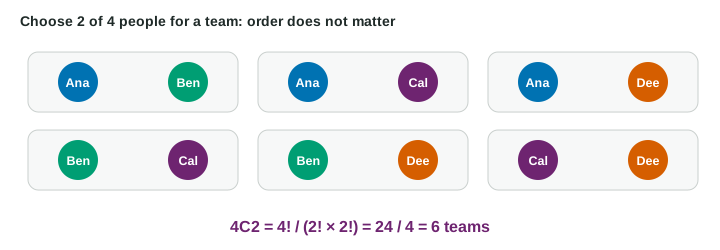
The general rule is the combination, the number of ways to choose k items from n when order does not matter:
Read it "n choose k". Both notations mean the same thing; on a calculator it is usually nCr, and in Bluebook you can type 10C3.
Choose 3 of 10. In how many ways can a student get exactly 3 of 10 quiz questions right?
The order does not matter (it is just which 3 questions), so use a combination.
The cancels: you only ever need the top k factors over .
Answer: 120 different sets of 3 questions.
Useful facts
- and : one way to choose nothing, one way to choose everything.
- : choosing the 3 questions that are right is the same as choosing the 7 that are wrong, so .
- : there are n ways to choose one item.
Order or no order?
| Situation | Order matters? | Count |
|---|---|---|
| Line up 5 books | yes | |
| Choose a team of 2 from 4 | no | |
| Pizza with 3 of 6 toppings | no | |
| Which 3 of 10 answers are right | no |
In Unit 2 the combination appears inside a probability formula, counting the different orders in which successes and failures can happen. Being quick and sure with now makes that formula much easier.