Factorials and Combinations
A factorial n!
Part 1 · Hook
Why this matters
Part 2 · Prerequisite check
Quick check before you start
1. Evaluate .
- 15
- 30
- 12
- 3
Show the answer
Top: 30. Bottom: 2. 30/2 = 15.
- Correct: 15:
- 30:
- 12:
- 3:
2. A count X can be 0 to 10. Which values are "at least 9"?
- 9 and 10
- 10 only
- 0 to 9
- 9 only
Show the answer
At least 9 includes 9.
- Correct: 9 and 10:
- 10 only:
- 0 to 9:
- 9 only:
Part 3 · See it
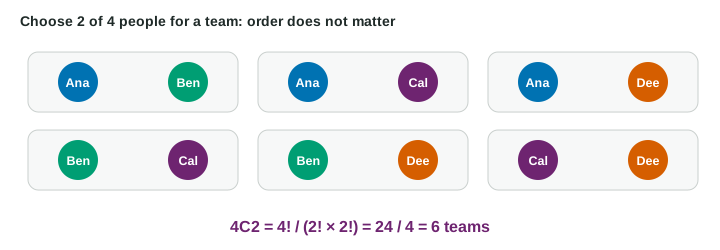
See it first
Part 4 · Step by step
How it works, step by step
- Line up n different itemsthere are n choices for the first place, n − 1 for the next, and so on: orders
- Choose k items in order for k places, but each set of k appears times
- Divide out the orders
counts the sets of k - Choosing k to include is choosing to leave out, and
Part 5 · Key ideas
Key ideas
- A factorial counts the orders of n different items; .
- A combination
counts the ways to choose k of n items when order does not matter. - Ordered choices overcount: counts each set of 3 six times, so .
- On a calculator or in Bluebook, type as 10C3 or nCr(10, 3).
Part 6 · Misconception
A common mistake
The wrong idea: There are teams of 2 from 4 people.
What actually happens: 12 counts ordered pairs, so Ana with Ben is counted twice. Divide by : .
Part 7 · Check yourself
Check yourself
Exam-style questions. Anything you miss goes into your review queue.
1. Type an expression for the number of ways to line up 5 different books on a shelf, and check its value.
Type the expression as on the exam, with the values substituted.
Show the answer
orders.
- Answer:
2. What is ?
- 16
- 24
- 10
- 4
Show the answer
, so .
- 16: That is , not the factorial.
- Correct: 24: Right: .
- 10: That is ; a factorial multiplies.
- 4: A factorial multiplies 4 by every whole number below it.
3. A quiz has 10 questions. Type an expression for the number of ways to choose which 3 questions a student gets right.
Type the expression as on the exam, with the values substituted.
Show the answer
- Answer:
4. How many different teams of 2 can be chosen from 4 people?
- 12
- 8
- 16
- 6
Show the answer
A team does not depend on order: .
- 12: That counts ordered pairs: Ana then Ben is the same team as Ben then Ana, so divide by 2.
- 8: That is 4 × 2, which is not how choices combine.
- 16: That is , which allows the same person twice and counts order.
- Correct: 6: Right: .
5. Why does choosing 3 of 10 questions use a combination and not ?
- The order in which the 3 questions are picked does not matter
- is too large for a calculator
- Combinations are used when questions can be repeated
- counts the questions answered wrong
Show the answer
Ordered choices overcount each set by the number of its orders. Dividing by gives the number of sets: .
- Correct: The order in which the 3 questions are picked does not matter: Right: counts each set of 3 questions times, once for each order.
- is too large for a calculator: Calculators handle 720 easily; the problem is counting each set several times.
- Combinations are used when questions can be repeated: A combination chooses different items, with no repeats.
- counts the questions answered wrong: It counts ordered choices of 3, not the wrong answers.
6. A pizza shop offers 6 toppings. How many different pizzas with exactly 3 different toppings are possible?
- 120
- 18
- 216
- 20
Show the answer
Order does not matter and toppings do not repeat: .
- 120: That counts ordered choices; the order of toppings on a pizza does not matter.
- 18: That is 6 × 3, which is not a count of choices.
- 216: That is , which allows the same topping three times.
- Correct: 20: Right:
.
Part 8 · Summary
Summary
Part 9 · Up next
What comes next
Part 10 · Connections