The first numbers you compute from data are parts of a whole: how many students in a group out of how many in all. This page is the arithmetic behind them: fractions, decimals and percents, and how to choose the right whole.
A part over its whole
A part of a whole is a division:
The answer is always between 0 and 1, because the part sits inside the whole. If you get a number bigger than 1, you have the fraction upside down.
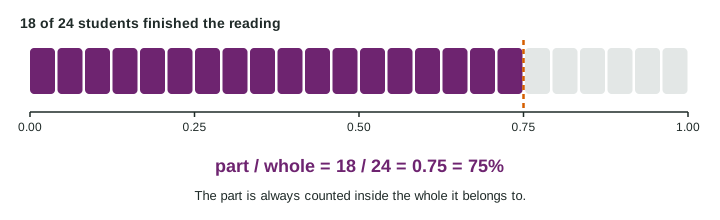
Part, whole, decimal, percent. In a reading group, 18 of the 24 students finished the book.
The whole: the 24 students in the group. The part: the 18 who finished.
Decimal: .
Percent: .
In words: 75% of the reading group finished the book.
Decimals and percents
A percent is "out of 100". To turn a decimal into a percent, multiply by 100 (move the decimal point two places right). To turn a percent into a decimal, divide by 100.
| Fraction | Decimal | Percent |
|---|---|---|
| 0.25 | 25% | |
| 0.375 | 37.5% | |
| 0.08 | 8% | |
| 0.6667 | 66.7% (rounded) |
Watch small percents: 8% is 0.08, not 0.8. And to find a percent of a number, multiply by the decimal: 45% of 300 is .
Which whole?
The hardest part is usually picking the whole. Read the question for the word "of": the group after it is the whole.
Choose the whole. Of 60 seniors, 24 play a school sport, and 9 of those play two sports. What part of the sport players play two sports?
"Of the sport players": the whole is the 24 players, not the 60 seniors.
, so 37.5% of the sport players play two sports.
The other question, "what part of all seniors play two sports?", has whole 60: . Same part, different whole, different answer.
Compare parts, not counts
School A has 18 walkers out of 30 students, and school B has 25 out of 50. School B has more walkers, but it is also bigger. Divide each part by its own whole: and . A larger part of school A walks. Whenever groups have different sizes, compare decimals or percents.