Some acids hand over their proton to water so readily that, in solution, no acid molecules are left at all. These are the strong acids, and they are the easiest case in Unit 8: their pH comes straight from their concentration. This page lists them and their partners, the strong bases, and then shows the one calculation that needs care: mixing an acid with a base.
What "strong" means
A strong acid ionizes fully in water. For hydrochloric acid:
HCl(aq) + H₂O(l) → H₃O⁺(aq) + Cl⁻(aq)
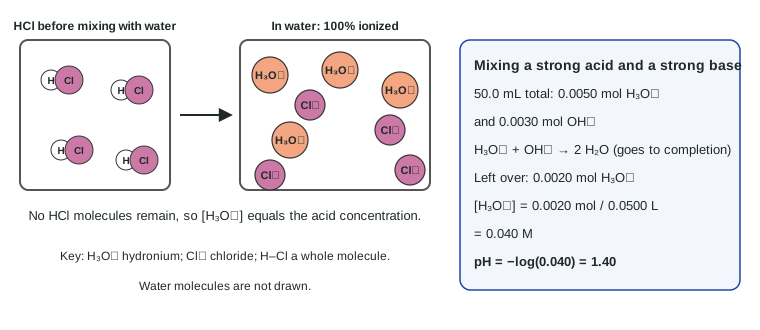
The single arrow means the reaction goes essentially to completion: in a 0.10 M HCl solution there are 0.10 M H₃O⁺, 0.10 M Cl⁻ and no measurable HCl molecules (see the figure). "Strong" is about how fully the acid ionizes, not about how concentrated it is. A 0.0010 M HCl solution is dilute, but the acid is still strong.
Learn the list; the exam expects it:
| Strong acids | Strong bases |
|---|---|
| HCl, HBr, HI | LiOH, NaOH, KOH, RbOH, CsOH (group 1) |
| HNO₃, HClO₄ | Ca(OH)₂, Sr(OH)₂, Ba(OH)₂ (heavier group 2) |
| H₂SO₄ (its first proton) |
Any acid not on the list, such as HF, acetic acid (CH₃COOH) or carbonic acid (H₂CO₃), ionizes only partly. That is the next topic. Note that HF is not strong, even though HCl, HBr and HI are.
A strong base such as NaOH is an ionic compound that dissociates fully: NaOH(s) → Na⁺(aq) + OH⁻(aq). The hydroxides of Ca, Sr and Ba release two OH⁻ ions per formula unit, so [OH⁻] is twice the base concentration.
pH of a strong acid
Worked example 1. What is the pH of 0.0063 M HNO₃?
Step 1. HNO₃ is strong, so [H₃O⁺] = 0.0063 M.
Step 2. pH = −log(0.0063) = 2.2007.
Step 3. Two significant figures in the concentration, two decimal places in the pH: 2.20.
Dilution changes the concentration, so it changes the pH. A strong acid diluted ten times has one tenth the [H₃O⁺], so its pH rises by exactly 1.
Worked example 2: dilute first. 3.50 mL of 1.00 M HCl is diluted to 250.0 mL in a volumetric flask. What is the pH?
Step 1. Moles of HCl = 0.00350 L × 1.00 mol/L = 0.00350 mol.
Step 2. New concentration = 0.00350 mol / 0.2500 L = 0.0140 M = [H₃O⁺].
Step 3. pH = −log(0.0140) = 1.854 (three significant figures, three decimal places).
pH of a strong base
Worked example 3. What is the pH of 0.0150 M Ca(OH)₂?
Step 1. Ca(OH)₂ → Ca²⁺ + 2 OH⁻, so [OH⁻] = 2 × 0.0150 M = 0.0300 M.
Step 2. pOH = −log(0.0300) = 1.5229 → 1.523.
Step 3. pH = 14.000 − 1.523 = 12.477. Check: a base, so above 7. It is.
The two slips here are the classic ones: forgetting the 2 for a group 2 hydroxide, and reporting the pOH as the pH. (A real Ca(OH)₂ solution can hold only about 0.02 M before it stops dissolving, so do not expect 1 M calcium hydroxide.)
Mixing a strong acid and a strong base
When the two meet, the net ionic reaction is H₃O⁺ + OH⁻ → 2 H₂O, and it goes to completion. Whichever ion has more moles is left over. Acid and base react by moles, so the method is always the same:
- Moles of H₃O⁺ and of OH⁻: volume (L) × molarity.
- Subtract. The smaller amount is used up; the excess remains.
- Divide the excess by the total volume of the mixture.
- Take the log: pH directly for excess H₃O⁺, or pOH then pH for excess OH⁻.
Worked example 4. 40.0 mL of 0.100 M NaOH is added to 50.0 mL of 0.0600 M HCl. What is the pH?
Step 1. H₃O⁺: 0.0500 L × 0.0600 M = 3.00 × 10⁻³ mol. OH⁻: 0.0400 L × 0.100 M = 4.00 × 10⁻³ mol.
Step 2. OH⁻ is in excess: 4.00 × 10⁻³ − 3.00 × 10⁻³ = 1.00 × 10⁻³ mol OH⁻.
Step 3. Total volume 90.0 mL: [OH⁻] = 1.00 × 10⁻³ mol / 0.0900 L = 0.0111 M.
Step 4. pOH = −log(0.0111) = 1.954; pH = 14.000 − 1.954 = 12.046.
If the moles are exactly equal, you are at the equivalence point. The solution holds only water and spectator ions such as Na⁺ and Cl⁻, which neither give nor take protons, so the pH is 7.00 at 25 °C. That is true only for strong acid with strong base; Unit 8 will show other pairs that are not neutral at equivalence.
A very dilute strong acid
Water itself supplies 1.0 × 10⁻⁷ M H₃O⁺. Usually that is negligible next to the acid. But for 1.0 × 10⁻⁸ M HCl, plugging into −log gives 8.00, a basic pH for an acid solution, which is impossible. Here you must add water's contribution: solving (1.0 × 10⁻⁸ + x)(x) = Kw gives [H₃O⁺] = 1.05 × 10⁻⁷ M and pH 6.98. The rule of thumb: if the acid concentration is above about 1 × 10⁻⁶ M, ignore water.
Where students lose points
- Forgetting that Ca(OH)₂, Sr(OH)₂ and Ba(OH)₂ give two OH⁻.
- Calling the pOH the pH. Check the answer against 7.
- Using concentrations instead of moles when mixing, or dividing by one solution's volume instead of the total.
- Calling HF strong because the other hydrohalic acids are.