Unit 7 showed that a slightly soluble salt dissolves until Q = Ksp, and that adding a common ion makes it less soluble. This topic adds the opposite trick: removing one of the ions makes the salt more soluble. Acid removes ions that are bases, which is why some salts dissolve in acid while others do not.
Removing an ion shifts the dissolving equilibrium
Take calcium fluoride, CaF₂, a salt that barely dissolves in water:
CaF₂(s) ⇌ Ca²⁺(aq) + 2 F⁻(aq) Ksp = [Ca²⁺][F⁻]²
F⁻ is the conjugate base of HF, a weak acid, so it takes a proton from hydronium:
F⁻(aq) + H₃O⁺(aq) → HF(aq) + H₂O(l)
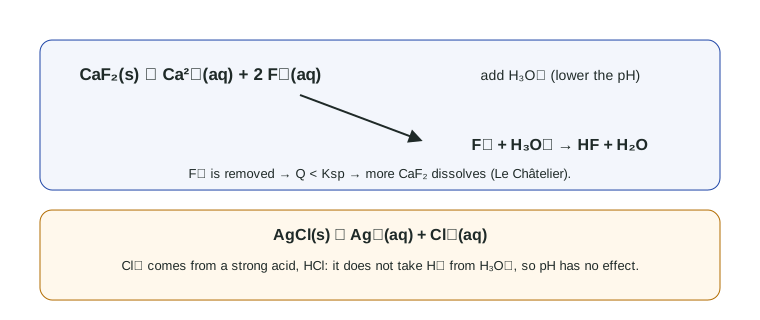
Add acid to a saturated CaF₂ solution and this reaction lowers [F⁻]. Now Q = [Ca²⁺][F⁻]² is less than Ksp, so more solid dissolves to bring Q back up to Ksp. The result: CaF₂ is more soluble at low pH (see the figure). Ksp itself has not changed; it depends only on temperature. What changed is that much of the dissolved fluoride is now hiding as HF, which does not count in Q.
Which salts are affected
| Anion | Conjugate acid | Effect of lowering pH on the salt's solubility |
|---|---|---|
| OH⁻ | H₂O | large increase (Mg(OH)₂, Fe(OH)₃ dissolve in acid) |
| CO₃²⁻ | HCO₃⁻ (weak) | large increase (CaCO₃, limestone) |
| PO₄³⁻ | HPO₄²⁻ (weak) | large increase (Ca₃(PO₄)₂, tooth enamel) |
| F⁻ | HF (weak) | increase (CaF₂) |
| Cl⁻, Br⁻, I⁻, NO₃⁻ | strong acids | no effect (AgCl, PbI₂) |
The rule: if the anion is the conjugate base of a weak acid, the salt dissolves better in acid. The weaker that conjugate acid (the smaller its Ka), the stronger the anion is as a base, and the bigger the effect. Carbonate, whose conjugate acid HCO₃⁻ has Ka 4.7 × 10⁻¹¹, is protonated almost completely even in mildly acidic water; fluoride, from HF with Ka 6.8 × 10⁻⁴, needs much more acid.
Anions from strong acids, such as Cl⁻, do not take protons at all, so acid leaves them alone and the solubility of their salts does not change with pH.
Writing the explanation
The exam asks for this reasoning in words, not numbers. A full-credit answer names the reaction and uses Q and Ksp:
"Adding HNO₃ increases the solubility of CaF₂. The H₃O⁺ reacts with F⁻ to form HF, which decreases [F⁻]. Then Q = [Ca²⁺][F⁻]² is less than Ksp, so more CaF₂ dissolves until Q again equals Ksp."
Common ways to lose the point: saying the acid "raises Ksp" (Ksp changes only with temperature), saying the acid "breaks the bonds of the solid", or saying "Le Châtelier" without naming which ion is removed.
Connections
- The common-ion effect in reverse. Adding F⁻ (as NaF) lowers CaF₂'s solubility; removing F⁻ (with acid) raises it. Both are Q-vs-Ksp arguments.
- Hydroxides. Mg(OH)₂ is the active ingredient of milk of magnesia: it dissolves in stomach acid because H₃O⁺ + OH⁻ → 2 H₂O removes hydroxide, and in doing so it neutralizes the acid.
- Raising the pH works the other way for these salts: in basic solution the anion stays unprotonated, and adding OH⁻ to a hydroxide salt is a common-ion effect.