pH and Solubility
The solubility of a salt depends on pH when its anion is a base.
Part 1 · Hook
Why this matters
Part 2 · Before you start
What this builds on
Part 3 · Prerequisite check
Quick check before you start
1. For CaF₂(s) ⇌ Ca²⁺ + 2 F⁻, what is the expression for Ksp?
- [Ca²⁺][F⁻]²
- [Ca²⁺][F⁻]
- [Ca²⁺][2F⁻]
- [CaF₂]/([Ca²⁺][F⁻]²)
Show the answer
Products raised to their coefficients; the solid is left out.
- Correct: [Ca²⁺][F⁻]²:
- [Ca²⁺][F⁻]:
- [Ca²⁺][2F⁻]:
- [CaF₂]/([Ca²⁺][F⁻]²):
2. If Q < Ksp for a salt with solid present, what happens?
- More solid dissolves
- More solid forms
- Nothing: the system is at equilibrium
- Ksp increases
Show the answer
Q < K means the net reaction goes forward: dissolving.
- Correct: More solid dissolves:
- More solid forms:
- Nothing: the system is at equilibrium:
- Ksp increases:
3. Which anion is the conjugate base of a weak acid?
- F⁻
- Cl⁻
- NO₃⁻
- I⁻
Show the answer
HF is weak; HCl, HNO₃ and HI are strong.
- Correct: F⁻:
- Cl⁻:
- NO₃⁻:
- I⁻:
Part 4 · See it
See it first
Part 5 · Step by step
How it works, step by step
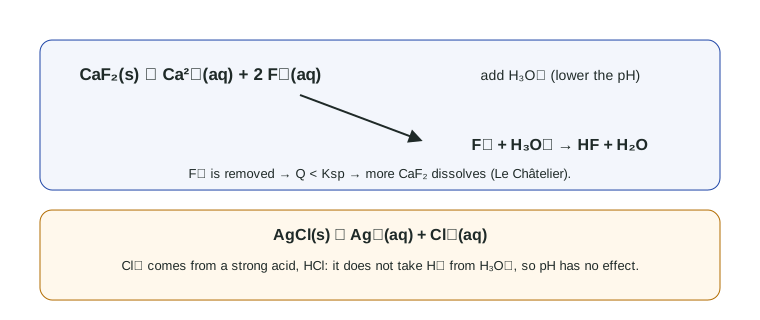
- A salt's anion is the conjugate base of a weak acidH₃O⁺ reacts with it: F⁻ + H₃O⁺ → HF + H₂O
- That reaction lowers the anion's concentrationQ = [Ca²⁺][F⁻]² falls below Ksp
- Q < Ksp with solid presentmore solid dissolves until Q = Ksp again, so solubility rises as pH falls
- An anion from a strong acid (Cl⁻, NO₃⁻) does not take protonsits salts' solubility does not depend on pH
Part 6 · Key ideas
Key ideas
- Lowering the pH dissolves more of a salt whose anion is a base: F⁻, CO₃²⁻, PO₄³⁻, S²⁻, OH⁻.
- Explain with Q and Ksp: H₃O⁺ removes the anion, Q < Ksp, more solid dissolves. Ksp itself does not change.
- Anions from strong acids (Cl⁻, Br⁻, I⁻, NO₃⁻) are unaffected, so those salts' solubility does not depend on pH.
- The weaker the conjugate acid, the stronger the base, and the more the solubility depends on pH.
Part 7 · Misconception
A common mistake
The wrong idea: Acid makes every salt more soluble.
What actually happens: Only salts whose anions are bases. AgCl is as insoluble in nitric acid as in water, because Cl⁻ does not react with H₃O⁺.
Part 8 · Check yourself
Check yourself
Exam-style questions. Anything you miss goes into your review queue.
Data table
Five slightly soluble salts
Each salt dissolves only slightly in pure water at 25 °C. Ka values are given for the conjugate acid of each anion; "strong" means the conjugate acid is a strong acid.
| Salt | Anion | Conjugate acid of the anion | Ka of that acid |
|---|---|---|---|
| CaF₂ | F⁻ | HF | 6.8 × 10⁻⁴ |
| AgCl | Cl⁻ | HCl | strong |
| BaCO₃ | CO₃²⁻ | HCO₃⁻ | 4.7 × 10⁻¹¹ |
| PbI₂ | I⁻ | HI | strong |
| Mg(OH)₂ | OH⁻ | H₂O | (OH⁻ reacts with H₃O⁺ to make water) |
1. Which salts become more soluble when the solution is made more acidic? Select all that apply.
- CaF₂
- AgCl
- BaCO₃
- PbI₂
- Mg(OH)₂
Show the answer
Each of these anions is a base: H₃O⁺ converts F⁻ to HF, CO₃²⁻ to HCO₃⁻ (and on to H₂CO₃ and CO₂), and OH⁻ to water. Removing the anion makes Q < Ksp, so more solid dissolves.
- Correct: CaF₂: Right: F⁻ is the conjugate base of the weak acid HF.
- AgCl: Cl⁻ comes from a strong acid and does not react with H₃O⁺.
- Correct: BaCO₃: Right: carbonate is a fairly strong base.
- PbI₂: I⁻ comes from a strong acid and does not react with H₃O⁺.
- Correct: Mg(OH)₂: Right: H₃O⁺ + OH⁻ → 2 H₂O removes hydroxide.
2. Which explanation correctly says why adding HNO₃ dissolves more CaF₂(s)?
- H₃O⁺ turns F⁻ into HF, so Q < Ksp
- HNO₃ increases the Ksp of the CaF₂ solid
- NO₃⁻ ions react with Ca²⁺ to form a soluble compound
- The H₃O⁺ ions attack the solid and break its covalent bonds
Show the answer
The answer names the reaction (F⁻ + H₃O⁺ → HF + H₂O), its effect on Q, and the shift: the reasoning readers look for.
- Correct: H₃O⁺ turns F⁻ into HF, so Q < Ksp: Right: Q vs Ksp with the specific reaction.
- HNO₃ increases the Ksp of the CaF₂ solid: Ksp depends only on temperature; it is Q that changes.
- NO₃⁻ ions react with Ca²⁺ to form a soluble compound: Calcium nitrate is soluble, but NO₃⁻ was not needed to remove Ca²⁺; the effect comes from removing F⁻.
- The H₃O⁺ ions attack the solid and break its covalent bonds: CaF₂ is an ionic solid; dissolving separates ions rather than breaking covalent bonds.
3. How does adding HNO₃ change the solubility of AgCl?
- Very little: Cl⁻ does not react with H₃O⁺
- It increases, because H₃O⁺ reacts with Cl⁻ to form HCl
- It decreases, because NO₃⁻ is a common ion
- It increases, because salts dissolve better in acid
Show the answer
HCl is a strong acid, so Cl⁻ has essentially no tendency to take a proton. [Cl⁻] stays the same, Q is unchanged, and the solubility is unchanged.
- Correct: Very little: Cl⁻ does not react with H₃O⁺: Right: no reaction with the anion, no shift.
- It increases, because H₃O⁺ reacts with Cl⁻ to form HCl: HCl would immediately ionize again; Cl⁻ is not removed.
- It decreases, because NO₃⁻ is a common ion: NO₃⁻ is not in AgCl, so it is not a common ion.
- It increases, because salts dissolve better in acid: Only salts whose anions are bases dissolve better in acid.
Particle view
Calcium fluoride in water and in acid
Key: Ca²⁺ calcium ion; F⁻ fluoride; HF hydrogen fluoride molecule; H₃O⁺ hydronium. Each box is the solution above undissolved CaF₂(s), not drawn, at the same temperature. Water and the anions of the added acid are not drawn.
4. Which box best represents the solution after a strong acid is added to Box 1 and equilibrium is restored?
- Box 2
- Box 3
- Box 4
- Box 1, unchanged
Show the answer
More CaF₂ dissolved (4 Ca²⁺ instead of 1), and most of its fluoride became HF. F atoms are conserved (1 F⁻ + 7 HF = 8 = 2 × 4 Ca²⁺), and the free-ion product [Ca²⁺][F⁻]² is 4 × 1² = 4, the same as Box 1 (1 × 2² = 4), as Ksp requires.
- Correct: Box 2: Right: more dissolved, fluoride mostly protonated, ion product back at Ksp.
- Box 3: Box 3 shows more dissolved with no HF: its ion product (4 × 8² = 256) is far above Ksp, so it is not at equilibrium.
- Box 4: Box 4 has no free F⁻, so Q = 0 < Ksp: more solid would still dissolve. It is not at equilibrium.
- Box 1, unchanged: Adding acid removes F⁻, so the solution cannot stay the same.
5. In every box, the total number of F atoms (in F⁻ and HF) should be twice the number of Ca²⁺ ions. Why?
- Both come from CaF₂, with two F per Ca
- Ca²⁺ has a 2+ charge, so it attracts two water molecules
- HF molecules contain two atoms
- Ksp has [F⁻] squared
Show the answer
Dissolving CaF₂ releases one Ca²⁺ and two F⁻; protonating F⁻ to HF does not change the number of F atoms.
- Correct: Both come from CaF₂, with two F per Ca: Right: the formula sets the ratio.
- Ca²⁺ has a 2+ charge, so it attracts two water molecules: The ratio comes from the formula of the salt, not from hydration.
- HF molecules contain two atoms: The number of atoms in HF does not set the Ca : F ratio.
- Ksp has [F⁻] squared: The square in Ksp follows from the same formula; it is a consequence, not the cause.
Experimental setup
Dissolving a hydroxide
Three test tubes each contain 0.10 g of solid Mg(OH)₂ in 10 mL of liquid: Tube A, distilled water; Tube B, 1.0 M HCl; Tube C, 1.0 M NaOH. The tubes are shaken and left to settle.
Mg(OH)₂(s) ⇌ Mg²⁺(aq) + 2 OH⁻(aq)
6. In which tube does the most Mg(OH)₂ dissolve?
- Tube B
- Tube A
- Tube C
- The same amount in each
Show the answer
H₃O⁺ in HCl reacts with OH⁻ (H₃O⁺ + OH⁻ → 2 H₂O), driving [OH⁻] down, so the dissolving equilibrium shifts right until the solid dissolves.
- Correct: Tube B: Right: acid removes OH⁻.
- Tube A: Water dissolves only a trace of Mg(OH)₂.
- Tube C: Added OH⁻ is a common ion; it pushes the equilibrium left.
- The same amount in each: The liquids affect [OH⁻] very differently.
7. Why does even less Mg(OH)₂ dissolve in Tube C than in Tube A?
- OH⁻ is a common ion, so Q reaches Ksp sooner
- NaOH reacts with Mg(OH)₂ to form a new solid
- Na⁺ ions lower Ksp
- NaOH raises the temperature
Show the answer
The large [OH⁻] makes Q = [Mg²⁺][OH⁻]² exceed Ksp at a tiny [Mg²⁺], so the dissolving stops much earlier.
- Correct: OH⁻ is a common ion, so Q reaches Ksp sooner: Right: the common-ion effect.
- NaOH reacts with Mg(OH)₂ to form a new solid: No new solid is involved; the effect is on Q.
- Na⁺ ions lower Ksp: Ksp does not change with added ions.
- NaOH raises the temperature: Dissolving a little NaOH in 10 mL does warm it slightly, but that is not why the solubility falls.
Part 9 · Summary
Summary
Part 10 · Up next
What comes next
Part 11 · Connections