Introduction to Entropy
Entropy measures how many ways a system’s particles and energy can be arranged.
Part 1 · Hook
Why this matters
Part 2 · Before you start
What this builds on
Part 3 · Prerequisite check
Quick check before you start
1. In a gas, how do the particles move?
- Freely and randomly through the whole container, with a range of speeds
- Only back and forth in fixed positions
- Only when the container is heated
- In straight lines toward the walls, all at the same speed
Show the answer
Kinetic molecular theory: gas particles move randomly through the container and have a distribution of speeds.
- Correct: Freely and randomly through the whole container, with a range of speeds:
- Only back and forth in fixed positions:
- Only when the container is heated:
- In straight lines toward the walls, all at the same speed:
2. What happens to the distribution of molecular speeds when a gas is heated?
- The average speed rises and the range of speeds widens
- Every molecule ends up with the same speed
- The average speed falls
- Nothing changes; only the pressure changes
Show the answer
A higher temperature shifts the Maxwell-Boltzmann curve to higher speeds and flattens it, so the speeds are more spread out.
- Correct: The average speed rises and the range of speeds widens:
- Every molecule ends up with the same speed:
- The average speed falls:
- Nothing changes; only the pressure changes:
Part 4 · See it
See it first
Part 5 · Step by step
How it works, step by step
- Particles move constantly and can be in many positions with many energiesa system can be in a huge number of microstates that look the same from outside
- Each microstate is equally likelythe system ends up in the condition that has the most microstates
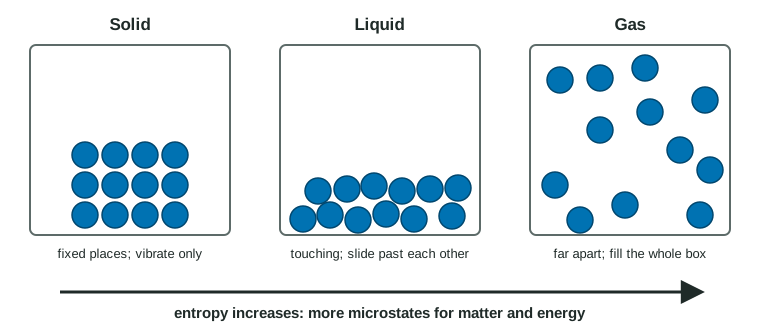
- More volume, more particles or a phase where particles move more freely gives more arrangements of matterentropy rises when matter disperses
- A higher temperature spreads the energy over a wider range of speedsentropy rises when energy disperses
Part 6 · Key ideas
Key ideas
- Entropy measures the number of microstates: the ways the particles and their energy can be arranged.
- Entropy increases when matter disperses: solid → liquid → gas, a gas expanding, a solute dissolving, or a reaction making more moles of gas.
- Entropy increases when energy disperses: at a higher temperature the energy is spread over a wider range of speeds.
- To predict the sign of ΔS for a reaction, compare the moles of gas first, then the phases.
- Justify with dispersal and microstates, never with "disorder".
Part 7 · Misconception
A common mistake
The wrong idea: Entropy is disorder, so a messier-looking picture always has more entropy.
What actually happens: Entropy counts the ways particles and energy can be arranged. Justify a sign with dispersal of matter (more volume, more gas particles, a freer phase) or of energy (a higher temperature), not with how messy something looks.
Part 8 · Check yourself
Check yourself
Exam-style questions. Anything you miss goes into your review queue.
Particle view
One gas, three snapshots
A rigid container at constant temperature holds a gas of A atoms. In Box X a barrier keeps the atoms in the left half. In Box Y the barrier has been removed. In Box Z the same atoms have joined in pairs to form A₂ molecules.
Key: dark circle, one A atom; two touching dark circles, one A₂ molecule; thick line in Box X, a barrier.
1. When the barrier is removed, the gas changes from Box X to Box Y. Which statement correctly gives the sign of the change in entropy and the particle-level reason?
- ΔS > 0: the atoms look messier once the barrier is gone, and a messier gas is a more disordered gas.
- ΔS > 0: each atom can now be anywhere in twice the volume, so there are more possible arrangements (microstates).
- ΔS < 0: the atoms are farther apart in Box Y, so they attract each other less and hold less energy.
- ΔS = 0: no bonds form or break and the temperature stays constant, so nothing about the gas has changed at the particle level.
Show the answer
Entropy measures the number of microstates. Removing the barrier doubles the volume each atom can explore, so the number of ways to arrange the atoms rises and ΔS is positive.
- ΔS > 0: the atoms look messier once the barrier is gone, and a messier gas is a more disordered gas.: The sign is right, but "messier" and "disorder" describe a picture, not a cause. The reason the exam rewards is dispersal: more volume gives more possible arrangements.
- Correct: ΔS > 0: each atom can now be anywhere in twice the volume, so there are more possible arrangements (microstates).: Right: the matter disperses into a larger volume, so the number of microstates rises and entropy increases.
- ΔS < 0: the atoms are farther apart in Box Y, so they attract each other less and hold less energy.: Spreading out does not lower the entropy; it gives the atoms more places to be. Attractions between gas atoms are tiny here and do not decide the sign.
- ΔS = 0: no bonds form or break and the temperature stays constant, so nothing about the gas has changed at the particle level.: A change in entropy does not need a reaction or a temperature change. The volume available to the atoms doubled, and that alone raises the entropy.
2. The atoms in Box Y combine to form the molecules in Box Z, at the same temperature and volume. What is the sign of the change in entropy?
- Positive: each A₂ molecule is larger than an atom and so takes up more of the space.
- Zero: the number of A atoms is the same in both boxes, so the entropy of the gas is the same too.
- Positive: forming bonds releases energy, and the released energy spreads into the surroundings.
- Negative: eight independent particles become four, so there are fewer ways to arrange them.
Show the answer
Fewer gas particles means fewer ways to place them. 8 A(g) → 4 A₂(g) has ΔS < 0.
- Positive: each A₂ molecule is larger than an atom and so takes up more of the space.: Larger particles do not raise entropy here; the count of independent gas particles drops from eight to four, which lowers it.
- Zero: the number of A atoms is the same in both boxes, so the entropy of the gas is the same too.: Atoms are conserved, but the atoms are now tied together in pairs and move as four particles instead of eight, so there are fewer arrangements.
- Positive: forming bonds releases energy, and the released energy spreads into the surroundings.: Energy released to the surroundings is a separate matter from the entropy of the gas itself. For the gas, fewer particles means fewer microstates.
- Correct: Negative: eight independent particles become four, so there are fewer ways to arrange them.: Right: 8 A → 4 A₂ halves the number of gas particles, so the number of possible arrangements falls.
3. The gas in Box Y is heated from 300 K to 400 K at constant volume. What happens to its entropy, and why?
- It increases: the atoms have a wider range of speeds, so the energy can be shared in more ways.
- It stays the same: the volume and the number of atoms do not change, and those two alone decide entropy.
- It decreases: faster atoms spend less time in each spot, so each atom has fewer positions on average.
- It increases: the heated atoms expand, so each atom becomes bigger and fills more of the box.
Show the answer
Raising the temperature widens the Maxwell-Boltzmann distribution of speeds. Energy can then be distributed among the atoms in more ways, so entropy increases.
- Correct: It increases: the atoms have a wider range of speeds, so the energy can be shared in more ways.: Right: a higher temperature spreads the kinetic energy over a wider range of speeds, so energy is dispersed over more microstates.
- It stays the same: the volume and the number of atoms do not change, and those two alone decide entropy.: Volume and particle count matter, but so does energy. At a higher temperature there are more ways to share out the energy.
- It decreases: faster atoms spend less time in each spot, so each atom has fewer positions on average.: Speed does not remove positions. Faster atoms with a wider spread of speeds give more, not fewer, possible microstates.
- It increases: the heated atoms expand, so each atom becomes bigger and fills more of the box.: Atoms do not grow when heated. The entropy rises because the energy is spread over a wider range of speeds.
4. Which changes to the gas in Box Y would increase its entropy? Select ALL that apply.
- Letting it expand into a container twice as large at the same temperature
- Warming it from 300 K to 350 K in the same container
- Compressing it into half the volume at the same temperature
- Cooling it from 300 K to 250 K in the same container
- Letting the atoms pair up to form A₂ molecules, as in Box Z
Show the answer
Entropy goes up when matter spreads into more volume or energy spreads over a wider range of speeds; it goes down when the gas is squeezed, cooled or combined into fewer particles.
- Correct: Letting it expand into a container twice as large at the same temperature: Increases: more volume, more possible positions for each atom.
- Correct: Warming it from 300 K to 350 K in the same container: Increases: energy is spread over a wider range of speeds.
- Compressing it into half the volume at the same temperature: Decreases: each atom has fewer positions available.
- Cooling it from 300 K to 250 K in the same container: Decreases: the narrower range of speeds gives fewer ways to share the energy.
- Letting the atoms pair up to form A₂ molecules, as in Box Z: Decreases: fewer independent gas particles to arrange.
5. Which has the greater entropy: 1 mol of liquid water at 100 °C or 1 mol of steam at 100 °C?
- The liquid, because its molecules are packed closely and collide more often
- The steam, because its molecules spread through the whole container
- They are equal, because the substance, amount and temperature are the same
- The liquid, because hydrogen bonds hold more energy than a gas does
Show the answer
A gas has far more entropy than its liquid: its particles spread through the whole volume.
- The liquid, because its molecules are packed closely and collide more often: More collisions do not mean more arrangements. The gas has far more room, and so far more microstates.
- Correct: The steam, because its molecules spread through the whole container: Right: same substance and temperature, but the gas spreads over a much larger volume, so there are many more arrangements.
- They are equal, because the substance, amount and temperature are the same: The phase differs. A gas has much more entropy than its liquid at the same temperature.
- The liquid, because hydrogen bonds hold more energy than a gas does: Hydrogen bonds hold the liquid molecules close, which limits their arrangements and keeps the entropy lower.
6. Which reaction has a positive change in entropy?
- 2 NO(g) + O₂(g) → 2 NO₂(g)
- 2 NO₂(g) → N₂O₄(g)
- 2 NO₂(g) → 2 NO(g) + O₂(g)
- NH₃(g) + HCl(g) → NH₄Cl(s)
Show the answer
Count moles of gas on each side. Only the decomposition of NO₂ increases the number of gas particles.
- 2 NO(g) + O₂(g) → 2 NO₂(g): This is the reverse: 3 mol of gas become 2 mol, so ΔS is negative.
- 2 NO₂(g) → N₂O₄(g): 2 mol of gas become 1 mol, so ΔS is negative.
- Correct: 2 NO₂(g) → 2 NO(g) + O₂(g): Right: 2 mol of gas become 3 mol of gas, so there are more particles to arrange.
- NH₃(g) + HCl(g) → NH₄Cl(s): Two gases become a solid, so ΔS is strongly negative.
7. Two students explain why the entropy of water decreases when it freezes. Student 1: "The ice is more ordered." Student 2: "In ice the molecules are held in fixed positions in a lattice, so there are fewer arrangements of the molecules and their energy." Which evaluation is correct?
- Student 1 alone is right, because entropy is defined as the amount of disorder in a system.
- Both are wrong, because the entropy of the water increases when the liquid freezes into a solid lattice.
- Both are equally complete, since "ordered" and "fewer arrangements" mean the same thing.
- Both give the right sign; Student 2 also gives the particle-level reason (fewer arrangements).
Show the answer
A full justification names the particle-level cause: the number of possible arrangements of matter and energy.
- Student 1 alone is right, because entropy is defined as the amount of disorder in a system.: Entropy is defined through microstates. "Disorder" is a loose picture that readers do not accept as reasoning.
- Both are wrong, because the entropy of the water increases when the liquid freezes into a solid lattice.: Freezing locks the molecules in place, so the entropy of the water decreases.
- Both are equally complete, since "ordered" and "fewer arrangements" mean the same thing.: They are not equally complete: only Student 2 gives the particle-level cause the exam asks for.
- Correct: Both give the right sign; Student 2 also gives the particle-level reason (fewer arrangements).: Right: Student 2 links the change to microstates. "More ordered" names a picture without explaining it.
Part 9 · Summary
Summary
Part 10 · Up next
What comes next
Part 11 · Connections