Absolute Entropy and Entropy Change
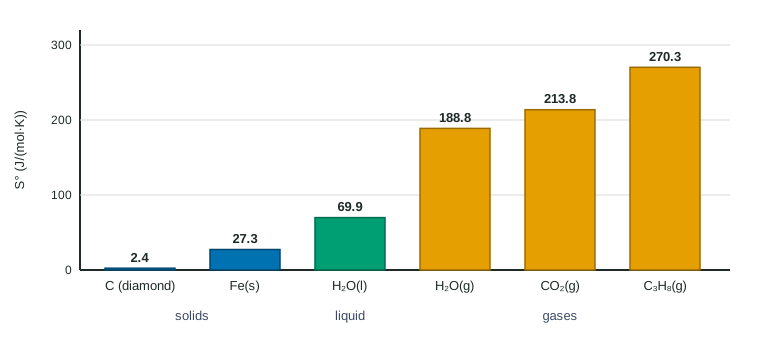
Standard molar entropies S° are measured up from zero for a perfect crystal at 0 K, so every one is positive.
Part 1 · Hook
Why this matters
Part 2 · Before you start
What this builds on
Part 3 · Prerequisite check
Quick check before you start
1. For which process does the entropy of the system increase?
- Dry ice turning to CO₂ gas
- Steam condensing to water
- 2 SO₂(g) + O₂(g) → 2 SO₃(g)
- Water freezing
Show the answer
Solid to gas disperses the matter; the others reduce the dispersal.
- Correct: Dry ice turning to CO₂ gas:
- Steam condensing to water:
- 2 SO₂(g) + O₂(g) → 2 SO₃(g):
- Water freezing:
2. How is ΔH°rxn found from standard enthalpies of formation?
- Σ nΔH°f(products) − Σ nΔH°f(reactants)
- Σ ΔH°f(reactants) − Σ ΔH°f(products), without coefficients
- Multiply all the ΔH°f values together
- Add every ΔH°f value in the equation
Show the answer
Products minus reactants, each multiplied by its coefficient.
- Correct: Σ nΔH°f(products) − Σ nΔH°f(reactants):
- Σ ΔH°f(reactants) − Σ ΔH°f(products), without coefficients:
- Multiply all the ΔH°f values together:
- Add every ΔH°f value in the equation:
Part 4 · See it
See it first
Part 5 · Step by step
How it works, step by step
- A perfect crystal at 0 K has a single arrangement of its particles and energyits entropy is zero, the starting point for measuring every S°
- Any substance above 0 K has motion and so more than one microstatethe standard molar entropy S° of every pure substance at 298 K is positive, elements included
- Entropy is a state function measured per moleΔS° of a reaction is Σ nS°(products) − Σ nS°(reactants)
- The result should match the change in moles of gaschecking its sign catches missing coefficients and sign slips
Part 6 · Key ideas
Key ideas
- A perfect crystal at 0 K has S = 0; every pure substance at 298 K has a positive S°, elements included (unlike ΔH°f).
- S° values: gases ≫ liquids > solids; among similar substances, more atoms per molecule means a larger S°.
- ΔS° = Σ nS°(products) − Σ nS°(reactants), each multiplied by its coefficient. Units: J/(mol·K).
- Reverse a reaction: flip the sign. Double it: double ΔS°.
- Check the sign of the answer against the change in moles of gas.
Part 7 · Misconception
A common mistake
The wrong idea: Elements in their standard states have S° = 0, just as they have ΔH°f = 0.
What actually happens: ΔH°f is zero for an element by definition. S° is measured from zero at 0 K, so every pure substance at 298 K, elements included, has a positive S°: O₂(g) has 205.2 J/(mol·K).
Part 8 · Check yourself
Check yourself
Exam-style questions. Anything you miss goes into your review queue.
Data table
Standard molar entropies
Standard molar entropies at 298 K.
| Substance | S° (J/(mol·K)) |
|---|---|
| N₂(g) | 191.6 |
| H₂(g) | 130.7 |
| NH₃(g) | 192.8 |
| O₂(g) | 205.2 |
| CH₄(g) | 186.3 |
| CO₂(g) | 213.8 |
| H₂O(l) | 69.9 |
| H₂O(g) | 188.8 |
| SO₂(g) | 248.2 |
1. Calculate ΔS° for the reaction N₂(g) + 3 H₂(g) → 2 NH₃(g).
Type a number and its unit.
Show the answer
ΔS° = Σ nS°(products) − Σ nS°(reactants) = 2(192.8) − [191.6 + 3(130.7)] = 385.6 − 583.7 = −198.1 J/(mol·K). Each value is known to 0.1, so the answer keeps one decimal place. The sign fits the prediction: 4 mol of gas become 2 mol.
- Answer: -198.1 J/(mol·K)
2. Calculate ΔS° for the combustion of methane at 298 K: CH₄(g) + 2 O₂(g) → CO₂(g) + 2 H₂O(l).
Type a number and its unit.
Show the answer
ΔS° = [213.8 + 2(69.9)] − [186.3 + 2(205.2)] = 353.6 − 596.7 = −243.1 J/(mol·K). Three moles of gas become one mole of gas plus a liquid, so the large negative value makes sense.
- Answer: -243.1 J/(mol·K)
3. If the water in the combustion of methane were formed as a gas instead of a liquid, ΔS° would be −5.3 J/(mol·K) instead of −243.1 J/(mol·K). Which statement explains the difference?
- Making a gas releases less heat, and less heat released means more entropy for the products.
- Gaseous water molecules spread through the whole container, so H₂O(g) has far more microstates.
- The version that makes water vapor has fewer moles of products, so its ΔS° is closer to zero.
- H₂O(g) has a larger molar mass than H₂O(l), so each mole of the gas carries more entropy.
Show the answer
Only the phase of the water changes. Gas molecules are far more dispersed, so S°(H₂O(g)) is much larger, and ΔS° is less negative.
- Making a gas releases less heat, and less heat released means more entropy for the products.: This mixes up enthalpy and entropy. The difference comes from the S° values of the two phases of water.
- Correct: Gaseous water molecules spread through the whole container, so H₂O(g) has far more microstates.: Right: S°(H₂O(g)) is 188.8 against 69.9 for the liquid, because the gas molecules are dispersed.
- The version that makes water vapor has fewer moles of products, so its ΔS° is closer to zero.: The moles of product are the same (1 CO₂ + 2 H₂O) either way; only the phase of the water differs.
- H₂O(g) has a larger molar mass than H₂O(l), so each mole of the gas carries more entropy.: The molar mass of water is 18.02 g/mol in every phase. The phase changes the number of arrangements, not the mass.
4. Calculate ΔS° for the vaporization of one mole of water at 298 K, H₂O(l) → H₂O(g).
Type a number and its unit.
Show the answer
ΔS° = S°(H₂O(g)) − S°(H₂O(l)) = 188.8 − 69.9 = 118.9 J/(mol·K). Positive, as expected when a liquid becomes a gas.
- Answer: 118.9 J/(mol·K)
5. Which statement about standard molar entropies at 298 K is correct?
- Elements in their standard states have S° = 0, just as they have ΔH°f = 0.
- Solids have negative S° values, liquids have zero, and gases have positive S° values.
- Every pure substance, elements in their standard states included, has S° > 0.
- S° is given in kJ/mol, the same energy unit as ΔH°f values are.
Show the answer
S° is an absolute value measured up from zero at 0 K, so it is positive for every pure substance at 298 K, elements included.
- Elements in their standard states have S° = 0, just as they have ΔH°f = 0.: This confuses S° with ΔH°f. ΔH°f of an element is zero by definition; S° is measured from 0 K and is positive.
- Solids have negative S° values, liquids have zero, and gases have positive S° values.: S° values are measured from a perfect crystal at 0 K, so they are all positive; solids are simply the smallest.
- Correct: Every pure substance, elements in their standard states included, has S° > 0.: Right: any substance above 0 K has some motion and so more than one microstate.
- S° is given in kJ/mol, the same energy unit as ΔH°f values are.: S° is in J/(mol·K): joules, not kilojoules, and per kelvin.
6. Hydrogen peroxide decomposes: 2 H₂O₂(l) → 2 H₂O(l) + O₂(g). S° values in J/(mol·K): H₂O₂(l) 109.6, H₂O(l) 69.9, O₂(g) 205.2. Calculate ΔS°.
Type a number and its unit.
Show the answer
ΔS° = [2(69.9) + 205.2] − 2(109.6) = 345.0 − 219.2 = 125.8 J/(mol·K).
- Answer: 125.8 J/(mol·K)
7. For which reaction is it hardest to predict the sign of ΔS° without a table of S° values?
- 2 H₂(g) + O₂(g) → 2 H₂O(g)
- H₂(g) + Cl₂(g) → 2 HCl(g)
- NH₄Cl(s) → NH₃(g) + HCl(g)
- C₃H₈(g) + 5 O₂(g) → 3 CO₂(g) + 4 H₂O(g)
Show the answer
When the moles of gas and the phases do not change, ΔS° is small and the S° values are needed to decide its sign.
- 2 H₂(g) + O₂(g) → 2 H₂O(g): Three moles of gas become two, so ΔS° is clearly negative.
- Correct: H₂(g) + Cl₂(g) → 2 HCl(g): Right: 2 mol of gas on each side and no phase change, so the change is small and its sign is not obvious.
- NH₄Cl(s) → NH₃(g) + HCl(g): A solid makes two moles of gas, so ΔS° is clearly positive.
- C₃H₈(g) + 5 O₂(g) → 3 CO₂(g) + 4 H₂O(g): Six moles of gas become seven, so ΔS° is positive.
Part 9 · Summary
Summary
Part 10 · Up next
What comes next
Part 11 · Connections