Why is HCl strong but HF weak? Why does vinegar taste sour while alcohol does not, even though both have an O–H group? Topic 8.3 measured acid strength with Ka. This topic explains it from structure. The single idea that runs through every case: an acid is stronger when its conjugate base is more stable.
The key idea: look at what is left behind
When HA ionizes, the H leaves as H⁺ and its bonding electrons stay behind on A⁻:
HA + H₂O ⇌ H₃O⁺ + A⁻
If A⁻ can carry its extra negative charge comfortably, the reverse reaction (A⁻ taking the proton back) is less favored, the equilibrium lies further right, and Ka is larger. A negative charge is more comfortable when it is:
- pulled toward electronegative atoms,
- spread out over several atoms by resonance, or
- held on a large atom, where it occupies more volume.
Each of the following sections is one of these effects.
Oxyacids: more oxygen, stronger acid
In an oxyacid the acidic H is bonded to an O, which is bonded to a central atom: H–O–X. The figure shows two series.
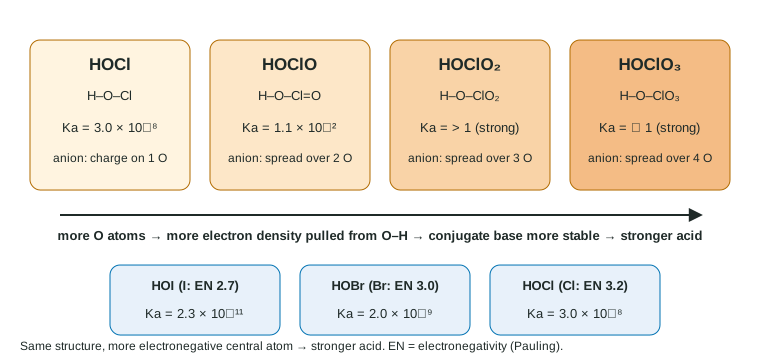
More O atoms on the central atom. HOCl (Ka 3.0 × 10⁻⁸) is weak; HOClO (Ka 1.1 × 10⁻²) is much stronger; HOClO₂ and HOClO₃ (perchloric acid, HClO₄) are strong. Each extra O does two things. It pulls electron density away from the central atom and so from the O–H bond, which makes the bond more polar. And in the conjugate base, the negative charge is shared over more O atoms by resonance: ClO⁻ has it on one O, ClO₄⁻ spreads it over four.
A more electronegative central atom. HOI (Ka 2.3 × 10⁻¹¹), HOBr (2.0 × 10⁻⁹) and HOCl (3.0 × 10⁻⁸) have identical structures. The more electronegative the halogen, the harder it pulls electron density from the O–H bond and from the O⁻ of the anion, and the stronger the acid.
The same reasoning ranks H₂SO₃ below H₂SO₄ and HNO₂ below HNO₃.
Carboxylic acids and resonance
A carboxylic acid contains the –COOH group: a C double-bonded to one O and single-bonded to an O–H. Acetic acid, CH₃COOH, is the familiar one. Compare it with ethanol, CH₃CH₂OH:
| Ethanol | Acetic acid | |
|---|---|---|
| Acidic group | –O–H on a CH₂ | –O–H on a C=O |
| Conjugate base | CH₃CH₂O⁻, charge on one O | CH₃COO⁻, charge shared by two O (resonance) |
| Ka | about 1 × 10⁻¹⁶ | 1.8 × 10⁻⁵ |
The carboxylate ion has two equivalent resonance structures; the real ion has the charge spread evenly over both O atoms and two identical C–O bonds. That delocalization stabilizes it enormously, so acetic acid is about 10¹¹ times more acidic than ethanol, even though both lose H from an O–H.
Electron-withdrawing groups. Replace an H on the CH₃ of acetic acid with Cl, and Ka rises from 1.8 × 10⁻⁵ to 1.4 × 10⁻³. Two Cl atoms raise it to 5.5 × 10⁻². The electronegative Cl atoms pull electron density through the bonds toward themselves and away from the carboxylate, so its negative charge is less concentrated. F, more electronegative still, has a larger effect than Cl.
Worked example: the effect in numbers. Compare the pH of 0.10 M acetic acid and 0.10 M chloroacetic acid (Ka = 1.8 × 10⁻⁵ and 1.4 × 10⁻³).
Step 1, acetic acid. x = √(1.8 × 10⁻⁵ × 0.10) = 1.34 × 10⁻³ M (1.3% of 0.10, fine). pH = 2.87.
Step 2, chloroacetic acid. Small x gives 1.2 × 10⁻² M, 12% of 0.10: too large. The quadratic x² + (1.4 × 10⁻³)x − 1.4 × 10⁻⁴ = 0 gives x = 1.12 × 10⁻² M, pH = 1.95.
Step 3. One Cl atom lowers the pH by about 0.9 units at this concentration.
Binary acids: electronegativity across, bond strength down
For acids of the form HₙX, two effects compete.
Across a period (CH₄, NH₃, H₂O, HF), the atoms are about the same size, so electronegativity decides. F holds a negative charge best, so HF is the most acidic of the four; CH₄ is not acidic at all.
Down a group (HF, HCl, HBr, HI or H₂O, H₂S, H₂Se), the atoms get much larger. The bond to H gets longer and weaker (H–F 567, H–Cl 431, H–Br 366, H–I 299 kJ/mol), and the negative charge of X⁻ is spread over a larger volume. These win over the falling electronegativity, so acid strength rises down the group: HF is weak, while HCl, HBr and HI are all strong.
Amines are weak bases
An amine is an organic compound with an N bonded to carbon, such as methylamine, CH₃NH₂. Like ammonia, the N has a lone pair, which can bond to a proton from water:
CH₃NH₂ + H₂O ⇌ CH₃NH₃⁺ + OH⁻ Kb = 4.4 × 10⁻⁴
The proton goes on the N, because that is where the lone pair is; never on a carbon, which has four bonds and no lone pair. In a molecule with both a –COOH group and an –NH₂ group, the –COOH is the acidic site and the –NH₂ is the basic site. Putting a proton on the wrong atom is a point lost on recent exams.
Writing the argument
A full-credit structure explanation names the structural feature, says what it does to the conjugate base, and links that to Ka:
"HOClO is a stronger acid than HOCl because its conjugate base, ClO₂⁻, has two O atoms over which the negative charge is delocalized by resonance, and the extra electronegative O withdraws electron density from the O–H bond. The more stable conjugate base means the ionization equilibrium lies further to the right, so Ka is larger."
Avoid "it wants to lose its H" (purpose language) and "it has more H atoms" (only acidic H atoms count, and the count does not decide strength).