Pulmonary ventilation
1Why this matters
Jordan, a tall, thin 19-year-old, is sitting in class when he feels a sudden sharp pain in the right side of his chest and becomes short of breath. His doctor hears almost no breath sounds over his right lung. An X-ray shows the lung shrunk down toward its root, with a dark band of air between it and the chest wall. Nothing has blocked his airway, and his breathing muscles work normally. So why can't that lung fill with air?
2What this builds on
3Quick check before you start
1. Air flows through a tube from region A to region B. What must be true?
- Pressure is higher at A than at B
- Pressure is higher at B than at A
- The two pressures are equal
Show the answer
A fluid, including air, flows down a pressure gradient: from higher pressure to lower pressure. With no pressure difference there is no flow.
- Correct: Pressure is higher at A than at B:
- Pressure is higher at B than at A:
- The two pressures are equal:
2. What do the external intercostal muscles do when they contract?
- Pull the ribs down and in
- Pull the ribs up and out
- Flatten the diaphragm
Show the answer
The external intercostals run down and forward between neighboring ribs. Contracting, they lift the ribs up and out, which enlarges the chest. The internal intercostals pull the ribs down.
- Pull the ribs down and in:
- Correct: Pull the ribs up and out:
- Flatten the diaphragm:
3. What fills the pleural cavity of a healthy person?
- Air
- A thin film of pleural fluid
- Loose connective tissue
Show the answer
The pleural cavity is a very narrow gap between visceral and parietal pleura, holding only a thin film of serous pleural fluid.
- Air:
- Correct: A thin film of pleural fluid:
- Loose connective tissue:
4Anatomy
With labels hidden, select a box to reveal its label.
5How it works, step by step
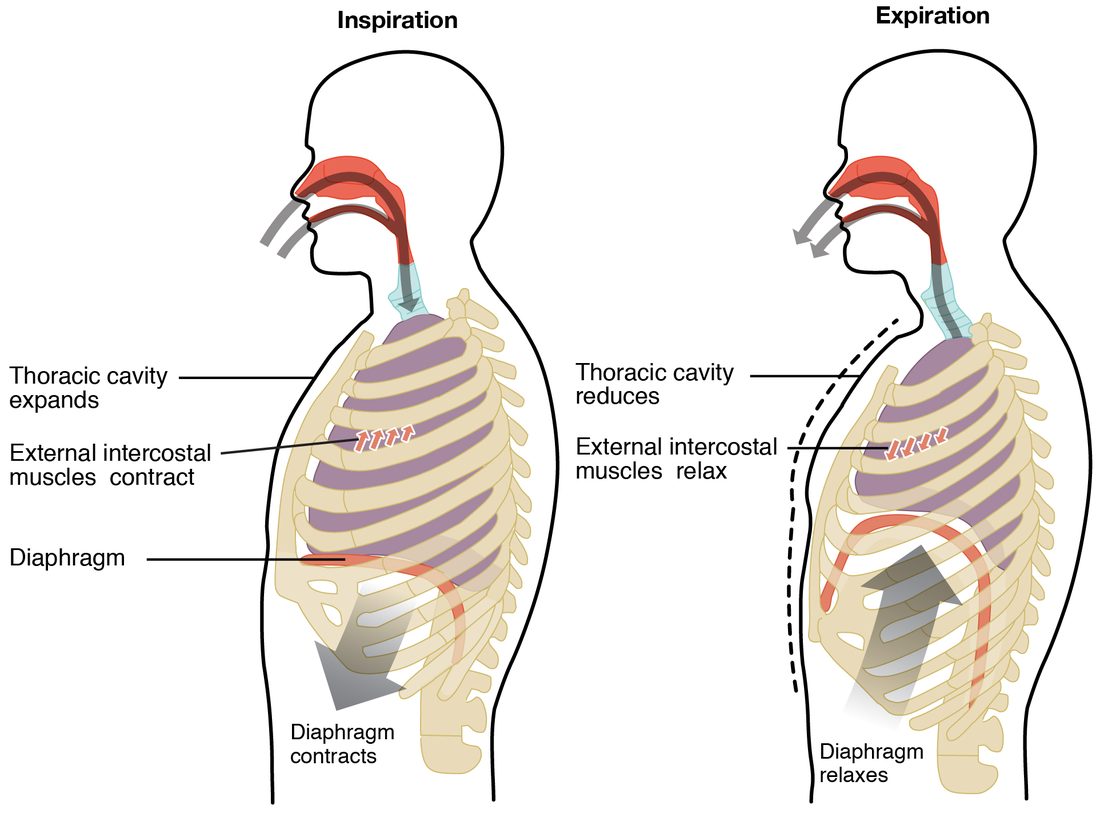
- Signals from the brainstem travel down the phrenic nerves and the intercostal nerves.The diaphragm contracts and flattens, and the external intercostals lift the ribs, so the thoracic cavity enlarges.
- The chest wall moves outward, and the film of pleural fluid holds the lungs to it.Intrapleural pressure falls from about −4 to about −6 mm Hg, so transpulmonary pressure rises and the lungs expand.
- The alveoli enlarge while holding the same amount of air.By Boyle's law, alveolar pressure falls to about 1 mm Hg below atmospheric pressure.
- Alveolar pressure is now lower than atmospheric pressure.Air flows in through the airways down the pressure gradient.
- As air enters, alveolar pressure rises back to atmospheric pressure.The gradient disappears and airflow stops: the end of inspiration.
6Core concepts
7A common mistake
The wrong idea: Your lungs expand because air rushes into them, or because the lungs themselves pull the air in.
What actually happens: Lungs have no muscle of their own. The breathing muscles enlarge the thorax first; the pleural fluid film makes the lungs follow; the larger alveolar volume lowers alveolar pressure (Boyle's law); and only then does air flow in, down the pressure gradient. Expansion causes the airflow, not the other way round. That is why a lung collapses when air gets into its pleural cavity, even though its airways are wide open.
8Check yourself
Anything you miss goes into your review queue.
1. A sealed container holds 500 mL of air at 760 mm Hg. It is squeezed to 400 mL at constant temperature. What is the new pressure?
- 608 mm Hg
- 950 mm Hg
- 860 mm Hg
- 660 mm Hg
Show the answer
Boyle's law: P₂ = P₁ × V₁ ÷ V₂ = 760 × 500 ÷ 400 = 950 mm Hg. A smaller volume gives a higher pressure.
- 608 mm Hg: 608 comes from 760 × 400 ÷ 500, the ratio upside down. That would be the answer for an expansion, not a squeeze.
- Correct: 950 mm Hg: Correct. 760 × 500 ÷ 400 = 950 mm Hg.
- 860 mm Hg: 860 comes from adding the 100 mL change to 760. Pressure and volume are related by a ratio, not by adding the difference.
- 660 mm Hg: 660 comes from subtracting the 100 mL change from 760. Pressure changes by a ratio, and a squeeze raises it.
2. According to the graph, what is the intrapleural pressure at the end of breathing in?
- About 0 mm Hg
- About −1 mm Hg
- About −6 mm Hg
- About −4 mm Hg
Show the answer
Intrapleural pressure falls during inspiration, from about −4 to about −6 mm Hg by 2 seconds, the end of breathing in.
- About 0 mm Hg: 0 is where alveolar pressure sits at the end of breathing in, not intrapleural pressure.
- About −1 mm Hg: −1 is the lowest alveolar pressure, reached at mid-inspiration.
- Correct: About −6 mm Hg: Correct. At the end of inspiration intrapleural pressure is about −6 mm Hg.
- About −4 mm Hg: −4 is the intrapleural pressure at rest, at the start of breathing in and the end of breathing out.
3. Order the events of a quiet breath in, from the nerve signal to the airflow.
- Signals travel down the phrenic nerves
- The diaphragm contracts and flattens
- The thoracic cavity enlarges
- Intrapleural pressure falls
- The lungs expand
- Alveolar pressure falls below atmospheric and air flows in
Show the answer
Nerve signal, muscle contraction, larger thorax, lower intrapleural pressure, lung expansion, lower alveolar pressure by Boyle's law, and finally airflow down the gradient.
- Correct order: 1. Signals travel down the phrenic nerves 2. The diaphragm contracts and flattens 3. The thoracic cavity enlarges 4. Intrapleural pressure falls 5. The lungs expand 6. Alveolar pressure falls below atmospheric and air flows in
4. A knife wound opens a hole through the chest wall into the left pleural cavity, and air enters it (a pneumothorax). Predict the change in each variable on the left side, compared with before the injury.
| Variable | Change |
|---|---|
| Intrapleural pressure | — |
| Transpulmonary pressure | — |
| Volume of the left lung | — |
| Airflow into the left lung with each breath | — |
Show the answer
Air in the pleural cavity raises intrapleural pressure toward atmospheric. Transpulmonary pressure disappears, the lung's own recoil collapses it, and the chest wall's movements no longer expand it.
- Intrapleural pressure: up. Air enters until the pressure in the cavity approaches atmospheric pressure, so it rises from about −4 toward 0.
- Transpulmonary pressure: down. Transpulmonary pressure is alveolar minus intrapleural pressure; with intrapleural pressure near 0, it falls toward 0.
- Volume of the left lung: down. Without transpulmonary pressure to hold it open, the lung recoils toward its hilum and collapses.
- Airflow into the left lung with each breath: down. The collapsed lung is no longer held to the chest wall, so it barely expands when the chest does, and little air flows into it.
5. Baby Amara is born at 28 weeks of pregnancy. Within hours she is breathing fast, grunting, and the soft tissue between her ribs is sucked inward with each breath. Her lungs are stiff. What best explains her stiff lungs?
- Her pleural cavities contain air
- Her bronchioles are constricted
- Too few elastic fibers make her lungs recoil weakly
- Too little surfactant in her alveoli
Show the answer
Type II alveolar cells usually make enough surfactant only by about 34 to 36 weeks. Without it, the water lining her alveoli has high surface tension, compliance is low, and many alveoli collapse at the end of each breath and must be reopened with great effort.
- Her pleural cavities contain air: Air in a pleural cavity would collapse a lung, but nothing here suggests a pneumothorax; her whole lungs are stiff.
- Her bronchioles are constricted: Narrow bronchioles raise resistance, which slows airflow; they would not make the lung tissue itself stiff.
- Too few elastic fibers make her lungs recoil weakly: Fewer elastic fibers would make the lungs easier to inflate, not stiffer: compliance would rise, not fall.
- Correct: Too little surfactant in her alveoli: Correct. Surfactant deficiency means high surface tension and low compliance.
6. Swelling and muscle contraction narrow an airway to one third of its original radius. By what factor does its resistance to airflow rise?
- 3 times
- 9 times
- 27 times
- 81 times
Show the answer
Resistance is proportional to 1 ÷ r⁴. If r falls to one third, r⁴ falls to (1/3)⁴ = 1/81, so resistance rises 81-fold.
- 3 times: 3 would apply if resistance depended on radius alone. It depends on the fourth power of the radius.
- 9 times: 9 uses the square of the radius change. Resistance depends on the fourth power.
- 27 times: 27 uses the cube of the radius change. Resistance depends on the fourth power.
- Correct: 81 times: Correct. 3⁴ = 81.
7. Why is intrapleural pressure below atmospheric pressure even at rest, between breaths?
- Lungs recoil inward while the chest wall springs outward
- The pleural cavity contains a small pocket of low-pressure air
- The diaphragm is contracted between breaths, pulling on the pleura
- Alveolar pressure is below atmospheric at rest
Show the answer
The lungs' elastic fibers and surface tension pull them inward; the chest wall tends to spring outward. The pleural fluid film holds the two together, so the film is pulled from both sides and its pressure falls below atmospheric.
- Correct: Lungs recoil inward while the chest wall springs outward: Correct. Opposing recoil of lungs and chest wall lowers the pressure in the film between them.
- The pleural cavity contains a small pocket of low-pressure air: A healthy pleural cavity contains no air at all, only a thin film of fluid. Air there would be a pneumothorax.
- The diaphragm is contracted between breaths, pulling on the pleura: Between breaths the diaphragm is relaxed; the negative pressure is present even with all breathing muscles at rest.
- Alveolar pressure is below atmospheric at rest: Between breaths alveolar pressure equals atmospheric pressure, because no air is flowing.
8. During an asthma attack, Leila's wheezing is loudest and her airflow slowest when she breathes out. Why is breathing out harder than breathing in?
- Her expiratory muscles are weaker than her diaphragm
- Surfactant is used up during each breath out
- Her vocal folds close during each breath out
- Her airways narrow further as her lungs shrink
Show the answer
Expanding lung tissue pulls the airways open during inspiration. During expiration the lungs shrink, that pull weakens, and in forced expiration the rising pressure around the airways squeezes them, so already-narrowed bronchioles narrow further or close, trapping air.
- Her expiratory muscles are weaker than her diaphragm: Muscle strength is not the problem; she can recruit her abdominal muscles. Narrowed airways limit the flow.
- Surfactant is used up during each breath out: Surfactant is not consumed breath by breath, and it acts in the alveoli, not on airway radius.
- Her vocal folds close during each breath out: The vocal folds open for breathing; the wheeze comes from air forced through narrowed bronchioles.
- Correct: Her airways narrow further as her lungs shrink: Correct. Airway radius falls during expiration, and resistance rises with the fourth power of that fall.
9Summary
Pulmonary ventilation is airflow down a pressure gradient. Boyle's law (P₁V₁ = P₂V₂) links volume and pressure: enlarging the alveoli lowers alveolar pressure. At rest, alveolar pressure equals atmospheric pressure and intrapleural pressure is about −4 mm Hg, because the lungs recoil inward while the chest wall springs outward; transpulmonary pressure (alveolar minus intrapleural) holds the lungs open. In quiet inspiration, the diaphragm and external intercostals enlarge the thorax, intrapleural pressure falls to about −6, the lungs expand, alveolar pressure falls to about −1 and air flows in. Quiet expiration is passive elastic recoil; forced breathing adds accessory muscles, the internal intercostals and the abdominal wall muscles. Air in the pleural cavity (pneumothorax) removes the transpulmonary pressure and the lung collapses. Lung compliance (ΔV ÷ ΔP) is set by elastic fibers and by surface tension, which surfactant from type II cells lowers. Airway resistance depends on the fourth power of airway radius: parasympathetic signals, histamine and leukotrienes cause bronchoconstriction; epinephrine on beta-2 receptor proteins causes bronchodilation. Asthma narrows the airways by muscle contraction, swelling and mucus.