Immune disorders
1Why this matters
Maya, 16, bites into a cookie at a party without knowing it contains peanut. Within ten minutes her lips swell, hives spread across her chest, she is wheezing, and she feels faint. Her blood pressure is 74/40 and her heart rate 132. A friend pushes her epinephrine auto-injector into her outer thigh, and within minutes she can breathe more easily and her color returns. A protein that is harmless to almost everyone has triggered her immune system to drop her blood pressure and narrow her airways. How, and why does one drug fix both?
2What this builds on
3Quick check before you start
1. Which antibody class binds mast cells by its Fc region?
- IgG
- IgE
- IgM
Show the answer
IgE sits on mast cells and basophils through their Fc receptor proteins. When an antigen cross-links two IgE molecules, the mast cell releases histamine.
- IgG:
- Correct: IgE:
- IgM:
2. In distributive shock, which term of MAP = CO × TPR falls first?
- TPR
- Heart rate
- Blood viscosity
Show the answer
Distributive shock is widespread vasodilation, so total peripheral resistance falls, and blood pools in widened vessels.
- Correct: TPR:
- Heart rate:
- Blood viscosity:
3. What does epinephrine do to smooth muscle through beta-2 receptor proteins?
- Makes it contract
- Makes it relax
- Has no effect
Show the answer
Beta-2 receptor proteins raise cyclic AMP in smooth muscle, and the muscle relaxes: the small airways widen.
- Makes it contract:
- Correct: Makes it relax:
- Has no effect:
4Anatomy
With labels hidden, select a box to reveal its label.
5How it works, step by step
- On a first exposure to peanut protein, Th2 cells drive B cells to switch to IgE, which binds mast cells and basophils all over the body.The person is sensitized but has no symptoms.
- Peanut protein reaches the blood on a later exposure and cross-links IgE on mast cells and basophils everywhere.They degranulate at once, releasing histamine, tryptase and then leukotrienes.
- Histamine and leukotrienes dilate arterioles and veins and make capillaries leak.TPR falls, plasma leaves the vessels, and venous return falls.
- Low TPR and low venous return lower both terms of MAP = CO × TPR.MAP falls into distributive shock, while airway smooth muscle contracts and throat tissues swell.
- Epinephrine is injected into the thigh muscle.Alpha-1 constricts vessels and cuts leak, beta-1 strengthens the heart, and beta-2 widens the airways, so MAP and breathing recover.
6Core concepts
7A common mistake
The wrong idea: An antihistamine such as diphenhydramine is the treatment for anaphylaxis.
What actually happens: Antihistamines block only histamine, act slowly and do not raise blood pressure or open narrowed airways; they relieve itching and hives. Leukotrienes and other mediators keep acting. Epinephrine is the first and essential drug, because through alpha-1, beta-1 and beta-2 receptor proteins it reverses vasodilation, leak, weak cardiac output and airway narrowing all at once.
8Check yourself
Anything you miss goes into your review queue.
1. A man stung by a wasp develops anaphylaxis. Before any treatment, predict each variable across the immune, cardiovascular, nervous and respiratory systems.
| Variable | Change |
|---|---|
| Histamine and leukotrienes in the blood | — |
| Total peripheral resistance (TPR) | — |
| Plasma volume | — |
| Venous return | — |
| Mean arterial pressure | — |
| Heart rate | — |
| Airway diameter | — |
Show the answer
Body-wide mast cell degranulation lowers TPR and plasma volume, so venous return and MAP fall into distributive shock. The baroreceptor reflex speeds the heart, and airway smooth muscle contracts. The immune trigger reaches the circulation, the nervous system's reflexes and breathing.
- Histamine and leukotrienes in the blood: up. Venom cross-links IgE on mast cells and basophils throughout the body, and they degranulate at once.
- Total peripheral resistance (TPR): down. Histamine and leukotrienes relax the smooth muscle of arterioles, which widen.
- Plasma volume: down. The mediators make capillaries and venules leak, and plasma moves into the tissues.
- Venous return: down. Plasma is lost from the vessels and blood pools in widened veins, so less returns to the heart.
- Mean arterial pressure: down. MAP = CO × TPR, and TPR falls while cardiac output falls with venous return.
- Heart rate: up. Lower MAP reduces baroreceptor firing, so the cardiovascular center raises sympathetic output to the SA node.
- Airway diameter: down. Mediators contract airway smooth muscle and swell the airway lining.
2. Over years of untreated infection, HIV destroys a person's helper T cells. Predict each variable in the late stage, compared with before infection.
| Variable | Change |
|---|---|
| CD4 count in the blood | — |
| Cytotoxic T cell response to a new virus | — |
| Class-switched antibody made against a new protein antigen | — |
| Infections by microbes that rarely trouble healthy people | — |
| Amount of HIV in the blood | — |
Show the answer
Helper T cells coordinate almost every adaptive response. As HIV destroys them, cytotoxic and antibody responses fail, the virus climbs again, and opportunistic infections define AIDS.
- CD4 count in the blood: down. HIV enters cells through CD4, and infected and bystander helper T cells die faster than they are replaced.
- Cytotoxic T cell response to a new virus: down. Cytotoxic T cells need helper T cell IL-2 and licensed dendritic cells to expand strongly.
- Class-switched antibody made against a new protein antigen: down. B cells need helper T cell contact and cytokines to respond to protein antigens and to switch class.
- Infections by microbes that rarely trouble healthy people: up. With both arms of adaptive immunity weakened, opportunistic fungi, viruses and bacteria can grow.
- Amount of HIV in the blood: up. As helper T cells collapse, cytotoxic T cells lose their help and no longer hold the virus down.
3. Two days after clearing brush, a gardener develops an itchy, blistering rash in streaks on her forearms, where poison ivy touched her. She has had this rash before. Which type of hypersensitivity is it?
- Type I, IgE on mast cells
- Type II, antibody against skin cells
- Type III, immune complexes
- Type IV, delayed, T cells
Show the answer
A rash that takes one to three days to appear, at the site of contact, in someone sensitized before, is delayed hypersensitivity. Memory Th1 cells gather at the site, release cytokines and call in macrophages, and cytotoxic T cells kill skin cells displaying the altered proteins.
- Type I, IgE on mast cells: Type I reactions begin within minutes, not days.
- Type II, antibody against skin cells: Type II needs antibody against a fixed cell-surface antigen; this rash is caused by T cells.
- Type III, immune complexes: Type III involves soluble immune complexes lodging in vessels, joints and kidneys, not a rash exactly where a plant touched.
- Correct: Type IV, delayed, T cells: Correct. The two-day delay points to T cells.
4. Select every condition caused mainly by antibodies bound to a cell-surface antigen or receptor protein (type II).
- An ABO-mismatched transfusion reaction
- Poison ivy rash
- Myasthenia gravis
- Hay fever
- Graves disease
- Hemolytic disease of the newborn
Show the answer
In type II hypersensitivity, IgG or IgM binds an antigen fixed on a cell. Recipient antibodies destroy donor red cells, maternal anti-D destroys fetal red cells, and antibodies against the acetylcholine receptor protein and the TSH receptor protein change how those receptor proteins work.
- Correct: An ABO-mismatched transfusion reaction: Correct. Recipient anti-A or anti-B bind the donor red cells.
- Poison ivy rash: Poison ivy rash is type IV, caused by T cells over days.
- Correct: Myasthenia gravis: Correct. Antibodies against acetylcholine receptor proteins reduce their number.
- Hay fever: Hay fever is type I, IgE on mast cells.
- Correct: Graves disease: Correct. An antibody switches on the TSH receptor protein.
- Correct: Hemolytic disease of the newborn: Correct. Maternal anti-D binds the fetus's red cells.
5. Minutes after an antibiotic injection, a woman has hives, wheezing, a blood pressure of 70/40 and a heart rate of 128. What should be given first?
- An oral antihistamine
- A corticosteroid tablet
- Intramuscular epinephrine
- A beta blocker to slow her heart
Show the answer
This is anaphylaxis with shock. Intramuscular epinephrine into the outer thigh raises TPR and cuts leak (alpha-1), supports the heart (beta-1) and widens the airways (beta-2). Fluids, oxygen and lying flat support it.
- An oral antihistamine: An antihistamine is slow, blocks only histamine and does not treat shock or airway narrowing.
- A corticosteroid tablet: Corticosteroids take hours to act and do not reverse the immediate problem.
- Correct: Intramuscular epinephrine: Correct. Epinephrine is the first-line treatment.
- A beta blocker to slow her heart: Her fast heart rate is the baroreceptor reflex holding up cardiac output. A beta blocker would worsen shock and block epinephrine's effects.
6. A woman with myasthenia gravis can hold her eyes open normally in the morning, but by evening her eyelids droop. What explains weakness that grows with use?
- Her motor neurons stop making acetylcholine after a few hours
- Her acetylcholinesterase is missing, so acetylcholine builds up
- Her muscle fibers run out of ATP faster than normal after repeated contractions
- Her end plates have fewer receptor proteins, so they fail as release declines
Show the answer
Antibodies have reduced her acetylcholine receptor proteins, so each end plate potential is smaller and the normal safety margin is gone. With repeated firing, each impulse releases a little less acetylcholine, and more and more fibers fail to reach threshold.
- Her motor neurons stop making acetylcholine after a few hours: Her motor neurons release acetylcholine normally. The fault is at the receptor proteins on the muscle side.
- Her acetylcholinesterase is missing, so acetylcholine builds up: Her acetylcholinesterase is normal. Drugs that inhibit it actually help her.
- Her muscle fibers run out of ATP faster than normal after repeated contractions: Her muscle fibers are normal when they are excited. The failure is in transmission at the end plate.
- Correct: Her end plates have fewer receptor proteins, so they fail as release declines: Correct. Fewer receptor proteins leave no safety margin as acetylcholine release falls with use.
7. A baby boy with SCID was well until 4 months of age, then had one severe infection after another. Why did the infections start then?
- His mother's borrowed IgG was being broken down
- His thymus only began making T cells at 4 months
- He had just received his first vaccines
- His B cells stopped working at 4 months
Show the answer
IgG carried across from his mother protected him for the first months. It fades over weeks to months and leaves no memory. Because he has no working T cells, he cannot make his own adaptive response, so infections begin as the borrowed IgG runs out.
- Correct: His mother's borrowed IgG was being broken down: Correct. Fading maternal IgG unmasks the missing T cells.
- His thymus only began making T cells at 4 months: In healthy babies the thymus makes T cells well before birth. In SCID the T cells never develop at all.
- He had just received his first vaccines: First vaccines are given at 2 months, and a single vaccine would not explain one severe infection after another with many kinds of microbe. (A live vaccine, such as oral rotavirus vaccine, can itself make a baby with SCID ill.) The timing matches the loss of maternal antibody.
- His B cells stopped working at 4 months: His B cells were never able to make useful antibody without helper T cells; that did not change at 4 months.
9Summary
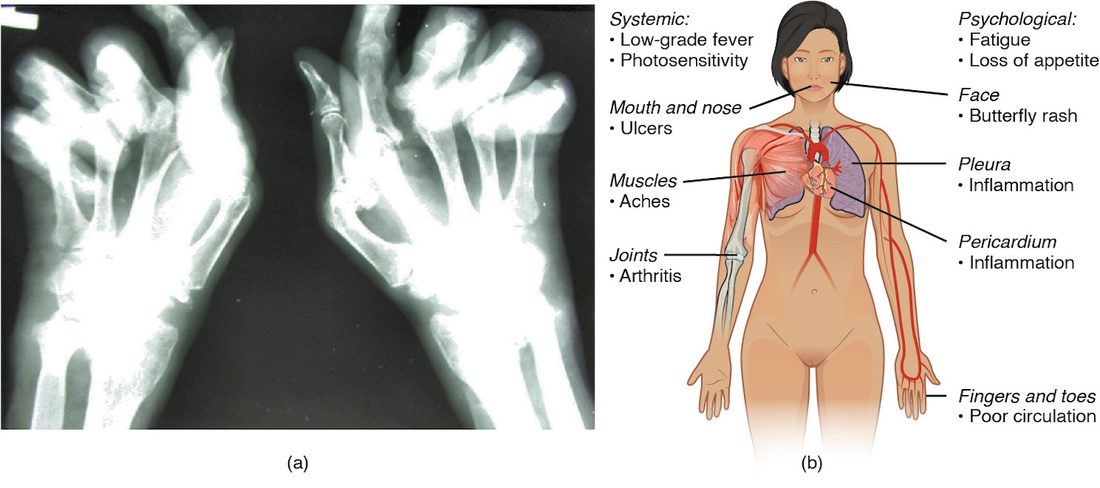
Hypersensitivity is a harmful immune response, usually to a harmless allergen, usually after a symptom-free sensitization. Type I (immediate) is IgE on mast cells; type II is antibody against cell-surface antigens or receptor proteins; type III is immune complexes lodging in vessels, joints and kidneys; type IV (delayed) is T cells. Anaphylaxis is body-wide mast cell degranulation: vasodilation lowers TPR, capillary leak lowers plasma volume and venous return, MAP falls into distributive shock, and the airways narrow. Intramuscular epinephrine reverses it through alpha-1, beta-1 and beta-2 receptor proteins. Autoimmune disease is lost self-tolerance: organ-specific (type 1 diabetes, Hashimoto, Graves, myasthenia gravis) or systemic (rheumatoid arthritis, lupus). In myasthenia gravis, antibodies remove acetylcholine receptor proteins, so weakness grows with use. Immunodeficiency is primary (SCID) or secondary; HIV destroys helper T cells, and AIDS is a CD4 count below 200 per microliter or a defining illness. Cytotoxic T cells and NK cells attack cancers, which escape by losing MHC class I and using brake proteins that checkpoint inhibitors block.