Nose, pharynx and larynx
1Why this matters
Mr. Evans, 58, is laughing at dinner when he suddenly stands up, clutching his throat. He cannot speak, cannot cough and makes no sound at all. A piece of steak has lodged in his larynx, the gateway where the paths for air and food split. Another diner wraps her arms around him from behind and gives sharp upward thrusts below his ribs until the meat flies out. Why could he not speak, and why could he not cough it out himself?
2What this builds on
3Quick check before you start
1. Which tissue lines most of the nasal cavity and the trachea?
- Simple squamous epithelium
- Pseudostratified ciliated columnar epithelium
- Keratinized stratified squamous epithelium
Show the answer
Pseudostratified ciliated columnar epithelium, with its goblet cells, is called respiratory epithelium because it lines most of the air passages. Simple squamous epithelium lines the alveoli, and keratinized stratified squamous epithelium is the epidermis.
- Simple squamous epithelium:
- Correct: Pseudostratified ciliated columnar epithelium:
- Keratinized stratified squamous epithelium:
2. What do the paranasal sinuses have in common?
- They are air spaces in skull bones around the nasal cavity
- They are blood-filled spaces in the brain's coverings
- They are cartilage plates that shape the nose
Show the answer
The frontal, maxillary, sphenoid and ethmoid sinuses are air-filled spaces inside those skull bones, lined with mucous membrane and opening into the nasal cavity.
- Correct: They are air spaces in skull bones around the nasal cavity:
- They are blood-filled spaces in the brain's coverings:
- They are cartilage plates that shape the nose:
3. What do cilia on an epithelial cell do?
- Absorb nutrients from the surface
- Anchor the cell to the basement membrane
- Beat to move fluid or mucus across the cell surface
Show the answer
Cilia are short hair-like projections built on microtubules. They beat in coordinated waves and move a layer of fluid or mucus across the surface of the cell.
- Absorb nutrients from the surface:
- Anchor the cell to the basement membrane:
- Correct: Beat to move fluid or mucus across the cell surface:
4Anatomy
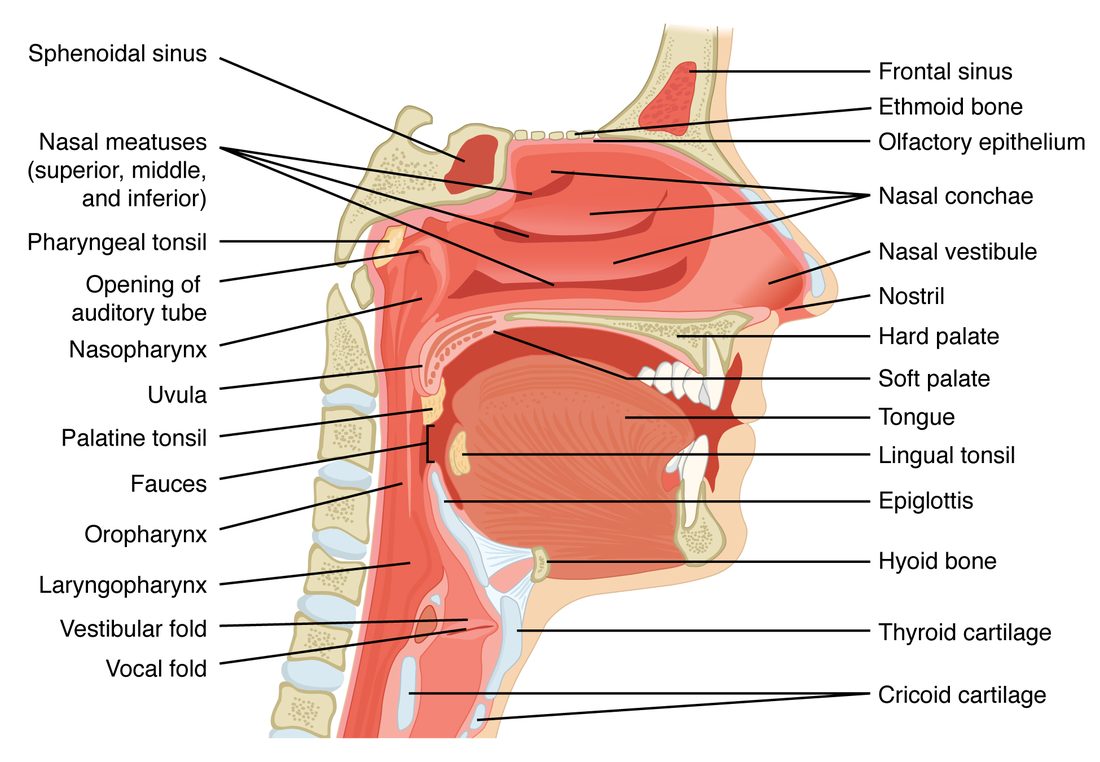
With labels hidden, select a box to reveal its label.
5How it works, step by step
- You swallow, and muscles attached to the hyoid bone pull the larynx up and forward under the base of the tongue.The vocal and vestibular folds close, and the epiglottis tips down and back over the opening of the larynx.
- With the larynx covered and sealed, food moves down through the laryngopharynx.It slides past the larynx into the esophagus instead of into the airway.
- If a crumb slips past the seal, it touches sensory receptors in the lining of the larynx below the folds.Sensory fibers of the vagus nerve signal the brainstem, which triggers the cough reflex.
- The cough reflex draws a deep breath in, closes the vocal folds, and contracts the abdominal wall muscles hard.Pressure builds in the chest; when the vocal folds open suddenly, a blast of air carries the crumb up and out.
6Core concepts
7A common mistake
The wrong idea: The respiratory tract is one continuous gas-exchange surface, so oxygen starts entering the blood as soon as air enters the nose.
What actually happens: Oxygen and carbon dioxide cross between air and blood only in the respiratory zone, deep in the lungs, where alveoli have walls one thin cell thick. The nose, pharynx, larynx, trachea and the branching air tubes are the conducting zone: their walls are thick, glandular and ciliated, and they only filter, warm, humidify and deliver air.
8Check yourself
Anything you miss goes into your review queue.
1. Where in the respiratory tract do oxygen and carbon dioxide cross between air and blood?
- In the lining of the nasal cavity and its conchae
- In the larynx, between the vocal folds
- In the alveoli and the tiny airways that carry them
- In the trachea and the air tubes below it
Show the answer
Gases cross between air and blood only in the respiratory zone: the alveoli and the tiny airways whose walls carry alveoli. Everything above is conducting zone.
- In the lining of the nasal cavity and its conchae: The nasal cavity and its conchae are conducting zone. Their thick, glandular, ciliated lining warms, moistens and filters air but does not exchange gases with blood.
- In the larynx, between the vocal folds: The larynx is conducting zone. It guards the airway and makes sound; its walls are far too thick for gases to cross.
- Correct: In the alveoli and the tiny airways that carry them: Correct. Only the respiratory zone, where alveolar walls are a single thin layer of cells, exchanges gases with the blood.
- In the trachea and the air tubes below it: The trachea and the larger air tubes are conducting zone. They deliver air to the lungs; their walls of mucosa and cartilage are too thick for gas exchange.
2. Name the pinned structure.
- Thyroid cartilage
- Epiglottis
- Vestibular fold
- Hyoid bone
Show the answer
The leaf-shaped flap of elastic cartilage standing up behind the base of the tongue is the epiglottis. It tips back over the opening of the larynx when you swallow.
- Thyroid cartilage: The thyroid cartilage is the large shield in the front wall of the larynx, lower down.
- Correct: Epiglottis: Correct. This flap at the top of the larynx is the epiglottis.
- Vestibular fold: The vestibular folds are folds of mucous membrane inside the larynx, just above the vocal folds.
- Hyoid bone: The hyoid bone is the U-shaped bone in front, below the jaw; the larynx hangs from it.
3. A runner breathes hard through her mouth in freezing air for an hour. Compared with nose breathing, what happens to the air reaching her trachea?
- It is warmer from the faster airflow
- It is colder, drier and less filtered
- It arrives just as warm, moist and clean
- It carries more oxygen into her blood through the trachea
Show the answer
Mouth breathing bypasses the nasal cavity, where the conchae make air swirl against warm, blood-rich, mucus-covered surfaces. Air therefore arrives colder, drier and carrying more particles.
- It is warmer from the faster airflow: Faster air has less contact time with warm surfaces, so it is less warmed, not more.
- Correct: It is colder, drier and less filtered: Correct. Skipping the nasal cavity skips most of the warming, humidifying and filtering.
- It arrives just as warm, moist and clean: The pharynx adds some warmth and moisture, but the nasal cavity, with its conchae and dense blood supply, does most of the work, so skipping it changes the air.
- It carries more oxygen into her blood through the trachea: The trachea is conducting zone. No oxygen crosses into the blood there, however the air arrives.
4. After surgery to remove part of her thyroid gland, Ms. Park wakes up with a hoarse, breathy voice. A camera shows that her left vocal fold does not move. Which structure was most likely injured?
- The left recurrent laryngeal nerve
- The muscles that lift the hyoid bone
- The left vestibular fold's lining
- The cricoid cartilage ring
Show the answer
The recurrent laryngeal nerves, branches of the vagus nerve, supply most of the small muscles that move the arytenoid cartilages and vocal folds. They run up beside the thyroid gland, so thyroid surgery can injure one and leave that vocal fold unable to close.
- Correct: The left recurrent laryngeal nerve: Correct. Without its nerve supply, the fold cannot be brought to the midline, so air leaks past and the voice is breathy.
- The muscles that lift the hyoid bone: The muscles that lift the hyoid bone raise the larynx during swallowing; they do not open or close the vocal folds.
- The left vestibular fold's lining: The vestibular folds do not make sound, so damage to one would not stop a vocal fold moving.
- The cricoid cartilage ring: A cricoid injury is unlikely in thyroid surgery and would not explain a single paralyzed fold.
5. This sequence for a cough has one wrong step. Find it.
- An irritant touches sensory receptors in the lining of the trachea
- Sensory fibers of the vagus nerve signal the brainstem
- A quick, deep breath is drawn in
- The vocal folds open wide while the abdominal muscles contract
- Air bursts out at high speed, carrying the irritant
Show the answer
The vocal folds must first close, so that the contracting abdominal wall muscles build up pressure against a sealed airway. Only then do the folds open suddenly and release the blast.
- An irritant touches sensory receptors in the lining of the trachea: Correct step. Sensory receptors in the lining of the larynx, trachea and large air tubes detect the irritant.
- Sensory fibers of the vagus nerve signal the brainstem: Correct step. The vagus nerve carries the sensory signal to the brainstem.
- A quick, deep breath is drawn in: Correct step. A deep breath in loads the lungs with air for the blast.
- Correct: The vocal folds open wide while the abdominal muscles contract: This is the wrong step. The folds close while the muscles contract, so pressure can build; with open folds the air would leak out gently.
- Air bursts out at high speed, carrying the irritant: Correct step. The sudden opening releases a high-speed blast.
6. How do the nasal conchae help clean the air you breathe in?
- They secrete antibodies directly into the air
- They swirl the air so particles strike the mucus
- They squeeze the air so it moves faster
- They carry cilia that sweep particles out through the nares
Show the answer
The conchae break the airstream into narrow, turbulent channels. Heavier particles cannot follow the air around the bends and land on the sticky mucus that covers the conchae.
- They secrete antibodies directly into the air: The mucosa's mucus does contain antibodies, but they act on particles trapped in the mucus, not in the air.
- Correct: They swirl the air so particles strike the mucus: Correct. Turbulence throws particles against the mucus-covered surfaces.
- They squeeze the air so it moves faster: The conchae increase surface area and turbulence; their benefit is contact with the lining, not speed.
- They carry cilia that sweep particles out through the nares: Cilia in the nasal cavity sweep mucus backward toward the pharynx, where it is swallowed, not forward out of the nose.
7. A singer moves from a low note to a high note at the same loudness. What change in her vocal folds produces the higher pitch?
- They are pushed apart more widely
- They are held completely open
- More air pressure is built up beneath them
- They are stretched tighter and thinner
Show the answer
Pitch depends on how fast the folds vibrate. Muscles that stretch the folds tighter and thinner make them vibrate faster, raising the pitch, as with a tightened guitar string.
- They are pushed apart more widely: A wider swing of the folds makes the sound louder, not higher.
- They are held completely open: Open vocal folds do not vibrate at all, so no voice is produced.
- More air pressure is built up beneath them: More pressure beneath the folds makes the sound louder; the question holds loudness constant.
- Correct: They are stretched tighter and thinner: Correct. Tighter, thinner folds vibrate faster, producing a higher pitch.
9Summary
The conducting zone (nose to the smallest air tubes without alveoli) cleans, warms, humidifies and delivers air; only the respiratory zone, deep in the lungs, exchanges gases with blood. Air enters through the nares into the nasal cavity, divided by the nasal septum; the conchae make it swirl so particles stick to mucus, and blood-rich mucosa warms and moistens it. Mucus, the cilia of the mucociliary escalator, and the cough and sneeze reflexes defend the airway. The pharynx has three parts: the nasopharynx (air only; pharyngeal tonsil, auditory tube openings), the oropharynx and the laryngopharynx (air and food; stratified squamous lining). The larynx is built on the thyroid cartilage (with the laryngeal prominence), the ring-shaped cricoid cartilage and the epiglottis, which covers the airway when you swallow. The vocal folds (true vocal cords) vibrate to make sound; the glottis is the folds plus the gap between them; the vestibular folds above do not make sound.