Sampling Distributions for Sample Proportions
For random samples, p-hat is centered at p with a spread that shrinks as n grows.
Part 1 · Hook
Why this matters
Part 2 · Before you start
What this builds on
Part 3 · Prerequisite check
Quick check before you start
1. For a normal distribution with mean 0.85 and standard deviation 0.025, what is the z-score of 0.80?
Show the answer
- Correct: :
- :
- :
- :
2. As the size of a random sample grows, the sampling distribution of
- stays centered at and becomes less spread out
- moves closer to 0.5 and becomes more spread out
- stays centered at and keeps the same spread
- becomes centered at the sample's own proportion
Show the answer
from a random sample is unbiased at every sample size, and larger samples give less variability.
- Correct: stays centered at and becomes less spread out:
- moves closer to 0.5 and becomes more spread out:
- stays centered at and keeps the same spread:
- becomes centered at the sample's own proportion:
Part 4 · See it
See it first
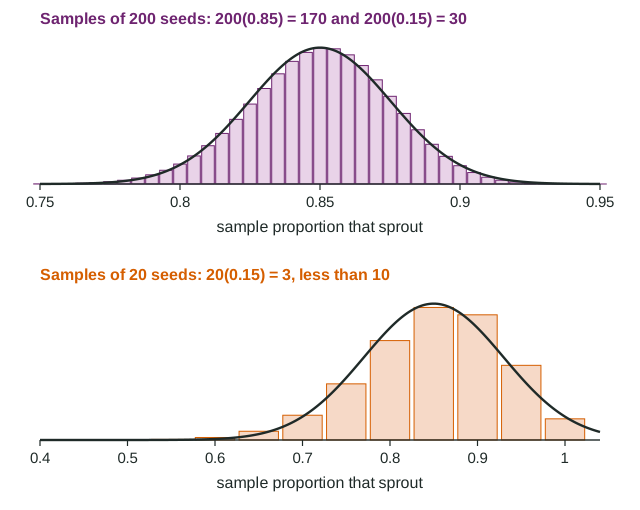
Part 5 · Step by step
How it works, step by step
- Each sampled seed sprouts (1) or not (0), with a 0-or-1 spread of averaging of them gives
, centered at - The sample is drawn without replacementthe formula is accurate only when is at most 10% of the population: the 10% condition
- At least 10 successes and 10 failures are expected (, )the sampling distribution is approximately normal: the large counts condition
- Both conditions holdstandardize with
and find probabilities about from the normal distribution
Part 6 · Key ideas
Key ideas
- and
, using the true . - 10% condition: at most 10% of the population, so the standard deviation formula holds when sampling without replacement.
- Large counts condition: and , so the shape is approximately normal. Never "" for proportions.
- When large counts fails, the distribution is skewed: right when is near 0, left when is near 1.
- Four times the sample size halves .
Part 7 · Misconception
A common mistake
The wrong idea: The 10% condition is what makes the distribution of normal, so a sample under 10% of the population can always use a normal model.
What actually happens: The 10% condition protects the standard deviation formula (independence). The normal shape comes from the large counts condition, and . Check both, for different reasons.
Part 8 · Check yourself
Check yourself
Exam-style questions. Anything you miss goes into your review queue.
Table
Testing a seed company's sprouting rate
A seed company says that 85% of its tomato seeds sprout. A garden store plants a random sample of 200 seeds from a shipment of 50,000 seeds and records the proportion that sprout. Suppose the company's figure is correct, so .
| Quantity | Value |
|---|---|
| Population | 50,000 seeds in the shipment |
| True proportion that sprout, | 0.85 |
| Sample size, | 200 seeds, chosen at random |
1. What are the mean and standard deviation of the sampling distribution of , the proportion of the 200 seeds that sprout?
- Mean 0.85, standard deviation 0.0252
- Mean 0.85, standard deviation 0.000638
- Mean 0.85, standard deviation 0.357
- Mean 170, standard deviation 5.05
Show the answer
and
- Correct: Mean 0.85, standard deviation 0.0252: Right: the mean is and the standard deviation is .
- Mean 0.85, standard deviation 0.000638: That is without the square root: the variance, not the standard deviation.
- Mean 0.85, standard deviation 0.357: That is , the spread for a single seed. Divide by inside the square root.
- Mean 170, standard deviation 5.05: Those describe the count of seeds that sprout, and , not the proportion.
2. Calculate the standard deviation of the sampling distribution of . Give four decimal places.
Type a number. A table answer and a calculator answer are both accepted.
Show the answer
- Answer: 0.0252
3. Why is it reasonable to use a normal model for the sampling distribution of here?
- Because is at least 30
- Because 200 is less than 10% of the 50,000 seeds in the shipment
- Both and are at least 10
- Because the seeds were chosen at random
Show the answer
The large counts condition: and
- Because is at least 30: The rule of 30 is for sample means. For proportions, check the expected numbers of successes and failures.
- Because 200 is less than 10% of the 50,000 seeds in the shipment: That is the 10% condition. It justifies the standard deviation formula, not the normal shape.
- Correct: Both and are at least 10: Right: the large counts condition, with both counts at least 10.
- Because the seeds were chosen at random: Random selection is needed, but it does not make the shape normal. The shape depends on the expected numbers of successes and failures.
4. Assuming the company's figure is correct, find the probability that 80% or fewer of the 200 seeds sprout.
Type a number. A table answer and a calculator answer are both accepted.
Show the answer
is approximately normal with mean 0.85 and standard deviation 0.0252.
- Answer: 0.0238
5. A pollster keeps everything else the same but takes a random sample 4 times as large. By what factor does the standard deviation of change?
- It is divided by 4
- It is divided by 2
- It is multiplied by 2
- It does not change, because is the same
Show the answer
- It is divided by 4: The sample size is inside a square root, so the effect is , not 4.
- Correct: It is divided by 2: Right: is twice .
- It is multiplied by 2: A larger sample gives less spread, not more.
- It does not change, because is the same: The formula depends on as well as .
6. About 3% of a factory's light bulbs are defective. An inspector takes a random sample of 250 bulbs from a large batch. What can you say about the shape of the sampling distribution of the proportion defective?
- Approximately normal, because 250 is a large sample
- Skewed left, because most bulbs are not defective
- Approximately normal, because
- Skewed right, because is less than 10
Show the answer
, which is less than 10. Large counts fails, so the distribution is skewed right (it piles up near 0 and has a longer tail to the right).
- Approximately normal, because 250 is a large sample: Size alone is not enough: the expected number of defective bulbs is only 7.5.
- Skewed left, because most bulbs are not defective: With near 0, the proportion piles up near 0 and stretches to the right: skewed right.
- Approximately normal, because : Both counts must be at least 10, and is not.
- Correct: Skewed right, because is less than 10: Right: large counts fails for the defective bulbs.
7. The garden store plants a random sample of 200 seeds and only 78% sprout. Assuming 85% of all the company's seeds sprout, . Build a sentence that uses this probability to judge the company's claim.
Write the conclusion in context.
Show the answer
A probability is useful only when you tie it back to the claim. If the claim were true, 78% or fewer sprouting would happen in about 3 of every 1,000 samples, so it would be very unusual. That casts doubt on the claim.
- A full-credit answer: Assuming 85% of all the company's seeds sprout, a sample proportion of 0.78 or less in a random sample of 200 seeds would be very unusual (probability 0.0028), so this result gives reason to doubt the company's claim.
Part 9 · Summary
Summary
Part 10 · Up next
What comes next
Part 11 · Connections