Long-term blood pressure regulation is the control of your blood pressure over hours, days and years. The baroreceptor reflex fixes changes within seconds, but it resets within a day or two. What holds your pressure steady over the long run is your blood volume, and your kidneys set that volume by deciding how much salt and water to keep. Three hormone systems tell them what to do: the renin–angiotensin–aldosterone system (RAAS), antidiuretic hormone (ADH) and atrial natriuretic peptide (ANP). This page follows each one, works through the numbers linking salt to volume, and ends with a comparison of short-term and long-term control.
Why blood volume sets long-term pressure
Start with a garden hose attached to a pump. Put less water in the system and the pump has less to push. The pressure in the hose falls, however hard the pump works. Your circulation behaves in the same way.
Most of your blood, about two thirds of it, sits in your veins at low pressure. That venous reservoir sets how much blood returns to your heart. Follow the chain when blood volume falls:
- Less blood fills the veins, so venous pressure and venous return fall.
- Less venous return means a smaller end-diastolic volume, so stroke volume falls by the Frank–Starling mechanism.
- Cardiac output falls with stroke volume.
- By MAP = CO × TPR, mean arterial pressure falls.
The chain runs the other way when volume rises: more venous return, larger stroke volume, higher cardiac output, higher pressure. This is blood volume and blood pressure in detail: over the long run, a larger blood volume means a higher mean arterial pressure, and a smaller one means a lower pressure.
The baroreceptor reflex can hide a volume change for a while by raising heart rate and TPR. It cannot put the missing blood back. And because baroreceptors reset over a day or two, the reflex fades if the change lasts. Only a change in volume corrects a lasting change in pressure.
Worked example 1: what a volume loss does to MAP
A resting adult has a heart rate of 70 beats/min, a stroke volume of 70 mL and a TPR of 18 mm Hg·min/L. After several days of losing more fluid than they drink, their blood volume is lower and stroke volume has fallen to 56 mL. Assume, for now, that heart rate and TPR have not changed.
- Starting cardiac output: 70 × 70 mL = 4,900 mL/min, which is 4.9 L/min.
- Starting MAP: 4.9 × 18 ≈ 88 mm Hg.
- New cardiac output: 70 × 56 mL = 3,920 mL/min, which is 3.92 L/min.
- New MAP: 3.92 × 18 ≈ 71 mm Hg. A 20 percent fall in stroke volume gives a 20 percent fall in MAP.
- Now let the baroreceptor reflex act. It raises heart rate to 85 beats/min: 85 × 56 mL = 4.76 L/min, and MAP = 4.76 × 18 ≈ 86 mm Hg. Pressure is almost back, but only because the heart is working harder with less blood. Restoring the volume is what lets heart rate come back down.
The kidneys set blood volume
You gain water and salt by eating and drinking, and you lose them in urine, sweat, breath and feces. Blood volume stays steady only when gains and losses match. Of all those routes, only one is adjusted to match: how much salt and water your kidneys put into urine. That is the idea that the kidneys set blood volume.
Sodium holds water
Why salt and not just water? Sodium ions stay mostly outside your cells, because the sodium–potassium pump keeps moving them out. So the amount of sodium in your body sets how much fluid stays outside your cells, in your plasma and interstitial fluid. Water follows sodium by osmosis: wherever the kidneys keep sodium, water stays with it, and wherever they excrete sodium, water leaves with it.
Keeping water alone does something different. Pure water spreads through every fluid in your body, inside cells as well as outside, and dilutes them. Only a fraction of it stays in the blood. Keeping salt and water together adds fluid that stays outside the cells, where the plasma is.
Worked example 2: how much fluid a salty meal holds
Fluid outside your cells normally holds about 140 mmol of sodium in every liter. A salty restaurant meal contains about 5.8 g of salt (sodium chloride). How much extra fluid will the body hold until the kidneys excrete that sodium?
- Convert grams of sodium chloride to millimoles. Its molar mass is 58.5 g/mol, so 5.8 g ÷ 58.5 g/mol ≈ 0.1 mol, which is 100 mmol. Each unit carries one sodium ion, so that is 100 mmol of sodium.
- The new sodium stays outside the cells. The salt raises the concentration there, which triggers thirst and ADH, and you drink and keep water until the concentration is back to 140 mmol/L.
- Volume that 100 mmol occupies at 140 mmol/L: 100 ÷ 140 ≈ 0.71 L.
- Plasma is roughly a fifth of the fluid outside your cells, so about 0.14 L of that ends up in the blood; the rest is in the interstitial fluid.
Over the next day or two, the kidneys excrete the extra sodium, the water leaves with it, and the volume returns to where it was.
How pressure itself changes excretion
The kidneys also respond to pressure directly, with no hormone involved.
This link is why the kidneys can set long-term pressure. If pressure is above the level the kidneys hold it at, they lose extra salt and water until volume, and so pressure, fall back. If pressure is below it, they keep salt and water until it rises. The hormones below shift that level up or down.
The renin–angiotensin–aldosterone system
You met the renin–angiotensin–aldosterone system (RAAS) with the adrenal glands. Here is what it does to blood pressure: RAAS in blood pressure control raises pressure fast by constricting arterioles, and raises it lastingly by making the kidneys keep salt and water.
What starts it
Specialized cells in the walls of the small arteries inside each kidney release renin, an enzyme, into the blood. Three things increase renin release:
- Low pressure in the kidney's small arteries. The cells that make renin are themselves stretch-sensitive. Less stretch means more renin.
- Sympathetic stimulation. Norepinephrine on beta-1 receptors of the renin-making cells increases release. So the baroreceptor reflex, when pressure falls, also switches on the RAAS.
- Less salt reaching sensing cells in the kidney. When the fluid flowing through the kidney carries less sodium chloride, sensing cells there signal the renin-making cells to release more.
The cascade
- Renin cuts angiotensinogen, an inactive protein the liver releases into the plasma all the time, into angiotensin I. Angiotensin I does very little itself.
- Angiotensin-converting enzyme (ACE), on the surface of endothelial cells and most plentiful in the lungs' capillaries, converts angiotensin I into angiotensin II.
- Angiotensin II is the active hormone. The renin step limits the rate of the whole cascade, so the amount of renin released sets how much angiotensin II you make.
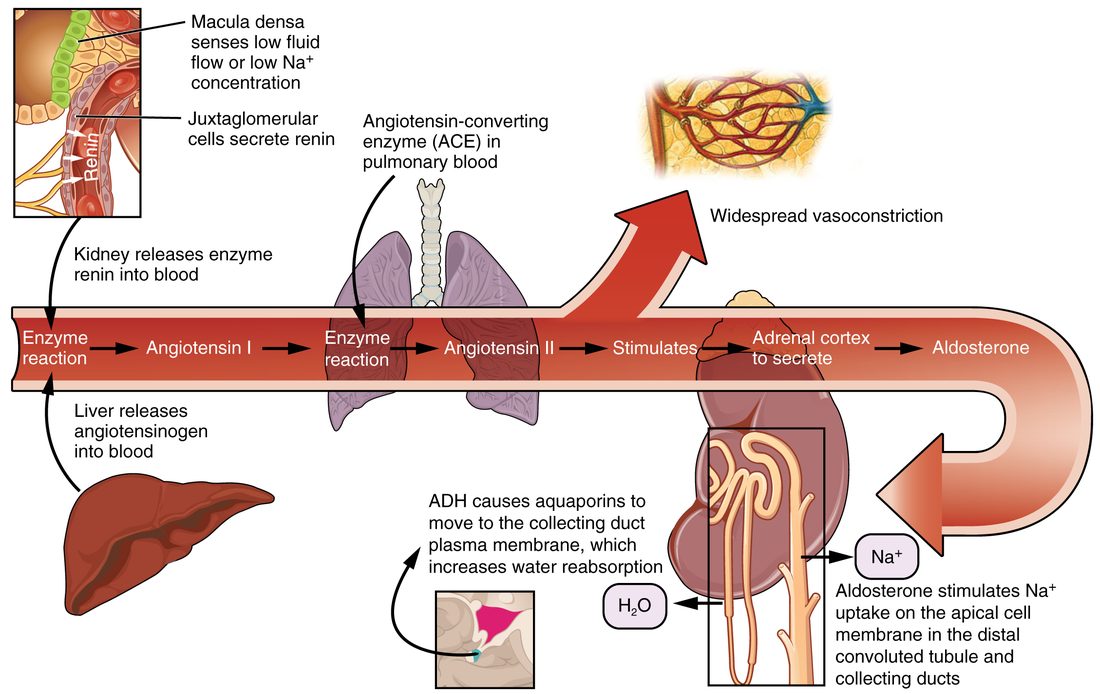
The cascade involves several organs, as Figure 1 shows. None of them has to be near the others, because every product travels in the blood.
What angiotensin II does
- Constricts arterioles. Angiotensin II binds receptor proteins on arteriole smooth muscle and makes it contract. TPR rises within minutes. This is the fast arm.
- Releases aldosterone. It acts on the outer layer of the adrenal cortex. Aldosterone makes the last parts of the kidney's tubules reabsorb more sodium into the blood and secrete more potassium into the urine. Water follows the sodium by osmosis, so blood volume rises. Aldosterone works by making cells build new transport proteins, so its effect takes hours to build and lasts for days. This is the slow, lasting arm.
- Makes the kidneys keep sodium directly, by acting on the tubule cells nearest the start of each tubule.
- Releases ADH and triggers thirst, through the hypothalamus. You drink more, and your kidneys keep more water.
- Boosts sympathetic signaling, adding to the vasoconstriction.
As pressure and volume recover, renin release falls, and the whole cascade winds down. That makes the RAAS a negative feedback loop (Figure 2).
ADH in blood pressure control
You met antidiuretic hormone (ADH, also called vasopressin) with the hypothalamus and posterior pituitary. ADH in blood pressure control works mainly by making the kidneys keep water, and, when volume falls a lot, by constricting arterioles.
Two triggers, with different sensitivities
- A rise in plasma osmolarity. Osmoreceptors in the hypothalamus respond to a change as small as 1 to 2 percent. This is the everyday trigger. Most of the time, ADH is controlling the concentration of your plasma, not its volume.
- A fall in blood volume or pressure. Less stretch of the arterial baroreceptors and of stretch-sensitive sensory receptors in the atria and large veins increases ADH release. This trigger needs a larger change, a fall in volume of roughly 5 to 10 percent. Once it is reached, ADH rises steeply, to levels far above those osmolarity alone produces. That is what happens after a large bleed.
After a large loss of volume, ADH release stays high even if osmolarity is normal or low. The volume signal overrides the osmolarity signal.
Two effects
- Kidneys keep water. ADH makes the last parts of the kidney's tubules insert aquaporins into their membranes, so more water moves back into the blood by osmosis. Urine becomes smaller in volume and more concentrated. This adds water without sodium, so it raises volume and dilutes the plasma at the same time.
- Arterioles constrict. At the high levels reached after a large volume loss, ADH binds receptor proteins on arteriole smooth muscle and raises TPR. This is where its other name, vasopressin (vas/o = vessel, press- = press), comes from.
Angiotensin II also triggers thirst and ADH release, so the RAAS and ADH usually rise together when volume is low.
ANP in blood pressure control
The first two systems raise pressure. The third one lowers it. When your blood volume rises, for example after a fast IV infusion or a large salty meal, more blood returns to your heart and stretches the atrial walls. Stretched atrial muscle cells release atrial natriuretic peptide (ANP; natri- = sodium, -uretic = relating to urine).
ANP in blood pressure control works against the RAAS on nearly every point:
- Kidneys excrete more sodium and water. ANP increases the amount of fluid the kidneys filter and reduces sodium reabsorption. Excreting extra sodium in the urine is called natriuresis, and water leaves with it.
- Less renin, aldosterone and ADH. ANP reduces the release of all three.
- Vasodilation. ANP relaxes arteriole smooth muscle, so TPR falls.
- Fluid moves out of the plasma. ANP makes capillaries a little more permeable, so some plasma fluid filters into the interstitial fluid.
Blood volume falls, atrial stretch falls, and ANP release falls with it: another negative feedback loop.
Putting it together: a long day without water
Ana, 34, hikes for six hours in desert heat and runs out of water halfway. She sweats about 3 L. Sweat is saltier than water but much less salty than plasma, so she loses more water than salt. Follow what her body does:
- Plasma osmolarity rises, because she lost more water than salt. Osmoreceptors increase ADH release and trigger thirst.
- Blood volume falls. Venous return, stroke volume and MAP drift down. Baroreceptor firing falls, so sympathetic output rises and heart rate climbs.
- Renin release rises, from lower pressure in the kidney's small arteries and from sympathetic stimulation. Angiotensin II rises, constricts arterioles and releases aldosterone.
- ANP release falls, because less blood stretches her atria.
- Result: her kidneys keep sodium and water, and she passes a small volume of dark, concentrated urine. Her pressure is held up in the meantime by a faster heart and constricted arterioles.
- Repair: only drinking, with some salt, restores her volume. As it returns, ADH, renin and aldosterone fall, ANP rises, and her kidneys excrete any excess.
Short-term and long-term control compared
The two kinds of control work on the same equation, MAP = CO × TPR, but on different timescales and through different variables. The fast reflexes change heart rate and resistance; the slow hormones change how much blood there is to pump.
| Short-term control | Long-term control | |
|---|---|---|
| Main mechanism | Baroreceptor reflex, with the atrial reflex and local autoregulation | Kidneys adjusting salt and water excretion, directed by RAAS, ADH and ANP |
| Sensors | Baroreceptors in the carotid sinuses and aortic arch; stretch sensors in the atria | Stretch-sensitive renin-making cells in the kidney; osmoreceptors; atrial muscle cells; the baroreceptors as well |
| Messengers | Autonomic nerves | Hormones in the blood |
| Speed | Seconds | Minutes (vasoconstriction) to hours and days (volume) |
| What it changes | Heart rate, contractility, arteriole and vein diameter | Blood volume, and so venous return and stroke volume; also TPR |
| Lasting change in pressure? | No: baroreceptors reset within a day or two | Yes: sets the pressure level held over weeks and years |
| Everyday example | Standing up from bed | A day of heavy sweating, or a week of very salty meals |
The two are not separate systems. The same fall in pressure that lowers baroreceptor firing also raises sympathetic stimulation of the kidney, which releases renin. The fast reflex holds pressure up while the slow hormones rebuild the volume.
Summary
Over the long run, blood pressure follows blood volume: more volume means more venous return, stroke volume and cardiac output. The kidneys set blood volume by adjusting how much sodium and water they excrete, and water follows sodium. When pressure or volume falls, the kidneys release renin, which leads to angiotensin II: it constricts arterioles, releases aldosterone so the kidneys keep sodium and water, and triggers ADH and thirst. ADH makes the kidneys keep water, responds most to osmolarity but strongly to a large volume loss, and constricts arterioles at high levels. ANP, released when the atria are stretched, does the opposite: more sodium and water in the urine, less renin, aldosterone and ADH, and vasodilation. Short-term reflexes act in seconds and reset; these long-term systems act over hours to days and set the level your pressure is held at.