Logarithmic Functions
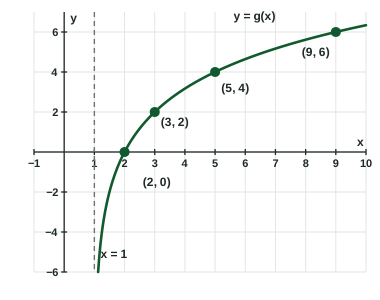
A logarithmic function f(x) = alog_b x is defined only for x > 0 , with a vertical asymptote at x = 0 .
Part 1 · Hook
Why this matters
Part 2 · Before you start
What this builds on
Part 3 · Prerequisite check
Quick check before you start
1. What is ?
Show the answer
.
- Correct: :
- :
- :
- :
2. has the horizontal asymptote . Which asymptote does its inverse have?
Show the answer
Reflecting across turns into .
- Correct: :
- :
- :
- :
3. says what about the graph of ?
- Just right of , it drops without bound
- Just left of , it drops without bound
- It approaches from above
- It crosses going down
Show the answer
means from the right; means decreasing without bound.
- Correct: Just right of , it drops without bound:
- Just left of , it drops without bound:
- It approaches from above:
- It crosses going down:
Part 4 · See it
See it first
Part 5 · Step by step
How it works, step by step
- The input of a logarithm must be positive
has domain and a vertical asymptote - Inputs approach the asymptote from the rightfor and ,
- Inputs grow without boundthe outputs grow without bound too, slowly:
- Compare average rates over equal intervalsthey decrease, so is concave down; it is increasing with no maximum or minimum
Part 6 · Key ideas
Key ideas
- (, , ): domain , range all real numbers, vertical asymptote .
- For , : increasing, concave down, and . No extrema, no points of inflection.
- Shifts move the asymptote: has domain and asymptote .
- Write behavior near the asymptote with a one-sided limit from the side where is defined.
Part 7 · Misconception
A common mistake
The wrong idea: Because grows so slowly, it levels off at a horizontal asymptote.
What actually happens: It never levels off: reaches any number at , so . Its rate of change decreases toward , but the outputs have no ceiling.
Part 8 · Check yourself
Check yourself
Exam-style questions. Anything you miss goes into your review queue.
Graph
The graph of
1. What is the domain of ?
Show the answer
A logarithm needs a positive input: , so . The asymptote itself is not included.
- Correct: : gives .
- : That is the domain of ; the graph is shifted units left.
- : At the input of the logarithm is , which is not allowed.
- : The shift is to the left: .
2. Which statement describes near its vertical asymptote?
Show the answer
is defined only to the right of , and there the graph drops without bound.
- Correct:
: From the right, the outputs decrease without bound. : is undefined to the left of , so only the right-hand limit makes sense. - : The graph goes down, not up, as approaches from the right.
- : is undefined for very negative ; is where the asymptote is, not a limit value.
3. Find the zero of .
No calculator. Type the exact value (a fraction, π, e or a root is fine).
Show the answer
means , so and . The graph crosses the -axis at .
- Answer: -2
4. Which statement describes on its whole domain?
- is increasing, and the rate of change of is decreasing
- is increasing, and the rate of change of is increasing
- is decreasing, and the rate of change of is increasing
- has a maximum value at
Show the answer
The graph rises everywhere and bends downward: secant slopes get smaller, from on to on to on . is concave down.
- Correct: is increasing, and the rate of change of is decreasing: Rising outputs with shrinking secant slopes: increasing and concave down.
- is increasing, and the rate of change of is increasing: An increasing rate of change would make the graph bend upward.
- is decreasing, and the rate of change of is increasing: Larger inputs give larger outputs, so is increasing.
- has a maximum value at : A logarithmic function has no maximum; keeps growing past .
5. Which statement describes the end behavior of ?
Show the answer
Slowly but without bound: and .
- Correct:
: Every whole number is reached at . : is the value at ; the outputs keep growing. : and : the outputs pass . : , and the outputs pass .
6. The graph of is the graph of shifted units right and units up. Write .
Type an expression for .
Show the answer
A shift units right replaces by ; a shift up adds to the output: .
- Answer:
7. What is the domain of ?
- or
Show the answer
The input must be positive: , so , which holds for and for .
- Correct: or : on both sides: or .
- : also works: .
- : The condition is , not .
- : For , is negative, so the logarithm is undefined there.
Part 9 · Summary
Summary
Part 10 · Up next
What comes next
Part 11 · Connections