Logarithmic Function Manipulation
Logarithms turn products into sums, quotients into differences and powers into multiples, because exponents behave that way.
Part 1 · Hook
Why this matters
Part 2 · Before you start
What this builds on
Part 3 · Prerequisite check
Quick check before you start
1. Which equals ?
Show the answer
Multiplying powers of one base adds the exponents.
- Correct: :
- :
- :
- :
2. What is ?
Show the answer
.
- Correct: :
- :
- :
- :
3. Multiplying the input of by does what to the output?
- Adds
- Multiplies it by
- Adds
- Multiplies it by
Show the answer
, so the output increases by .
- Correct: Adds :
- Multiplies it by :
- Adds :
- Multiplies it by :
Part 4 · See it
See it first
Part 5 · Step by step
How it works, step by step
- Exponents add when powers multiply: product property:
- Exponents subtract when powers dividequotient property:
- Exponents multiply when a power is raised to a powerpower property:
- Rewrite through another base change of base:
, so every logarithm is a vertical dilation of every other
Part 6 · Key ideas
Key ideas
, , , for . - Change of base: . So , a vertical dilation.
- Graphs:
is a vertical shift (and a horizontal dilation); is a vertical dilation. - Watch the domain: is defined for , but only for .
Part 7 · Misconception
A common mistake
The wrong idea:
What actually happens: The logarithm of a product is a sum: . There is no rule that splits .
Part 8 · Check yourself
Check yourself
Exam-style questions. Anything you miss goes into your review queue.
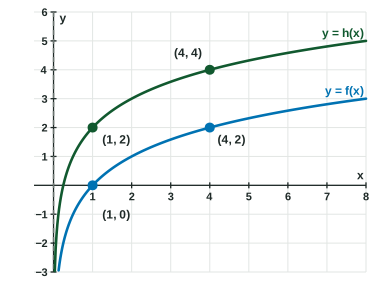
Graph
The graphs of and
1. For every , what is ?
Show the answer
By the product property,
- Correct: : , the same gap at every .
- : The factor inside the logarithm becomes outside it.
- : ; the factor is , and .
- : Subtracting the inputs is not how the outputs compare; the gap is a constant.
2. Which transformation of the graph of gives the graph of ?
- A vertical translation up units
- A horizontal translation left units
- A vertical dilation by a factor of
- A vertical translation up units
Show the answer
: every output of goes up by .
- Correct: A vertical translation up units: .
- A horizontal translation left units: A shift left would be ; here is multiplied by .
- A vertical dilation by a factor of : A vertical dilation multiplies outputs; while .
- A vertical translation up units: The shift is , not .
3. The graph of can also be described as which transformation of the graph of ?
- A horizontal dilation by a factor of
- A horizontal dilation by a factor of
- A vertical dilation by a factor of
- A horizontal translation right units
Show the answer
: reaches each output of at an input as large, so the graph is squeezed toward the -axis. For a logarithm, that horizontal dilation is the same as a vertical shift.
- Correct: A horizontal dilation by a factor of : and : each input is divided by .
- A horizontal dilation by a factor of : Multiplying the input by squeezes the graph; a factor of would stretch it.
- A vertical dilation by a factor of : , which does not match .
- A horizontal translation right units: A shift right would lower the graph; is above .
Table
Values of
| 2 | 3 | 5 | 7 | |
|---|---|---|---|---|
| 0.693 | 1.099 | 1.609 | 1.946 |
4. Which value is closest to ?
Show the answer
- Correct: : Product property: add the logarithms of the factors.
- : That multiplies by ; the logarithm of a product is a sum.
- : That is about .
- : That is .
5. Which value is closest to ?
Show the answer
- Correct: : Power property: the exponent multiplies .
- : That is ; the power property gives , not a square.
- : That is ; , so the factor is .
- : That is half of , which would be .
6. Write as a single logarithm that is equal to it for every .
Type an expression for .
Show the answer
Quotient property:
- Answer:
7. Which equation is true for every pair of positive numbers and ?
Show the answer
The product property turns a product inside a logarithm into a sum outside it. There is no rule for a sum inside.
- Correct: : The product property.
: Try : . : The quotient property gives . - : The power property is ; is a square of the logarithm.
Part 9 · Summary
Summary
Part 10 · Up next
What comes next
Part 11 · Connections