Exponential and Logarithmic Equations and Inequalities
To solve an exponential equation, isolate the power and use a common base or a logarithm.
Part 1 · Hook
Why this matters
Part 2 · Before you start
What this builds on
Part 3 · Prerequisite check
Quick check before you start
1. Which is equal to for ?
Show the answer
Product property.
- Correct: :
- :
- :
- :
2. and are inverse functions. What is ?
Show the answer
undoes .
- Correct: :
- :
- :
- :
3. Solve .
- or
- or
- or
- or
Show the answer
.
- Correct: or :
- or :
- or :
- or :
Part 4 · See it
See it first
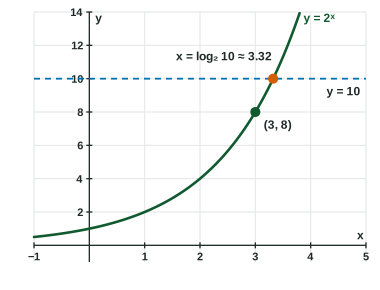
Part 5 · Step by step
How it works, step by step
- The unknown is in an exponentisolate the power, then take a logarithm of both sides (or use a common base)
- The unknown is inside logarithmscombine them into one logarithm, then rewrite in exponential form
- Combining logarithms widens the domainsome roots of the new equation are extraneous: check each in the original
- The equation is quadratic in substitute , solve, and reject any
- An inequality with or the direction stays for and flips for ; respect the domain
Part 6 · Key ideas
Key ideas
- Exponential equations: isolate , then use a common base or take or of both sides.
- Logarithmic equations: get one logarithm on each side or one logarithm equal to a number, then rewrite as a power.
- Check every answer in the original equation; a value that makes any logarithm's input or negative is extraneous.
- Inverses of transformed functions: swap and , undo the outer steps in reverse order, and use the matching exponential or logarithm.
Part 7 · Misconception
A common mistake
The wrong idea: Solving gives or , so both are answers.
What actually happens: solves the quadratic but not the original equation, where is undefined. It is extraneous; the only solution is .
Part 8 · Check yourself
Check yourself
Exam-style questions. Anything you miss goes into your review queue.
Graph
The graph of and the line
1. Solve .
No calculator. Type the exact value (a fraction, π, e or a root is fine).
Show the answer
Rewrite in exponential form: , so . The graph meets the line at .
- Answer: 7
2. Solve .
Show the answer
is increasing, so to the left of . The domain needs , so . Together: .
- Correct: : Below the line and inside the domain.
- : Inputs at or left of are outside the domain, where is undefined.
- : For the graph is below the line too: .
- : To the right of the graph is above the line.
Table
A student solves an equation
| Step | Work |
|---|---|
| 1 | |
| 2 | |
| 3 | |
| 4 | |
| 5 | or |
3. Which property of logarithms does step 1 use?
- The product property
- The quotient property
- The power property
- The change of base formula
Show the answer
A sum of two logarithms with the same base becomes the logarithm of a product.
- Correct: The product property:
. - The quotient property: The quotient property turns a difference into a quotient.
- The power property: The power property moves an exponent; no exponent moves here.
- The change of base formula: The base stays throughout.
4. Why does step 2 follow from step 1?
- means
- Both sides were squared
- Both sides were multiplied by , and was rounded to
- was divided out of both sides
Show the answer
Rewriting in exponential form gives .
- Correct: means : Logarithmic form to exponential form, with .
- Both sides were squared: Nothing was squared; comes from .
- Both sides were multiplied by , and was rounded to : Multiplying by would give ; the is .
- was divided out of both sides: A logarithm is a function, not a factor; it is undone by its exponential.
5. Which conclusion about the student's answers is correct?
- is the solution; is extraneous because is undefined
- Both and are solutions
- is the solution; is extraneous because is small
- Neither is a solution, because step 1 is not allowed
Show the answer
Check each in the original equation. :
- Correct: is the solution; is extraneous because is undefined: checks, and makes both logarithms undefined.
- Both and are solutions: solves the quadratic in step 3 but not the original equation.
- is the solution; is extraneous because is small: is allowed; checks.
- Neither is a solution, because step 1 is not allowed: Step 1 is fine for ; it can add a false root, which is why we check.
6. Solve .
No calculator. Type the exact value (a fraction, π, e or a root is fine).
Show the answer
Product property: , so , . makes undefined, so it is extraneous. The solution is .
- Answer: 4
7. Solve . Select every solution.
Show the answer
Let : , . gives . is impossible, because .
- Correct: : .
- : The factor is , which gives , not ; and that has no solution.
- : is the value of ; then .
- : , which does not solve .
Part 9 · Summary
Summary
Part 10 · Up next
What comes next
Part 11 · Connections