Logarithmic Function Context and Data Modeling
Use a logarithmic model y = a + bln x when the input must multiply by a constant for the output to rise by a constant.
Part 1 · Hook
Why this matters
Part 2 · Before you start
What this builds on
Part 3 · Prerequisite check
Quick check before you start
1. at equals
Show the answer
.
- Correct: :
- :
- :
- :
2. A residual is
- the actual value minus the predicted value
- the predicted value minus the actual value
- the predicted value divided by the actual value
- the slope of the model
Show the answer
Residual = actual − predicted.
- Correct: the actual value minus the predicted value:
- the predicted value minus the actual value:
- the predicted value divided by the actual value:
- the slope of the model:
3. Solve .
Show the answer
Exponential form, base .
- Correct: :
- :
- :
- :
Part 4 · See it
See it first
Part 5 · Step by step
How it works, step by step
- Inputs multiply by a constant factor while outputs add a constantthe data fit , a logarithmic model
- One point has the logarithm is there, so the output at is
- Data are not exactuse logarithmic regression, , and store the constants
- Solve for an inputisolate the logarithm and rewrite as a power
- Move far past the data or near the model is unsupported or gives impossible values, so restrict the domain
Part 6 · Key ideas
Key ideas
- A logarithmic model fits when equal factors in give equal changes in .
- Build it from two points (one with makes easy) or with logarithmic regression on a calculator.
- : increasing, concave down, so the rate of change decreases: growth that slows but never stops.
- Justify the choice with the numbers: "each time triples, increases by ".
Part 7 · Misconception
A common mistake
The wrong idea: A logarithmic model levels off at a maximum value, like a population reaching its limit.
What actually happens: A logarithmic model grows without bound:
Part 8 · Check yourself
Check yourself
Exam-style questions. Anything you miss goes into your review queue.
Table
Typing speed and practice
| (hours) | 1 | 3 | 9 | 27 | 81 |
|---|---|---|---|---|---|
| (words per minute) | 20 | 26 | 32 | 38 | 44 |
1. Why is a logarithmic model a good choice for these data?
- Each time the hours are multiplied by , the speed increases by
- The speed increases by the same amount over equal-length intervals of hours
- The ratios of successive speeds are equal
- The second differences of the speeds are equal over equal-length intervals
Show the answer
The inputs grow by a constant factor () while the outputs grow by a constant amount (). That is the pattern of .
- Correct: Each time the hours are multiplied by , the speed increases by : Multiplying the input adds a fixed amount to the output: logarithmic.
- The speed increases by the same amount over equal-length intervals of hours: The input intervals are not equal: hours. Equal differences over equal intervals would be linear.
- The ratios of successive speeds are equal: but : the ratios are not equal, so not exponential.
- The second differences of the speeds are equal over equal-length intervals: The inputs are not equally spaced, so differences of outputs cannot test a quadratic here.
2. Write a model that fits every point in the table.
Type an expression for .
Show the answer
At , , so . Each factor of adds to and to , so : .
- Answer:
3. Use the model to predict the typing speed after hours.
No calculator. Type the exact value (a fraction, π, e or a root is fine), in words per minute.
Show the answer
, so words per minute. It continues the pattern: one more factor of after adds .
- Answer: 50 words per minute
Table
Height of a sapling
| (months) | 1 | 2 | 4 | 6 | 10 | 15 |
|---|---|---|---|---|---|---|
| (centimeters) | 12.0 | 21.9 | 30.0 | 35.2 | 43.5 | 48.4 |
4. Find in the logarithmic regression for the data. Give it correct to three decimal places.
Calculator allowed. Give the answer correct to three decimal places.
Show the answer
Enter and as lists and run a logarithmic regression (): and . Store both for later parts.
- Answer: 13.398
5. Use the regression model to predict the sapling's height at months. Give it correct to three decimal places.
Calculator allowed. Give the answer correct to three decimal places, in centimeters.
Show the answer
With the stored constants,
- Answer: 45.293 centimeters
6. Monthly sales are modeled by , in thousands of dollars, months after launch. The model's average rate of change on is greater than on . What does this mean in context?
- Sales keep increasing, but each later month adds less than earlier months did
- Sales start to decrease after month , so the model has turned downward
- Sales increase faster after month than they did before month
- Sales reach their highest value at month and then stay at that level
Show the answer
Both rates are positive, so sales rise. The rate is smaller on the later interval, so the rate of change of is decreasing: growth slows down.
- Correct: Sales keep increasing, but each later month adds less than earlier months did: Positive but decreasing rates of change.
- Sales start to decrease after month , so the model has turned downward: The average rate on is still positive, so is increasing.
- Sales increase faster after month than they did before month : The later rate is smaller, so growth slows.
- Sales reach their highest value at month and then stay at that level: is increasing for every , so it has no maximum.
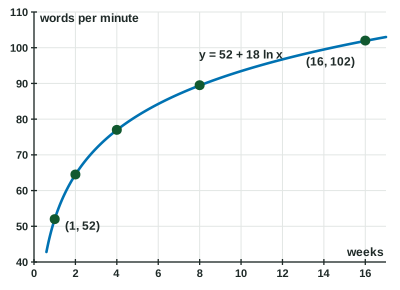
7. Reading speed is modeled by words per minute after weeks. Since , what does the model say?
- Each doubling of the number of weeks adds about words per minute
- Each week the speed rises by about words per minute, at a steady linear pace
- The reading speed doubles once each weeks, as in exponential growth
- After weeks of practice, the reading speed is about words per minute
Show the answer
- Correct: Each doubling of the number of weeks adds about words per minute: A fixed factor on the input adds a fixed amount to the output.
- Each week the speed rises by about words per minute, at a steady linear pace: A constant increase per week would be linear.
- The reading speed doubles once each weeks, as in exponential growth: Doubling outputs would be exponential.
- After weeks of practice, the reading speed is about words per minute:
.
Part 9 · Summary
Summary
Part 10 · Up next
What comes next
Part 11 · Connections