Discretionary fiscal policy needs a decision: someone has to notice the recession, agree on a plan and get the money moving. Some fiscal policy needs no decision at all. Certain taxes and transfer programs are written so that they respond to the business cycle by themselves. They are called automatic stabilizers, and they make every recession milder and every boom calmer than it would otherwise be.
The two main stabilizers
A progressive income tax. Under a progressive tax, higher slices of income are taxed at higher rates. When incomes fall in a recession, people slide down into lower-rate slices, so their tax bills fall faster than their incomes. When incomes rise in a boom, tax bills rise faster than incomes.
Unemployment compensation and other income-based transfers. Unemployment compensation pays people who lose their jobs, under rules set in advance. When unemployment rises, more people qualify and payments rise with no new vote. Food aid and other programs whose eligibility depends on income behave the same way.
How they soften the cycle
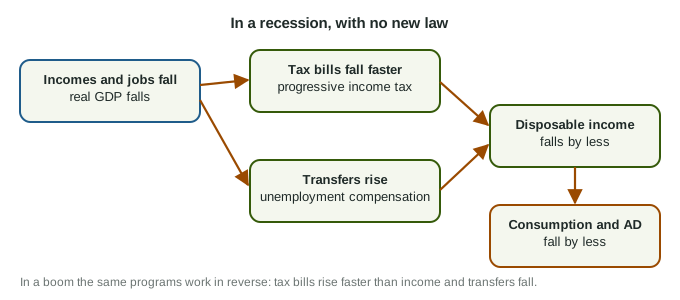
Follow the chain in the diagram, link by link. A recession lowers incomes. Taxes fall faster than income and transfers rise, so disposable income falls by less than income does. Households cut consumption by less, so AD falls by less, and real GDP and employment fall by less. In a boom the same programs work in reverse: tax bills climb faster than incomes and fewer people draw benefits, so disposable income, consumption and AD rise by less.
Worked example: a progressive tax at work. Country K taxes the first 40,000 dollars of a year's income at 10% and everything above it at 20%. A worker's income falls from 60,000 to 50,000 dollars.
- Tax at 60,000:
dollars. - Tax at 50,000:
dollars. - Compare the changes: income fell by
; the tax fell by . - After-tax income: from 52,000 to 44,000 dollars, a fall of about 15.4%, less than the 16.7% fall in income. The tax cushioned the household's spending without any new law.
Automatic against discretionary
| Automatic stabilizers | Discretionary fiscal policy | |
|---|---|---|
| Needs a new decision? | no: the rules are already in place | yes: a new law or budget choice |
| Speed | responds as soon as incomes change | waits on recognition, decision and implementation |
| Examples | progressive income tax, unemployment compensation, income-based food aid | a new road program, a one-time tax rebate, a change in tax rates |
| Effect on a gap | makes swings in AD smaller; a gap can remain | can be sized to close the gap (gap divided by the multiplier) |
Common slip: saying that automatic stabilizers bring the economy back to full employment in the long run. They do not. They make the fall in AD smaller, which keeps the gap from growing as large. The long-run return to full employment is self-adjustment: unemployment above the natural rate lowers nominal wages and input prices, and SRAS shifts right. Another slip is skipping the links: the point is earned by "taxes fall and transfers rise, so disposable income and consumption fall by less, so AD falls by less".
A tax that does not change with income, such as a fixed dollar amount per household, gives no such cushion: when incomes fall, the tax bill stays the same, so disposable income falls by the full amount. The more a tax or transfer moves with income, the stronger it works as a stabilizer.