When a government buys 100 million dollars of new roads, real GDP can rise by much more than 100 million dollars. The road crews and the firms that sell them asphalt earn that money, and they spend most of it. The people they buy from earn it and spend most of it again. This page shows how big that chain gets and how to use it to find the spending that closes an output gap.
MPC and MPS
Disposable income (DI) is what households have left after taxes. When it rises by a dollar, households spend part of the dollar and save the rest.
- The marginal propensity to consume is the share spent: .
- The marginal propensity to save is the share saved: .
- Every extra dollar is either spent or saved, so .
"Marginal" means "of the extra dollar". If disposable income rises from 1,000 to 1,100 and consumption from 900 to 980, the MPC is , not .
The spending multiplier
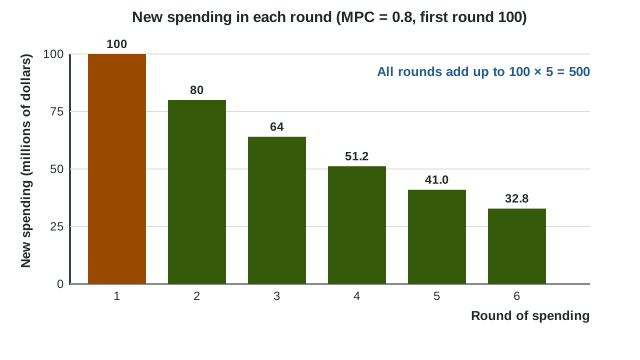
Suppose government spending rises by 100 and the MPC is 0.8. The first round adds 100 of income. Households spend 80 of it, which is income for someone else, who spends 64, then 51.2, and so on (the bar chart). The rounds add up to
The spending multiplier is . The bigger the MPC, the less leaks into saving each round, and the bigger the multiplier: an MPC of 0.5 gives 2, 0.75 gives 4, 0.8 gives 5 and 0.9 gives 10. The same multiplier applies to any new spending that starts the chain: investment, exports or consumption that rises at every price level.
The multiplier gives the change in real GDP when the price level stays the same, which is the largest change the spending can cause. If the price level rises as spending grows, part of the extra spending goes into higher prices.
The tax multiplier
A tax cut of 100 also raises disposable income by 100, but households spend only the MPC share of it, 80, at the very first round, and save 20. From then on the rounds are the same as before, so output rises by , not 500.
The tax multiplier is . It is negative because a tax rise lowers output, and it is one smaller in size than the spending multiplier: with an MPC of 0.8, the spending multiplier is 5 and the tax multiplier is .
| MPC | MPS | Spending multiplier, 1 / MPS | Tax multiplier, -MPC / MPS |
|---|---|---|---|
| 0.5 | 0.5 | 2 | -1 |
| 0.75 | 0.25 | 4 | -3 |
| 0.8 | 0.2 | 5 | -4 |
| 0.9 | 0.1 | 10 | -9 |
One consequence: if the government raises spending and taxes by the same amount, the two effects do not cancel. With an MPC of 0.8, 50 more of spending adds 250 and 50 more of taxes removes 200, so output still rises by 50. Raising both by the same amount raises output by that amount; this is called the balanced-budget multiplier, and it equals 1.
Closing a gap: direction first, then divide
Exam questions usually run the other way: they give the gap and ask for the change in spending or taxes. The multiplier turns a small change in spending into a large change in output, so you divide the gap by the multiplier.
Worked example. Real GDP is 120 billion dollars below full-employment output (a recessionary gap) and the MPC is 0.75.
- MPS: .
- Multipliers: spending ; tax .
- Direction: output is too low, so the government must add spending: raise G or cut taxes.
- Divide the gap: spending rise billion dollars; or a tax cut of billion dollars.
- Check: and . The tax cut is larger because households save a quarter of it.
Common slip: multiplying the gap by the multiplier (). That answers "what does 120 of new spending do to output?", not "what spending closes a 120 gap?". The other slips: using the spending multiplier for a tax change, and getting the direction wrong (cutting spending in a recessionary gap).
For an inflationary gap the routine is the same with the direction reversed: cut government spending or raise taxes, by the gap divided by the multiplier.