The Phillips Curve
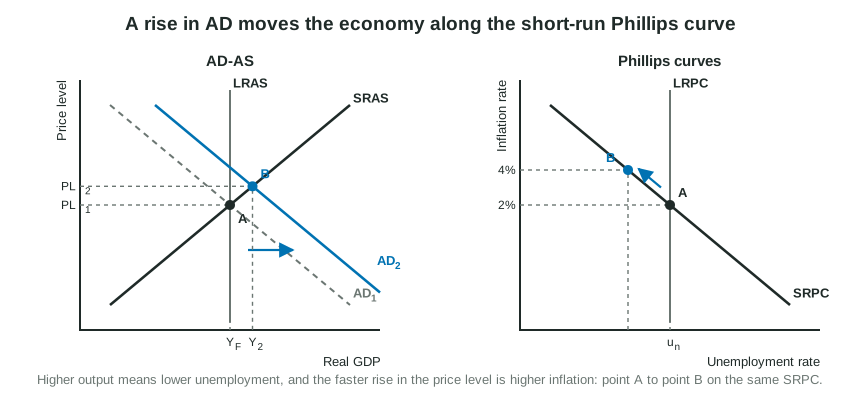
The short-run Phillips curve slopes down: changes in AD trade unemployment for inflation along it.
Part 1 · Hook
Why this matters
Part 2 · Before you start
What this builds on
Part 3 · Prerequisite check
Quick check before you start
1. AD shifts right while SRAS stays put. What happens in the short run?
- Real GDP and the price level rise
- Real GDP falls and the price level rises
- Real GDP rises and the price level falls
- Both fall
Show the answer
A rightward AD shift along an upward-sloping SRAS raises both output and the price level.
- Correct: Real GDP and the price level rise:
- Real GDP falls and the price level rises:
- Real GDP rises and the price level falls:
- Both fall:
2. What is the natural rate of unemployment made of?
- Frictional plus structural unemployment
- Cyclical unemployment alone
- Frictional plus cyclical unemployment
- Discouraged workers plus the unemployed
Show the answer
The natural rate is frictional plus structural; cyclical unemployment is zero at full employment.
- Correct: Frictional plus structural unemployment:
- Cyclical unemployment alone:
- Frictional plus cyclical unemployment:
- Discouraged workers plus the unemployed:
3. In a recessionary gap with no policy action, what moves the economy back to full employment?
- Nominal wages fall, so SRAS shifts right
- Nominal wages rise, so SRAS shifts left
- LRAS shifts left
- AD shifts right on its own
Show the answer
High unemployment pushes nominal wages and input prices down, shifting SRAS right.
- Correct: Nominal wages fall, so SRAS shifts right:
- Nominal wages rise, so SRAS shifts left:
- LRAS shifts left:
- AD shifts right on its own:
Part 4 · See it
See it first
Part 5 · Step by step
How it works, step by step
- AD shifts rightreal output rises and the price level rises faster
- Output risesunemployment falls below the natural rate
- Unemployment falls while inflation risesthe economy moves up and to the left along the SRPC
- Inflation stays above what people expectedexpected inflation rises and nominal wages rise
- Expected inflation risesthe SRPC shifts right, and unemployment returns to the natural rate at a higher inflation rate
Part 6 · Key ideas
Key ideas
- Axes: Inflation rate on the vertical axis, Unemployment rate on the horizontal one. SRPC slopes down; LRPC is vertical at the natural rate of unemployment.
- A change in AD is a movement along the SRPC: AD right means lower unemployment and higher inflation; AD left the reverse.
- The SRPC shifts when SRAS shifts or expected inflation changes. A negative supply shock or higher expected inflation shifts it right; a positive supply shock or lower expected inflation shifts it left.
- Where SRPC crosses LRPC, actual inflation equals expected inflation. LRPC matches LRAS: a change in the natural rate shifts LRPC.
Part 7 · Misconception
A common mistake
The wrong idea: A rise in AD shifts the short-run Phillips curve.
What actually happens: A rise in AD moves the economy along the SRPC, to lower unemployment and higher inflation. The SRPC itself shifts only when SRAS shifts (a supply shock) or when expected inflation changes.
Part 8 · Check yourself
Check yourself
Exam-style questions. Anything you miss goes into your review queue.
1. The economy starts where SRPC crosses LRPC. Then consumer spending rises, shifting AD right. Place point B to show where the economy moves in the short run.
Work on the graph (it needs JavaScript), then check.
Show the answer
An AD shift is a movement along the SRPC: higher output means lower unemployment, and the faster rise in prices means higher inflation, so B is up and to the left on the same SRPC.
- Key: see the explanation
2. A sharp rise in world oil prices raises production costs for firms across the economy. Shift the right curve to show the effect on the Phillips curves.
Work on the graph (it needs JavaScript), then check.
Show the answer
A negative supply shock shifts SRAS left on the AD-AS graph, which raises both inflation and unemployment: the SRPC shifts right. The natural rate is unchanged, so LRPC stays put.
- Key: the short-run Phillips curve shifts right
Data
Unemployment and inflation in Velor (invented)
| Year | Unemployment rate (%) | Inflation rate (%) |
|---|---|---|
| 1 | 5.0 | 2.0 |
| 2 | 4.0 | 3.0 |
| 3 | 5.0 | 4.0 |
| 4 | 6.5 | 6.0 |
3. Between which two years did Velor most likely move along a single short-run Phillips curve after a rise in AD?
- Year 1 to Year 2
- Year 2 to Year 3
- Year 3 to Year 4
- Year 1 to Year 3
Show the answer
Along a given SRPC, unemployment and inflation move in opposite directions. Only Year 1 to Year 2 fits.
- Correct: Year 1 to Year 2: Right: unemployment fell and inflation rose, the inverse short-run trade-off a rise in AD produces.
- Year 2 to Year 3: Both unemployment and inflation rose; a movement along one SRPC changes them in opposite directions.
- Year 3 to Year 4: Both rose again, which points to a shift of the SRPC, not a movement along it.
- Year 1 to Year 3: Unemployment is the same in both years while inflation is higher, so the economy is on a different SRPC.
4. In Year 3, unemployment is back at the natural rate, but inflation is 4 percent instead of the 2 percent of Year 1. What best explains this?
- The natural rate of unemployment fell, so LRPC shifted left and inflation rose along it
- AD fell, so the economy moved down along the SRPC toward higher inflation
- Expected inflation rose, so the SRPC shifted right and the economy returned to LRPC at a higher inflation rate
- A positive supply shock shifted the SRPC left, raising inflation
Show the answer
In the long run the economy is on LRPC at the natural rate, and inflation equals expected inflation. A higher inflation rate at the natural rate means expected inflation rose.
- The natural rate of unemployment fell, so LRPC shifted left and inflation rose along it: Unemployment is still 5 percent, the stated natural rate, so LRPC did not move.
- AD fell, so the economy moved down along the SRPC toward higher inflation: A fall in AD moves the economy down the SRPC to lower inflation and higher unemployment.
- Correct: Expected inflation rose, so the SRPC shifted right and the economy returned to LRPC at a higher inflation rate: Right: once people expect higher inflation, the SRPC crosses LRPC at that higher rate, so unemployment returns to 5 percent with inflation at 4 percent.
- A positive supply shock shifted the SRPC left, raising inflation: A leftward SRPC shift lowers inflation at each unemployment rate.
5. From Year 3 to Year 4, both unemployment and inflation rose. Which event fits that change?
- A rise in government spending on roads that shifted AD right
- A sharp rise in energy prices that shifted SRAS left
- A fall in consumer confidence that shifted AD left
- A fall in the natural rate of unemployment
Show the answer
When inflation and unemployment rise together, the SRPC has shifted right; a negative supply shock is the usual cause.
- A rise in government spending on roads that shifted AD right: More AD lowers unemployment while it raises inflation.
- Correct: A sharp rise in energy prices that shifted SRAS left: Right: a negative supply shock raises the price level and lowers output, so inflation and unemployment rise together.
- A fall in consumer confidence that shifted AD left: Less AD lowers inflation while it raises unemployment.
- A fall in the natural rate of unemployment: A lower natural rate would let unemployment fall, not rise, in the long run.
6. Select every event that shifts the short-run Phillips curve to the right.
- A rise in expected inflation
- A rise in the price of oil used across the economy
- A rise in government spending
- A fall in consumer spending
Show the answer
Supply shocks and changes in expected inflation shift the SRPC; changes in AD move the economy along it.
- Correct: A rise in expected inflation: Right: higher expected inflation raises inflation at each unemployment rate.
- Correct: A rise in the price of oil used across the economy: Right: a negative supply shock shifts SRAS left and the SRPC right.
- A rise in government spending: That shifts AD right: a movement along the SRPC, not a shift.
- A fall in consumer spending: That shifts AD left: a movement down the SRPC.
Part 9 · Summary
Summary
Part 10 · Up next
What comes next
Part 11 · Connections