Money Growth and Inflation
The quantity theory says M x V = P x Y.
Part 1 · Hook
Why this matters
Part 2 · Before you start
What this builds on
Part 3 · Prerequisite check
Quick check before you start
1. Real GDP measures output at which prices?
- Base-year prices, so it changes only when output changes
- This year's prices
- Prices adjusted for the money supply
- The prices of imports
Show the answer
Real GDP values output at constant (base-year) prices; nominal GDP uses current prices.
- Correct: Base-year prices, so it changes only when output changes:
- This year's prices:
- Prices adjusted for the money supply:
- The prices of imports:
2. In the limited-reserves framework, the central bank buys bonds. What happens on the money market graph?
- The money supply shifts right and the nominal interest rate falls
- Money demand shifts right and the nominal rate rises
- The money supply shifts left and the nominal rate rises
- Nothing: the graph shows only money demand
Show the answer
Buying bonds adds reserves and money, so the vertical money supply curve shifts right.
- Correct: The money supply shifts right and the nominal interest rate falls:
- Money demand shifts right and the nominal rate rises:
- The money supply shifts left and the nominal rate rises:
- Nothing: the graph shows only money demand:
Part 4 · See it
See it first
Part 5 · Step by step
How it works, step by step
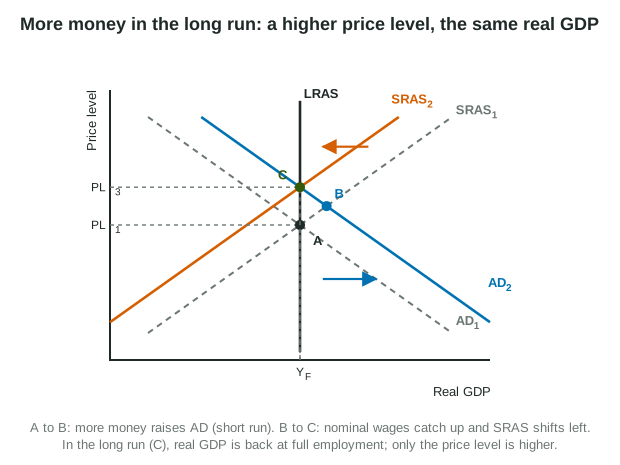
- The money supply grows faster than real outputnominal spending, M x V, grows faster than output
- Nominal spending grows fasterAD shifts right
- Output above full employment pushes nominal wages upSRAS shifts left until output returns to full employment
- Real output ends where it startedthe price level is higher: faster money growth means higher inflation
Part 6 · Key ideas
Key ideas
- The equation of exchange: . M is the money supply, V velocity, P the price level and Y real output, so is nominal GDP.
- Velocity is how often the average dollar is spent on final goods and services in a year: .
- In the long run, V is steady and Y is set by resources and technology, so P moves with M. In growth rates: inflation money growth + velocity growth - real output growth.
- Money neutrality: in the long run money changes nominal variables (the price level, nominal GDP, nominal wages and interest rates), not real GDP or unemployment. In the short run, sticky wages let money change output.
Part 7 · Misconception
A common mistake
The wrong idea: Printing more money makes a country richer in the long run.
What actually happens: Real output depends on resources and technology. Extra money with no extra output raises the price level, so each dollar buys less; real GDP ends where it started.
Part 8 · Check yourself
Check yourself
Exam-style questions. Anything you miss goes into your review queue.
Data
Money, velocity and real GDP in Kelvar (invented)
| Year | Money supply (billions of dollars) | Velocity | Real GDP (billions of base-year dollars) |
|---|---|---|---|
| 1 | 500 | 4 | 2,000 |
| 2 | 550 | 4 | 2,000 |
1. Use . What is Kelvar's nominal GDP in Year 1, in billions of dollars?
Type a number. A four-function calculator is allowed, as on the exam.
Show the answer
Nominal GDP is
- Answer: 2000
2. What is Kelvar's price level in Year 2? Give it as a number, where 1.0 means the base-year price level.
Type a number. A four-function calculator is allowed, as on the exam.
Show the answer
- Answer: 1.1
3. In the table, the money supply grows 10 percent while velocity and real GDP stay the same. Which statement fits the quantity theory?
- Real GDP rises 10 percent, and the price level is unchanged
- The price level rises by the same 10 percent, and real output is unchanged
- Velocity falls 10 percent, so nothing else changes
- The price level falls 10 percent, since each dollar can now buy more output
Show the answer
If and are fixed, means moves in proportion to .
- Real GDP rises 10 percent, and the price level is unchanged: The table shows real GDP unchanged; with V fixed, the extra money shows up in P.
- Correct: The price level rises by the same 10 percent, and real output is unchanged: Right: with V and Y fixed, P must rise in proportion to M so that both sides of the equation stay equal.
- Velocity falls 10 percent, so nothing else changes: The table holds velocity at 4 in both years.
- The price level falls 10 percent, since each dollar can now buy more output: More money chasing the same output raises prices; each dollar buys less.
4. An economy starts at full employment. The central bank increases the money supply once, and over time nominal wages adjust. Shift both curves that move and mark the new long-run equilibrium.
Work on the graph (it needs JavaScript), then check.
Show the answer
More money lowers interest rates and raises spending, so AD shifts right. Output above full employment pushes nominal wages up, so SRAS shifts left. The economy ends at full-employment output with a higher price level.
- Key: aggregate demand shifts right; short-run aggregate supply shifts left
5. A central bank permanently raises the money supply. Which of these changes in the long run?
- Real GDP
- The natural rate of unemployment
- The real interest rate
- The price level
Show the answer
The long-run neutrality of money: money changes nominal variables, not real ones.
- Real GDP: Real GDP returns to full-employment output, which depends on resources and technology.
- The natural rate of unemployment: The natural rate depends on frictional and structural unemployment, not on the amount of money.
- The real interest rate: In the long run the real interest rate is set by saving and investment, not by the money supply.
- Correct: The price level: Right: in the long run the extra money raises the price level and other nominal values.
6. Velocity rises because people start paying with cards and spend money faster. If the money supply and real GDP stay the same, what happens to the price level?
- It rises, because M x V is now larger while Y is unchanged
- It falls, because money is spent faster and so is worth more
- It stays the same, because the money supply did not change
- It rises by exactly the rise in the money supply
Show the answer
Both M and V feed nominal spending: with Y fixed, a rise in either raises the price level.
- Correct: It rises, because M x V is now larger while Y is unchanged: Right: P = (M x V) / Y, so a larger V raises P.
- It falls, because money is spent faster and so is worth more: Faster spending of the same money raises nominal spending, which raises prices.
- It stays the same, because the money supply did not change: The price level depends on M x V, not on M alone.
- It rises by exactly the rise in the money supply: The money supply did not change; the rise comes from velocity.
Part 9 · Summary
Summary
Part 10 · Up next
What comes next
Part 11 · Connections