Government Deficits and the National Debt
A budget deficit is one year's excess of government outlays over tax revenue; a surplus is the reverse.
Part 1 · Hook
Why this matters
Part 2 · Before you start
What this builds on
Part 3 · Prerequisite check
Quick check before you start
1. Which is an example of contractionary fiscal policy?
- Raising income taxes
- Cutting income taxes
- Raising government spending
- Lowering the policy rate
Show the answer
Higher taxes lower disposable income and consumption, shifting AD left.
- Correct: Raising income taxes:
- Cutting income taxes:
- Raising government spending:
- Lowering the policy rate:
2. How do automatic stabilizers act in a recession?
- Tax revenue falls and transfer payments rise with no new law
- Tax rates rise automatically to balance the budget
- The central bank lowers its policy rate
- Government spending falls automatically
Show the answer
Progressive taxes collect less and benefits such as unemployment compensation pay out more as incomes fall.
- Correct: Tax revenue falls and transfer payments rise with no new law:
- Tax rates rise automatically to balance the budget:
- The central bank lowers its policy rate:
- Government spending falls automatically:
Part 4 · See it
See it first
Part 5 · Step by step
How it works, step by step
Part 6 · Key ideas
Key ideas
- Budget balance = tax revenue - outlays. Negative is a deficit, positive a surplus, zero a balanced budget. Outlays include spending, transfer payments and interest on the debt.
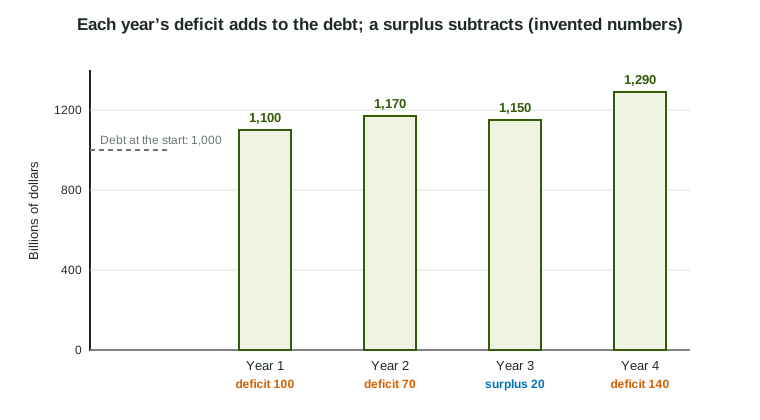
- The national debt is the total owed: past deficits minus past surpluses. A deficit is a flow over one year; the debt is a stock at a point in time.
- A smaller deficit still raises the debt. Only a surplus lowers it.
- Expansionary fiscal policy and recessions (through automatic stabilizers) widen deficits; contractionary policy and expansions shrink them.
Part 7 · Misconception
A common mistake
The wrong idea: When the deficit falls, the national debt falls.
What actually happens: The debt falls only when the government runs a surplus. A smaller deficit means the debt grows more slowly, because the government is still borrowing.
Part 8 · Check yourself
Check yourself
Exam-style questions. Anything you miss goes into your review queue.
1. What is a government's budget deficit?
- The total amount the government owes from past borrowing
- The amount by which its outlays exceed its tax revenue in one year
- The amount by which imports exceed exports in one year
- The amount by which the government's tax revenue exceeds its outlays in one year
Show the answer
Deficit = outlays - tax revenue, measured over one year. The debt is the running total.
- The total amount the government owes from past borrowing: That is the national debt, a stock built up from past deficits.
- Correct: The amount by which its outlays exceed its tax revenue in one year: Right: a deficit is a yearly flow, outlays (spending, transfers and interest) minus revenue.
- The amount by which imports exceed exports in one year: That is a trade gap between a country and the rest of the world, not the government budget.
- The amount by which the government's tax revenue exceeds its outlays in one year: Revenue above outlays is a budget surplus.
Data
The budget of Brenna (invented), billions of dollars
| Year | Tax revenue | Government outlays |
|---|---|---|
| 1 | 760 | 850 |
| 2 | 800 | 860 |
| 3 | 880 | 850 |
| 4 | 790 | 920 |
2. What is Brenna's budget balance in Year 2, in billions of dollars? Use a negative number for a deficit.
Type a number. A four-function calculator is allowed, as on the exam.
Show the answer
Budget balance revenue outlays : a deficit of 60 billion dollars.
- Answer: -60
3. How much does Brenna owe at the end of Year 3, in billions of dollars?
Type a number. A four-function calculator is allowed, as on the exam.
Show the answer
Deficits of 90 and 60 add to the debt and the surplus of 30 reduces it:
- Answer: 1320
4. In which year did Brenna's national debt fall?
- Year 2
- Year 4
- Year 3
- Year 1
Show the answer
The debt falls only in a year with a surplus.
- Year 2: The deficit was smaller than in Year 1, but a smaller deficit still adds to the debt.
- Year 4: Year 4 has the largest deficit, 130, so the debt rose the most.
- Correct: Year 3: Right: revenue (880) exceeded outlays (850), a surplus of 30 that pays down the debt.
- Year 1: Outlays exceeded revenue by 90, so the debt rose.
Scenario
A headline in Tarvia (invented country)
Last year the government of Tarvia, an invented country, ran a budget deficit of 80 billion dollars. This year its deficit is 50 billion dollars. A news headline reads: "Tarvia cuts its debt."
5. How does Tarvia's government pay for its 50 billion dollar deficit?
- It borrows, by selling government bonds
- It raises the reserve requirement for banks
- It cuts transfer payments by 50 billion dollars
- It records the deficit as an export to other countries
Show the answer
Deficits are financed by borrowing; the bonds sold are the debt.
- Correct: It borrows, by selling government bonds: Right: a government covers a deficit by borrowing from households, firms, banks and foreign lenders.
- It raises the reserve requirement for banks: A reserve requirement is a central bank tool; it does not raise money for the government budget.
- It cuts transfer payments by 50 billion dollars: That would shrink the deficit, but it is a policy choice, not how an existing deficit is paid for.
- It records the deficit as an export to other countries: A budget deficit is about the government's own revenue and outlays.
6. Which statement correctly compares a budget deficit with the national debt?
- A deficit is a flow over one year; the debt is a stock, the total owed at a point in time
- A deficit is the total owed; the debt is the amount borrowed this year
- A deficit is owed to foreigners; the debt is owed to citizens
- A deficit is measured in percent; the debt in dollars
Show the answer
Deficit or surplus: one year's budget gap (a flow). Debt: the accumulated total (a stock).
- Correct: A deficit is a flow over one year; the debt is a stock, the total owed at a point in time: Right: each year's deficit flows into the debt, like water into a tub.
- A deficit is the total owed; the debt is the amount borrowed this year: That reverses the two terms.
- A deficit is owed to foreigners; the debt is owed to citizens: Both deficits and debt can be financed at home or abroad; that is not the difference.
- A deficit is measured in percent; the debt in dollars: Both can be measured in dollars or as a percent of GDP.
Part 9 · Summary
Summary
Part 10 · Up next
What comes next
Part 11 · Connections