Hardy-Weinberg Equilibrium
Hardy-Weinberg equilibrium describes a population that is not evolving: its allele and genotype frequencies stay the same from generation to generation.
Part 1 · Hook
Why this matters
In 1908 the geneticist Reginald Punnett asked the mathematician G. H. Hardy a puzzling question: if short fingers are caused by a dominant allele, why don't short fingers spread until nearly everyone has them? Hardy answered on one page, and the German doctor Wilhelm Weinberg reached the same answer that year. Being dominant changes what an allele looks like, not how often it is passed on. Without some force acting on it, an allele's frequency stays put, generation after generation. That stillness is the yardstick biologists use to detect evolution.
Part 2 · Before you start
What this builds on
Part 3 · Prerequisite check
Quick check before you start
1. A population of 100 mice has 36 AA, 48 Aa and 16 aa. What is the frequency of allele a?
- 0.40
- 0.16
- 0.64
Show the answer
Copies of a = (2 × 16) + 48 = 80, out of 200 copies: 80 ÷ 200 = 0.40.
- Correct: 0.40:
- 0.16:
- 0.64:
2. The probability of two independent events both happening is found by
- multiplying their probabilities (product rule)
- adding their probabilities
- subtracting the smaller from the larger
Show the answer
For example, the chance that a sperm and an egg both carry a is q × q = q².
- Correct: multiplying their probabilities (product rule):
- adding their probabilities:
- subtracting the smaller from the larger:
3. Which process changes allele frequencies at random, most strongly in small populations?
- Genetic drift
- Natural selection
- Random mating
Show the answer
Drift is chance change in allele frequencies; its effect grows as the breeding population shrinks.
- Correct: Genetic drift:
- Natural selection:
- Random mating:
Part 4 · See it
See it first
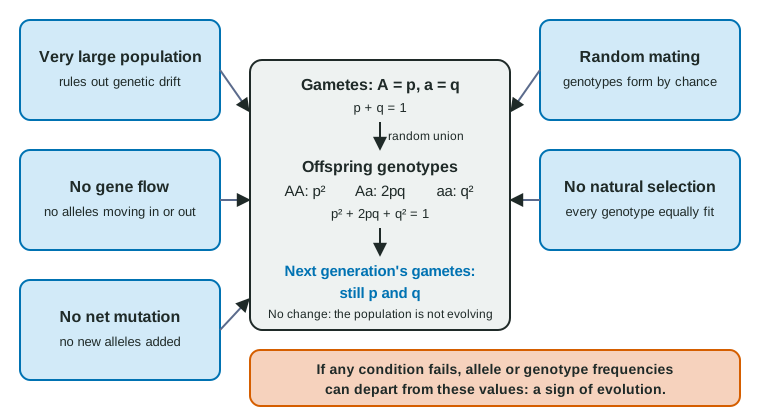
Part 5 · Step by step
How it works, step by step
- In a large population that mates at random, the next generation forms as if gametes were drawn at random from one big pool, in which a fraction p carry A and a fraction q carry a.The chance that a zygote gets two A gametes is p × p, two a gametes q × q, and one of each 2pq (A from the egg and a from the sperm, or the reverse).
- These probabilities set the genotype frequencies.AA = p², Aa = 2pq, aa = q², and p² + 2pq + q² = (p + q)² = 1.
- Those offspring make gametes: AA individuals give A, aa give a, Aa give half of each.The new gamete pool has A at p² + pq = p and a at q: allele frequencies are unchanged, whatever the dominance. This is Hardy-Weinberg equilibrium.
- Drift, gene flow, mutation, selection or nonrandom mating acts on the population.Allele frequencies, genotype frequencies or both move away from the equilibrium values.
- Observed genotype counts are compared with the counts expected from p², 2pq and q².A difference too large for chance shows that at least one condition is not met, and the kind of difference hints at which one.
Part 6 · Key ideas
Key ideas
- Hardy-Weinberg equilibrium: allele and genotype frequencies stay constant across generations in a population that is not evolving. It is the null model for evolution.
- p + q = 1 for alleles; p² + 2pq + q² = 1 for genotypes (AA, Aa, aa). Only q² can be read straight from phenotypes when a is recessive.
- Five Hardy-Weinberg conditions: very large population, no gene flow, no net mutation, random mating, no natural selection.
- A deviation from Hardy-Weinberg means a condition fails. Too few heterozygotes suggests inbreeding or self-fertilization; frequencies shifting over generations suggest selection, drift or gene flow.
- Dominance does not make an allele more common. Selection against a rare recessive allele is slow, because most of its copies are hidden in heterozygotes.
Part 7 · Misconception
A common mistake
The wrong idea: A dominant allele becomes more common over generations, and recessive alleles slowly disappear.
What actually happens: Dominance affects which phenotype a heterozygote shows, not how often each allele is passed on. Without drift, selection, gene flow or mutation, a dominant allele at 0.1 stays at 0.1. Many dominant alleles, such as the one for extra fingers, are rare.
Part 8 · Check yourself
Check yourself
Exam-style questions. Anything you miss goes into your review queue.
Data table
Genotype counts in three plant populations
A wildflower species has a gene with two codominant alleles, A and a, so every genotype can be identified from the plants' flower-pigment pattern. Researchers counted 500 flowering adults in each of three populations. Population X grows in a large meadow and is pollinated by bees. Population Y grows on a cliff where bees are rare, and most of its seeds come from flowers that pollinated themselves. Population Z grows on soil where, in seedling surveys, AA and aa seedlings were seen to die more often than Aa seedlings.
| Population | AA | Aa | aa |
|---|---|---|---|
| X | 318 | 164 | 18 |
| Y | 300 | 40 | 160 |
| Z | 150 | 300 | 50 |
1. Calculate p, the frequency of allele A, in population Y. Give your answer to two decimal places.
Type a number.
Show the answer
Copies of A = (2 × 300) + 40 = 640, out of 2 × 500 = 1,000 copies. p = 640 ÷ 1,000 = 0.64, so q = 0.36.
- Answer: 0.64
2. If population Y were in Hardy-Weinberg equilibrium with the allele frequencies it has, how many of its 500 plants would be expected to be Aa? Give a whole number.
Type a number in plants.
Show the answer
p = 0.64, q = 0.36. Expected Aa = 2pq × 500 = 2 × 0.64 × 0.36 × 500 = 230.4, about 230 plants. Only 40 were observed.
- Answer: 230 plants
3. Which explanation best accounts for the genotype counts in population Y?
- Selfing pairs like alleles, so homozygotes rise and heterozygotes fall while p and q stay the same.
- Natural selection against heterozygotes removes Aa plants, which lowers the frequency of allele a in each generation.
- Gene flow from bee-pollinated populations brings in extra AA and aa plants, so the cliff plants become homozygous.
- The small cliff population has nearly lost allele a by genetic drift, so few of its plants can be heterozygous.
Show the answer
Self-fertilization is extreme nonrandom mating. Each selfing halves the share of heterozygotes among the offspring, so homozygotes pile up while p and q stay the same.
- Correct: Selfing pairs like alleles, so homozygotes rise and heterozygotes fall while p and q stay the same.: Correct: the deficit of heterozygotes matches the mating system described.
- Natural selection against heterozygotes removes Aa plants, which lowers the frequency of allele a in each generation.: The stimulus describes self-pollination, not selection; nothing shows that Aa plants die more often.
- Gene flow from bee-pollinated populations brings in extra AA and aa plants, so the cliff plants become homozygous.: Bees are rare on the cliff, so pollen from bee-pollinated populations is unlikely to arrive; gene flow would not raise homozygosity anyway.
- The small cliff population has nearly lost allele a by genetic drift, so few of its plants can be heterozygous.: Allele a is not lost: q = 0.36, which would give about 230 heterozygotes under random mating.
Graph
Frequency of a recessive allele in four laboratory populations
Researchers founded four populations of flour beetles from one stock in which the frequency (q) of a recessive allele, a, was 0.50. Beetles with genotype aa have a reddish body; AA and Aa beetles look the same. Each population was treated differently for 20 generations. Population 1: 2,000 breeding adults, nothing else done. Population 2: 2,000 breeding adults, but every reddish (aa) beetle was removed before it could breed. Population 3: 2,000 breeding adults, but each generation 10% of the breeders were replaced by beetles from a stock in which q = 0.10. Population 4: 10 breeding adults chosen at random each generation.
Population 1Population 2Population 3Population 4
Data table
| Generation | Population 1 | Population 2 | Population 3 | Population 4 |
|---|---|---|---|---|
| 0 | 0.5 | 0.5 | 0.5 | 0.5 |
| 2 | 0.5 | 0.25 | 0.42 | 0.6 |
| 4 | 0.49 | 0.17 | 0.36 | 0.75 |
| 6 | 0.5 | 0.13 | 0.31 | 0.75 |
| 8 | 0.51 | 0.1 | 0.27 | 0.65 |
| 10 | 0.5 | 0.08 | 0.24 | 0.5 |
| 12 | 0.5 | 0.07 | 0.21 | 0.8 |
| 14 | 0.49 | 0.06 | 0.19 | 0.55 |
| 16 | 0.5 | 0.06 | 0.17 | 0.4 |
| 18 | 0.51 | 0.05 | 0.16 | 0.45 |
| 20 | 0.5 | 0.05 | 0.15 | 0.45 |
4. In population 2, q fell by 0.25 in the first two generations but by less than 0.05 in the last ten. Which explanation best accounts for the slowdown?
- As q falls, nearly all a alleles sit in Aa beetles, which look normal and are not removed.
- The beetles adapted to the removal of aa beetles by producing fewer aa offspring each generation.
- The researchers removed fewer reddish beetles in later generations because there were more beetles overall.
- Mutation from A to a speeds up when q is low, adding back the a alleles removed by selection.
Show the answer
Only aa beetles are removed, and they make up q² of the population. At q = 0.5, a quarter of beetles are aa; at q = 0.1, only 1 in 100, while 18 in 100 are hidden Aa carriers. Selection can barely reach the allele.
- Correct: As q falls, nearly all a alleles sit in Aa beetles, which look normal and are not removed.: Correct: selection against a recessive phenotype weakens as the allele becomes rare.
- The beetles adapted to the removal of aa beetles by producing fewer aa offspring each generation.: The share of aa offspring falls because q falls, not because beetles adapt to the procedure.
- The researchers removed fewer reddish beetles in later generations because there were more beetles overall.: Every reddish beetle was removed in every generation; there are simply very few of them when q is low.
- Mutation from A to a speeds up when q is low, adding back the a alleles removed by selection.: Mutation rates are far too low to offset selection like this, and they do not depend on q.
5. In population 2 at generation 8, q = 0.10, and the newly formed offspring are in Hardy-Weinberg proportions. What percentage of the a alleles in these offspring are carried by heterozygotes? Give a whole number.
Type a number in %.
Show the answer
Aa = 2pq = 2 × 0.9 × 0.1 = 0.18, carrying one a each: 0.18 copies per beetle. aa = q² = 0.01, carrying two each: 0.02. Share in heterozygotes = 0.18 ÷ (0.18 + 0.02) × 100 = 90%.
- Answer: 90 %
6. In a population assumed to be in Hardy-Weinberg equilibrium, 9% of individuals show a recessive trait. What percentage of the population is expected to be homozygous dominant? Give a whole number.
Type a number in %.
Show the answer
q² = 0.09, so q = 0.3 and p = 0.7. Homozygous dominant = p² = 0.49, or 49%. (Heterozygotes are 2pq = 42%.)
- Answer: 49 %
7. A student predicts that because allele B for brown fur is dominant, its frequency in a large, randomly mating mouse population with no selection will rise each generation until most mice are brown. Which response is correct?
- Dominance sets which phenotype heterozygotes show; with no force acting, B's frequency stays constant.
- The student is right, because heterozygotes look brown and so pass on the B allele more often than b.
- The student is right, provided the starting frequency of B in the population is greater than 0.5.
- The frequency of B will fall, because recessive alleles are hidden from selection in heterozygotes.
Show the answer
Heterozygotes pass B and b to equal shares of their gametes, whatever they look like. Without drift, selection, gene flow, mutation or nonrandom mating, p and q stay the same in every generation.
- Correct: Dominance sets which phenotype heterozygotes show; with no force acting, B's frequency stays constant.: Correct: this was Hardy's point in 1908.
- The student is right, because heterozygotes look brown and so pass on the B allele more often than b.: A heterozygote's appearance does not change which alleles go into its gametes: half carry B, half b.
- The student is right, provided the starting frequency of B in the population is greater than 0.5.: The starting frequency does not matter; with no force acting, any frequency stays put.
- The frequency of B will fall, because recessive alleles are hidden from selection in heterozygotes.: The stem says there is no selection, so hiding from selection has no effect here; the frequency stays constant.
8. A large plant population is in Hardy-Weinberg equilibrium with q = 0.2. A change in its pollinators makes the plants start fertilizing themselves, with no selection, drift, gene flow or mutation. Predict the change in each of these over the next few generations.
| Variable | Change |
|---|---|
| Frequency of allele a (q) | — |
| Proportion of heterozygous (Aa) plants | — |
| Proportion of aa plants | — |
Show the answer
Nonrandom mating changes genotype frequencies but not allele frequencies: the population departs from p², 2pq, q² without its gene pool changing.
- Frequency of allele a (q): no change. Self-fertilization pairs alleles differently but each plant still passes on its own alleles in the same proportions, so q stays 0.2.
- Proportion of heterozygous (Aa) plants: decreases. A selfed Aa plant gives only half Aa offspring; AA and aa plants give only homozygotes, so heterozygotes fall each generation.
- Proportion of aa plants: increases. Selfed Aa plants produce aa offspring a quarter of the time and aa plants produce only aa, so aa rises above q² = 0.04.
Part 9 · Summary
Summary
Hardy-Weinberg equilibrium describes a population that is not evolving: its allele and genotype frequencies stay the same from generation to generation. For a gene with alleles at frequencies p and q, p + q = 1, and random union of gametes gives genotype frequencies p² (AA), 2pq (Aa) and q² (aa), which add to 1; the gametes those offspring make carry the alleles at p and q again, whatever the dominance. Equilibrium requires a very large population, no gene flow, no net mutation, random mating and no natural selection. Because real populations rarely meet every condition, the equations serve as a null hypothesis: when observed frequencies differ from the expected ones by more than chance, at least one condition fails, and the pattern of the difference points to the cause.
Part 10 · Up next
What comes next
Part 11 · Connections