Hardy-Weinberg calculations
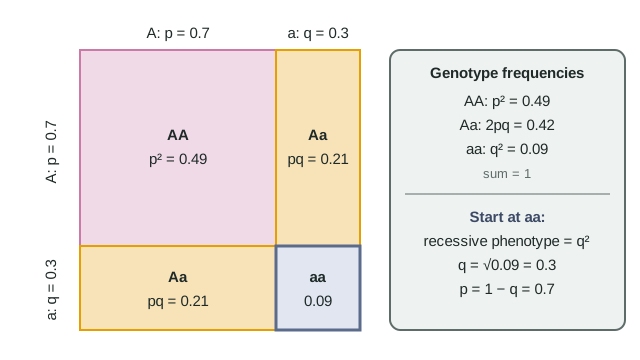
For a population in Hardy-Weinberg equilibrium, the recessive phenotype frequency is q², so q = √(recessive frequency) and p = 1 − q.
Part 1 · Hook
Why this matters
A meadow has 364 purple flowers and 36 white ones. How many of the purple plants secretly carry a white allele? You cannot tell by looking, but if the population is in Hardy-Weinberg equilibrium, two short equations on the formula sheet tell you: 168. The same arithmetic estimates how many people carry the allele for a recessive disorder.
Part 2 · Before you start
What this builds on
Part 3 · Prerequisite check
Quick check before you start
1. In p² + 2pq + q² = 1, what does 2pq stand for?
- The frequency of heterozygotes
- The frequency of the dominant allele
- The frequency of homozygous recessive individuals
Show the answer
p² is homozygous dominant, 2pq heterozygous and q² homozygous recessive.
- Correct: The frequency of heterozygotes:
- The frequency of the dominant allele:
- The frequency of homozygous recessive individuals:
2. Which condition is NOT required for Hardy-Weinberg equilibrium?
- A small population
- Random mating
- No natural selection
Show the answer
Equilibrium needs a very large population (no drift), random mating, no selection, no mutation and no gene flow.
- Correct: A small population:
- Random mating:
- No natural selection:
3. A chi-square value greater than the critical value means you…
- reject the null hypothesis
- fail to reject the null hypothesis
- accept the null hypothesis
Show the answer
A large χ² means the observed counts are too far from expected for chance.
- Correct: reject the null hypothesis:
- fail to reject the null hypothesis:
- accept the null hypothesis:
Part 4 · See it
See it first
Part 5 · Step by step
How it works, step by step
- Only the recessive phenotype has a single genotype (aa).Its frequency equals q² at equilibrium: 36 white of 400 gives q² = 0.09.
- Taking the square root undoes the squaring.q = √0.09 = 0.30, and since p + q = 1, p = 0.70.
- Random union of alleles gives genotypes in proportions p², 2pq and q².Heterozygotes are 2pq = 0.42 of the population: 168 of 400 plants.
- If you know all genotype counts, you can count alleles directly and calculate expected counts.A chi-square test compares observed and expected genotypes and shows whether the population departs from equilibrium.
- Allele frequencies measured at two times differ.The change in p or q is evidence that something (selection, drift, gene flow) is acting on the population.
Part 6 · Key ideas
Key ideas
- Worked example. 36 white of 400 plants. q² = 36 ÷ 400 = 0.09; q = 0.30; p = 0.70. Expected AA = 0.49 × 400 = 196; Aa = 0.42 × 400 = 168; aa = 36.
- Never take the dominant phenotype frequency as p: purple plants (0.91) are AA plus Aa. Always start from the recessive class.
- With genotype counts, count alleles: p = (2 × AA + Aa) ÷ (2 × total). Then expected counts are p²N, 2pqN and q²N.
- Rare recessive alleles hide in carriers: at q = 0.02, carriers (2pq ≈ 0.039) outnumber affected people (q² = 0.0004) about 98 to 1.
Part 7 · Misconception
A common mistake
The wrong idea: The frequency of the dominant allele is the fraction of the population showing the dominant phenotype.
What actually happens: Dominant-phenotype individuals include heterozygotes, so their fraction is p² + 2pq, not p. Find q from the recessive class first (q² = recessive frequency), then p = 1 − q.
Part 8 · Check yourself
Check yourself
Exam-style questions. Anything you miss goes into your review queue.
Data table
Flower color in a meadow
In a large, randomly mating population of a wildflower, purple (allele A) is completely dominant to white (allele a). A survey of 400 plants found the following. Assume the population is in Hardy-Weinberg equilibrium for this gene.
| Phenotype | Number of plants |
|---|---|
| Purple | 364 |
| White | 36 |
| Total | 400 |
1. Calculate q, the frequency of the white allele (a). Give your answer to two decimal places.
Type a number.
Show the answer
White plants are aa, so q² = 36 ÷ 400 = 0.09. q = √0.09 = 0.30.
- Answer: 0.30
2. How many of the 400 plants are expected to be heterozygous (Aa)? Give a whole number.
Type a number in plants.
Show the answer
p = 1 − 0.30 = 0.70. 2pq = 2 × 0.70 × 0.30 = 0.42. 0.42 × 400 = 168 plants.
- Answer: 168 plants
3. A student says p = 364 ÷ 400 = 0.91. What is wrong with this?
- 364 ÷ 400 is the frequency of purple plants, which includes both AA and Aa genotypes, not the frequency of the A allele.
- Nothing is wrong: the dominant allele frequency equals the fraction of plants that show the dominant phenotype.
- The student should have divided by 800, because each plant carries two copies of the gene for flower color.
- The student should have used 36 ÷ 364, comparing white plants with purple plants rather than with the total.
Show the answer
Purple plants are AA (p²) plus Aa (2pq): 0.49 + 0.42 = 0.91. The allele frequency p is 0.70. Start from the recessive class, the one phenotype with a single genotype.
- Correct: 364 ÷ 400 is the frequency of purple plants, which includes both AA and Aa genotypes, not the frequency of the A allele.: Correct.
- Nothing is wrong: the dominant allele frequency equals the fraction of plants that show the dominant phenotype.: Phenotype frequency (0.91) is not allele frequency (0.70) for a dominant trait.
- The student should have divided by 800, because each plant carries two copies of the gene for flower color.: Counting alleles needs genotype counts; purple plants' genotypes are unknown, so dividing phenotypes by 800 does not work.
- The student should have used 36 ÷ 364, comparing white plants with purple plants rather than with the total.: A ratio of white to purple is not a frequency of anything in the formula.
Data table
Genotypes in a small island population
Researchers genotyped 100 lizards on a small island for a gene with two alleles, B and b. Critical values of χ²: at p = 0.05, df 1 = 3.84, df 2 = 5.99.
| Genotype | BB | Bb | bb | Total |
|---|---|---|---|---|
| Number of lizards | 50 | 30 | 20 | 100 |
4. Calculate p, the frequency of allele B, from the genotype counts. Give your answer to two decimal places.
Type a number.
Show the answer
Count alleles: 100 lizards carry 200 alleles. B alleles = 2 × 50 (BB) + 30 (Bb) = 130. p = 130 ÷ 200 = 0.65.
- Answer: 0.65
5. How many Bb lizards are expected under Hardy-Weinberg equilibrium? Give your answer to one decimal place.
Type a number in lizards.
Show the answer
p = 0.65, q = 0.35. 2pq = 2 × 0.65 × 0.35 = 0.455. 0.455 × 100 = 45.5 lizards.
- Answer: 45.5 lizards
6. Expected counts are BB 42.25, Bb 45.5, bb 12.25. Calculate χ² to two decimal places.
Type a number.
Show the answer
BB: (50 − 42.25)² ÷ 42.25 = 1.42. Bb: (30 − 45.5)² ÷ 45.5 = 5.28. bb: (20 − 12.25)² ÷ 12.25 = 4.90. χ² = 11.60.
- Answer: 11.60
7. The chi-square value exceeds the critical value. Which conclusion and explanation fit the data best?
- Reject Hardy-Weinberg equilibrium: there are fewer heterozygotes than expected, which fits inbreeding in a small island population.
- Fail to reject equilibrium: the allele frequencies of 0.65 and 0.35 add up to 1, which shows the population is stable.
- Reject equilibrium: there are more heterozygotes than expected, which fits lizards choosing mates unlike themselves.
- Reject equilibrium: the population has too few individuals for any Hardy-Weinberg test to be carried out with confidence on an island.
Show the answer
Observed Bb (30) is far below expected (45.5), while both homozygotes are above expected. Mating between relatives in a small population raises homozygosity, which matches this pattern.
- Correct: Reject Hardy-Weinberg equilibrium: there are fewer heterozygotes than expected, which fits inbreeding in a small island population.: Correct: reject, with a mechanism matched to the pattern.
- Fail to reject equilibrium: the allele frequencies of 0.65 and 0.35 add up to 1, which shows the population is stable.: p + q = 1 by definition in any population; it says nothing about equilibrium.
- Reject equilibrium: there are more heterozygotes than expected, which fits lizards choosing mates unlike themselves.: There are fewer heterozygotes than expected, not more.
- Reject equilibrium: the population has too few individuals for any Hardy-Weinberg test to be carried out with confidence on an island.: A sample of 100 is enough for the test; the problem is the poor fit.
Part 9 · Summary
Summary
For a population in Hardy-Weinberg equilibrium, the recessive phenotype frequency is q², so q = √(recessive frequency) and p = 1 − q. Genotype frequencies are p², 2pq and q², and 2pq is the carrier frequency. With full genotype counts, count alleles to get p and use a chi-square test to check whether the population fits equilibrium. A change in allele frequency between generations is evidence of evolution.
Part 10 · Up next
What comes next
Part 11 · Connections