Regulation of Gene Expression
Cells control which genes are transcribed and how much, using regulatory sequences in the DNA and the proteins that bind them.
Part 1 · Hook
Why this matters
An E. coli cell carries genes for digesting lactose, but in a gut with plenty of glucose it barely uses them. Give it lactose and no glucose, and within minutes it is making the lactose-digesting enzymes a thousand times faster. Making proteins costs a lot of energy, and a cell that makes only what its surroundings call for grows faster than one that makes everything all the time. Your cells face the same problem with far more genes, and they solve it with switches built from DNA and protein.
Part 2 · Before you start
What this builds on
Part 3 · Prerequisite check
Quick check before you start
1. Where does RNA polymerase bind to start copying a gene?
- The promoter
- The terminator
- The first intron
Show the answer
The promoter, just before the gene, positions RNA polymerase at the start site.
- Correct: The promoter:
- The terminator:
- The first intron:
2. An allosteric regulator changes an enzyme's activity by
- binding a site other than the active site and changing the protein's shape
- becoming part of the substrate
- breaking the enzyme's peptide bonds
Show the answer
Binding at an allosteric site changes shape and activity; repressors are switched the same way.
- Correct: binding a site other than the active site and changing the protein's shape:
- becoming part of the substrate:
- breaking the enzyme's peptide bonds:
3. Tightly packed heterochromatin
- is mostly silent, because gene-reading proteins cannot reach its DNA
- has no genes at all
- is found only in prokaryotes
Show the answer
Packing controls access; heterochromatin has genes, but they are rarely read.
- Correct: is mostly silent, because gene-reading proteins cannot reach its DNA:
- has no genes at all:
- is found only in prokaryotes:
Part 4 · See it
See it first
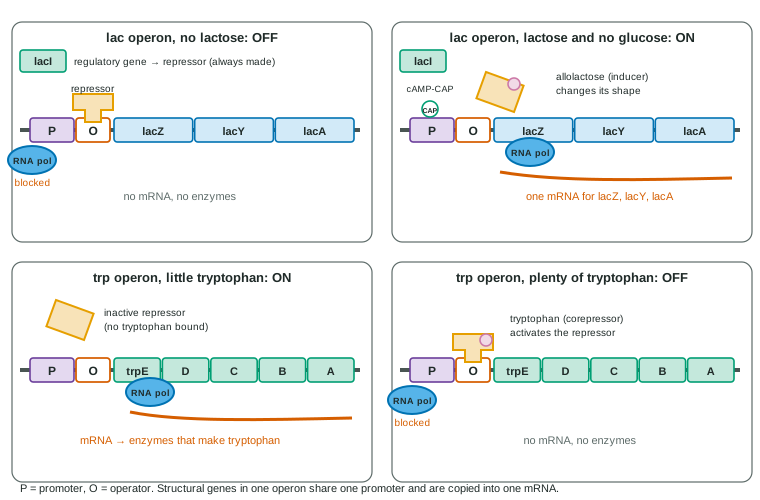
Part 5 · Step by step
How it works, step by step
- In bacteria, genes for one job sit together in an operon, after one promoter and an operator.They are copied into one mRNA and switched on or off together.
- With no lactose, the lac repressor binds the operator.RNA polymerase is blocked, so the lactose-digesting enzymes are not made.
- When lactose arrives, allolactose (the inducer) binds the repressor and changes its shape.The repressor leaves the operator, and the genes are transcribed; if glucose is scarce, cAMP-CAP boosts transcription further.
- When tryptophan is plentiful, it binds the trp repressor as a corepressor and activates it.The active repressor binds the trp operator and switches off the genes for making tryptophan.
- In eukaryotes, transcription factors bind the promoter and distant enhancers, and the DNA loops to bring them together.RNA polymerase is recruited, and the combination of factors in a cell sets how much each gene is transcribed.
- Acetyl groups on histones loosen chromatin, while methyl groups on DNA tighten it.Genes become easier or harder to transcribe, and these epigenetic marks can be passed to daughter cells without changing the DNA sequence.
Part 6 · Key ideas
Key ideas
- Regulatory sequences (promoters, operators, enhancers) are DNA that proteins bind; regulatory proteins (repressors, activators, transcription factors) decide whether and how much a gene is transcribed.
- An operon: promoter + operator + structural genes. Inducible (lac): usually off, an inducer inactivates the repressor. Repressible (trp): usually on, a corepressor activates it.
- Negative regulation: a bound repressor lowers transcription. Positive regulation: a bound activator, such as cAMP-CAP, raises it.
- Constitutive (housekeeping) genes are on all the time; inducible genes are switched on when needed.
- Epigenetics: DNA methylation silences; histone acetylation opens chromatin. Marks can be inherited through divisions. Gene products (proteins and RNAs) set the phenotype.
Part 7 · Misconception
A common mistake
The wrong idea: Lactose turns the lac operon on by binding to the DNA and attracting RNA polymerase.
What actually happens: The inducer binds the repressor, not the DNA. It changes the repressor's shape so the repressor lets go of the operator; RNA polymerase can then copy the genes, helped by cAMP-CAP when glucose is low.
Part 8 · Check yourself
Check yourself
Exam-style questions. Anything you miss goes into your review queue.
Data table
Enzyme activity in bacteria grown with different sugars
β-galactosidase is the enzyme that splits lactose into glucose and galactose. Its gene sits in an operon whose repressor is released from the DNA when lactose is present. Wild-type E. coli were grown in media with different carbon sources (glycerol is a food that does not affect this operon). The researchers measured β-galactosidase activity, the activity of an enzyme of glycolysis, and the cAMP level inside the cells. In the last medium, cAMP was added to the broth. Values are means of four cultures.
| Medium | β-galactosidase activity | Glycolysis enzyme activity | cAMP inside cells (%) |
|---|---|---|---|
| Glycerol | 3 | 510 | 100 |
| Glycerol + lactose | 1,020 | 495 | 100 |
| Glucose | 2 | 530 | 18 |
| Glucose + lactose | 55 | 505 | 18 |
| Glucose + lactose + added cAMP | 780 | 515 | 92 |
1. Which statement best describes the effect of lactose on β-galactosidase activity?
- Lactose raises it several hundredfold with glycerol, but far less when glucose is present.
- Lactose raises it by the same amount whether or not glucose is present in the medium.
- Lactose raises it a little with glycerol, but several hundredfold when glucose is present.
- Lactose has little effect on it; the type of sugar the cells grow on matters more.
Show the answer
With glycerol, adding lactose takes activity from 3 to 1,020 units. With glucose, it goes only from 2 to 55.
- Correct: Lactose raises it several hundredfold with glycerol, but far less when glucose is present.: Correct: strong induction without glucose, weak with it.
- Lactose raises it by the same amount whether or not glucose is present in the medium.: The increase is about 1,000 units without glucose but about 50 with it.
- Lactose raises it a little with glycerol, but several hundredfold when glucose is present.: This reverses the two media.
- Lactose has little effect on it; the type of sugar the cells grow on matters more.: Activity rises from 3 to 1,020 when lactose is added to glycerol medium, a large effect.
2. Which explanation for the low activity in glucose + lactose is best supported by all the data, including the last row?
- Glucose keeps cAMP low, so CAP does not boost transcription even with the repressor off.
- Glucose binds the repressor in place of lactose and holds it tightly on the operator.
- Glucose denatures β-galactosidase after it is made, so less of the enzyme is active.
- Glucose lowers the number of copies of the β-galactosidase gene in each bacterial cell.
Show the answer
cAMP is 18% with glucose, and adding cAMP restores activity to 780 units in the presence of glucose. cAMP-CAP is an activator that helps RNA polymerase bind the promoter; without it, removing the repressor gives only weak transcription.
- Correct: Glucose keeps cAMP low, so CAP does not boost transcription even with the repressor off.: Correct: low cAMP explains the glucose effect, and adding cAMP reverses it.
- Glucose binds the repressor in place of lactose and holds it tightly on the operator.: If glucose held the repressor on, adding cAMP would not restore activity to 780.
- Glucose denatures β-galactosidase after it is made, so less of the enzyme is active.: The glycolysis enzyme is unaffected, and adding cAMP restores activity, so the enzyme is not being destroyed.
- Glucose lowers the number of copies of the β-galactosidase gene in each bacterial cell.: Gene copies do not change with the food; adding cAMP restores activity with the same cells.
3. Which claim about the glycolysis enzyme's gene is best supported?
- It is expressed at a steady level in every medium, as a constitutive gene is.
- It is induced by lactose, but more weakly than the β-galactosidase gene is.
- It is switched off by glucose, the way the β-galactosidase gene is.
- It belongs to the same operon as β-galactosidase and shares its promoter.
Show the answer
Its activity stays between 495 and 530 units in all five media. Genes whose products every cell needs all the time, like this glycolysis enzyme, are constitutive (housekeeping) genes.
- Correct: It is expressed at a steady level in every medium, as a constitutive gene is.: Correct: no change with any sugar or with cAMP.
- It is induced by lactose, but more weakly than the β-galactosidase gene is.: Its activity does not rise with lactose (510 vs 495).
- It is switched off by glucose, the way the β-galactosidase gene is.: Its activity does not fall with glucose (530).
- It belongs to the same operon as β-galactosidase and shares its promoter.: Genes in one operon rise and fall together; this enzyme does not follow β-galactosidase.
Data table
Testing a DNA region that controls a liver gene
The DNA in front of a liver gene was joined to a reporter gene whose protein glows, so glow measures how actively the reporter is transcribed. Researchers made five versions (constructs) and put each into cultured liver cells and kidney cells. Region E lies about 2,000 base pairs before the promoter in the normal gene. Activity is the mean of three dishes, as a percentage of construct 1 in liver cells.
| Construct | DNA in front of the reporter | Liver cells | Kidney cells |
|---|---|---|---|
| 1 | Region E, 2,000 bp of spacer, promoter | 100 | 3 |
| 2 | Promoter only (region E removed) | 4 | 3 |
| 3 | Region E turned end to end, spacer, promoter | 96 | 3 |
| 4 | Promoter; region E placed 3,000 bp after the reporter instead | 88 | 2 |
| 5 | Region E and spacer, no promoter | 0.5 | 0.4 |
4. What does comparing constructs 1 and 2 in liver cells show?
- Region E is needed for high transcription of the reporter in liver cells.
- Region E is the promoter, where RNA polymerase binds to start transcription.
- Region E lowers transcription, acting as a silencer in liver cells.
- The reporter gene is transcribed equally well with or without region E.
Show the answer
Removing region E drops activity from 100% to 4%: region E greatly increases transcription, as an enhancer does.
- Correct: Region E is needed for high transcription of the reporter in liver cells.: Correct: without region E, activity is 4%.
- Region E is the promoter, where RNA polymerase binds to start transcription.: Construct 5 has region E but no promoter and is almost silent, so region E is not the promoter.
- Region E lowers transcription, acting as a silencer in liver cells.: A silencer would raise activity when removed; activity fell instead.
- The reporter gene is transcribed equally well with or without region E.: Activity drops 25-fold without region E.
5. Region E works when turned end to end (construct 3) and when placed after the gene (construct 4). Which explanation fits?
- Proteins bound to region E reach the promoter because the DNA between them bends into a loop.
- RNA polymerase starts copying at region E and continues through the spacer into the reporter.
- Region E codes for an activator protein, so its position on the DNA does not matter.
- Region E is copied into the reporter mRNA, where it makes the mRNA more stable.
Show the answer
Activator transcription factors bind the enhancer; the DNA loops so they contact the proteins at the promoter and help RNA polymerase start. Looping works from either side and in either orientation.
- Correct: Proteins bound to region E reach the promoter because the DNA between them bends into a loop.: Correct: looping brings distant enhancers to the promoter.
- RNA polymerase starts copying at region E and continues through the spacer into the reporter.: Construct 4 places region E after the gene, where copying from it could not pass through the reporter's start.
- Region E codes for an activator protein, so its position on the DNA does not matter.: If region E made a protein, turning it end to end would wreck its coding sequence; it is a binding site, not a gene.
- Region E is copied into the reporter mRNA, where it makes the mRNA more stable.: In construct 1, region E lies 2,000 bp before the promoter and is not transcribed into the reporter mRNA.
6. Construct 1 gives 100% in liver cells but 3% in kidney cells. Which explanation is best?
- Liver cells contain a transcription factor that binds region E; kidney cells lack it.
- Kidney cells do not contain region E in the DNA of their own chromosomes.
- Kidney cells are unable to make the reporter's glowing protein, whatever DNA it is joined to.
- Region E is methylated in the construct when it enters kidney cells but not liver cells.
Show the answer
The same DNA was put into both cell types. An enhancer works only where the activator that binds it is present, so the difference lies in which transcription factors each cell type makes.
- Correct: Liver cells contain a transcription factor that binds region E; kidney cells lack it.: Correct: same DNA, different proteins available to read it.
- Kidney cells do not contain region E in the DNA of their own chromosomes.: The construct carries its own region E, so the kidney cells had it.
- Kidney cells are unable to make the reporter's glowing protein, whatever DNA it is joined to.: Kidney cells give 2-3% with every construct with a promoter, so they can make some reporter; what they lack is the boost from region E.
- Region E is methylated in the construct when it enters kidney cells but not liver cells.: Nothing in the data points to methylation; the simplest difference is the activator.
7. A different mutation changes the lac repressor so that it binds the operator normally but can no longer bind allolactose. Predict the strain's β-galactosidase when it is grown with lactose and no glucose.
- Very low, because the inducer cannot remove the repressor from the operator
- High, because the repressor is no longer affected by any sugar in the medium
- High, because cAMP-CAP can override a repressor that is bound to the operator
- Very low, because the mutant repressor now binds the promoter instead of the operator
Show the answer
Induction depends on allolactose binding the repressor and changing its shape. A repressor that ignores the inducer stays on the operator, so the operon stays off even with lactose.
- Correct: Very low, because the inducer cannot remove the repressor from the operator: Correct: the operon cannot be induced.
- High, because the repressor is no longer affected by any sugar in the medium: Ignoring the inducer means it stays bound, so the operon stays off, not on.
- High, because cAMP-CAP can override a repressor that is bound to the operator: CAP increases transcription only when the operator is free; it cannot push past a bound repressor.
- Very low, because the mutant repressor now binds the promoter instead of the operator: The stem says the repressor binds the operator normally.
8. In most mammals, the lactase gene is switched off after weaning. Many adult humans keep making lactase and can digest milk. In one common form, the lactase protein is identical, and the DNA difference lies about 14,000 base pairs before the gene. Which explanation is best?
- A change in a regulatory sequence keeps the gene transcribed in adults; more lactase sets the phenotype.
- A change in the lactase gene's exons makes a more active enzyme, one that digests milk faster in adults.
- Drinking milk as a child induces the lactase gene permanently, the way lactose induces an operon.
- The extra DNA is a second copy of the lactase gene, one that adults transcribe but children do not.
Show the answer
The protein is unchanged, and the difference lies far from the gene, in a regulatory region (an enhancer). It changes when and how much the gene is transcribed, and the amount of gene product decides whether the person can digest lactose.
- Correct: A change in a regulatory sequence keeps the gene transcribed in adults; more lactase sets the phenotype.: Correct: regulation, not the protein, differs.
- A change in the lactase gene's exons makes a more active enzyme, one that digests milk faster in adults.: The stem says the protein is identical, so the coding sequence is not the difference.
- Drinking milk as a child induces the lactase gene permanently, the way lactose induces an operon.: Lactase persistence is inherited through a DNA difference; it is not caused by childhood milk drinking.
- The extra DNA is a second copy of the lactase gene, one that adults transcribe but children do not.: The difference is a change in a regulatory sequence, not an extra copy of the gene.
Part 9 · Summary
Summary
Cells control which genes are transcribed and how much, using regulatory sequences in the DNA and the proteins that bind them. In bacteria, related genes are grouped in operons with one promoter and an operator. The lac operon is inducible: its repressor blocks the operator until allolactose, the inducer, binds the repressor and releases it; cAMP-CAP, an activator, boosts transcription when glucose is scarce. The trp operon is repressible: tryptophan, the corepressor, activates the repressor and switches the operon off. Repressors give negative regulation, activators positive regulation. Constitutive genes are always on; inducible genes are switched on when needed. In eukaryotes, transcription factors bind promoters and enhancers, and DNA looping brings them together. DNA methylation and histone acetylation change how open chromatin is; these epigenetic marks can be inherited without a sequence change. Gene products determine the phenotype.
Part 10 · Up next
What comes next
Part 11 · Connections