Hormones and how they act
1Why this matters
A man stung by a bee collapses with a severe allergic reaction. The paramedic injects epinephrine, and within two minutes his blood pressure rises and his wheezing eases. At the hospital he also gets a steroid, a drug whose effects take hours to appear. Both drugs copy hormones. Why does one act in minutes and the other in hours?
2What this builds on
3Quick check before you start
1. Which messenger can cross the plasma membrane by diffusing through the phospholipid bilayer?
- A peptide made of amino acids
- A steroid made from cholesterol
- A charged ion such as sodium
Show the answer
The core of the bilayer is hydrophobic. Lipid-soluble molecules such as steroids diffuse through it; peptides and ions are hydrophilic and cannot.
- A peptide made of amino acids:
- Correct: A steroid made from cholesterol:
- A charged ion such as sodium:
2. What is a second messenger?
- A hormone released by a second gland
- A molecule made inside a cell that carries a signal onward from a membrane receptor protein
- A neurotransmitter that crosses a second synapse
Show the answer
A second messenger such as cAMP is made inside the target cell after the first messenger binds a receptor protein in the membrane. It carries the signal to the cell's machinery.
- A hormone released by a second gland:
- Correct: A molecule made inside a cell that carries a signal onward from a membrane receptor protein:
- A neurotransmitter that crosses a second synapse:
3. How does an endocrine gland differ from an exocrine gland?
- It releases its product into the blood, with no duct
- It releases its product through a duct onto a surface
- It is made of nervous tissue rather than epithelium
Show the answer
Endocrine glands are ductless: their hormones pass into the fluid around the cells and then into the blood. Exocrine glands release their products through ducts.
- Correct: It releases its product into the blood, with no duct:
- It releases its product through a duct onto a surface:
- It is made of nervous tissue rather than epithelium:
4Anatomy
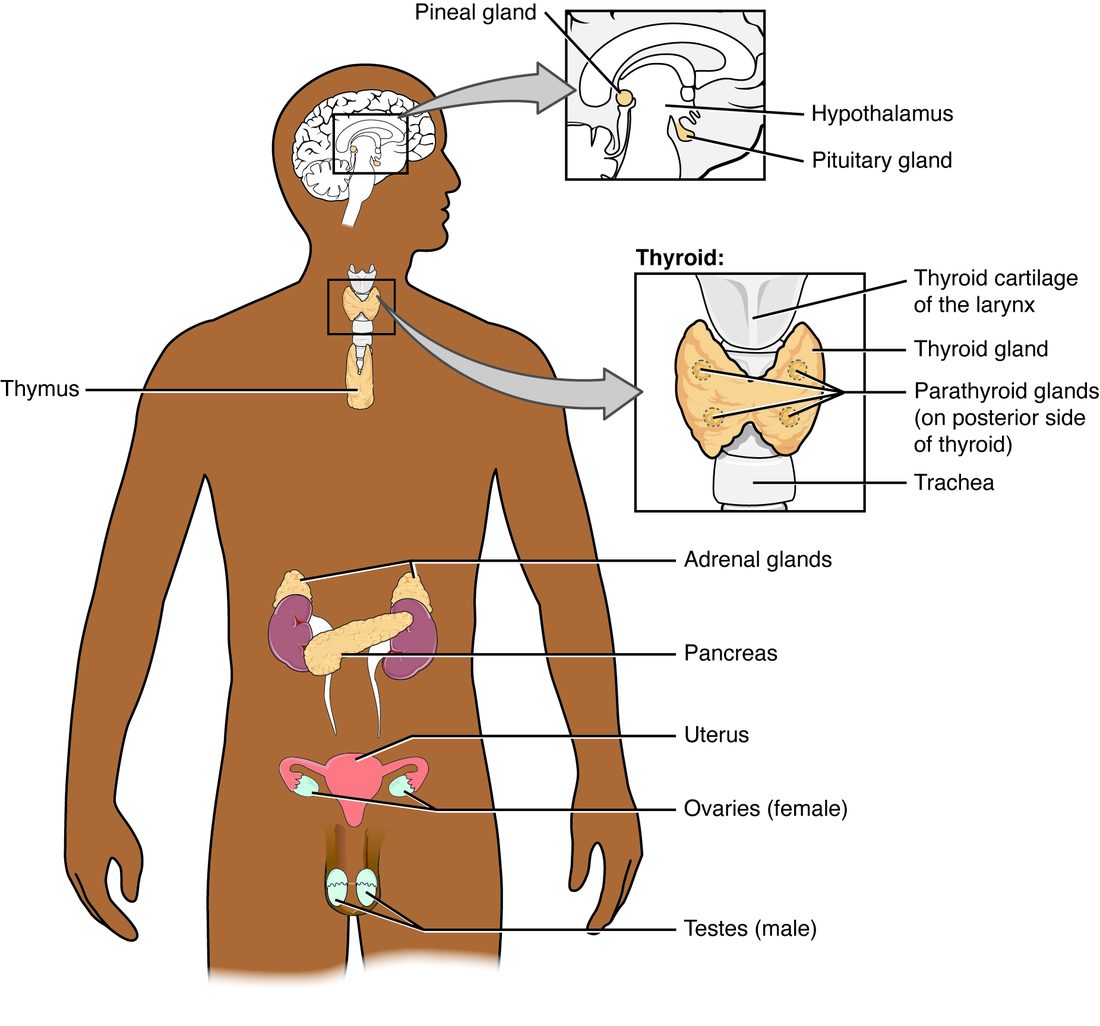
With labels hidden, select a box to reveal its label.
5How it works, step by step
- A water-soluble hormone such as epinephrine binds its receptor protein in the target cell's plasma membrane.The receptor protein changes shape and switches on a G protein on the inside of the membrane.
- The active G protein switches on adenylyl cyclase.Adenylyl cyclase converts ATP into cAMP, the second messenger.
- cAMP binds protein kinase A.Protein kinase A phosphorylates target proteins, and some of those are kinases that phosphorylate more proteins: a phosphorylation cascade that amplifies the signal.
- The phosphorylated enzymes and channels change their activity.The cell's behavior changes within seconds, for example a liver cell releases glucose.
- Phosphodiesterase breaks down cAMP and phosphatases remove the added phosphates once the hormone leaves.The response ends within minutes.
6Core concepts
7A common mistake
The wrong idea: Hormones enter their target cells to act.
What actually happens: Only lipid-soluble hormones (steroids and the thyroid gland's amines) enter cells to act; steroids diffuse through the bilayer, and the thyroid gland's amines cross on transporter proteins. Water-soluble hormones, which include all peptide and protein hormones and epinephrine, do not need to enter: they bind a receptor protein in the plasma membrane, and second messengers carry the signal inside. That difference is why water-soluble hormones act in seconds to minutes and lipid-soluble ones in hours.
8Check yourself
Anything you miss goes into your review queue.
1. A man with a severe allergic reaction gets injected epinephrine and a steroid drug at the same time. His breathing improves within minutes, but the steroid's effect only appears hours later. What best explains the difference?
- The steroid is injected more deeply and absorbed into the blood more slowly
- Epinephrine changes existing proteins via a second messenger; the steroid must change transcription
- The steroid is cleared from the blood much faster, so less of it reaches the target cells
- Epinephrine enters its target cells directly, while the steroid must wait for a carrier protein to let it in
Show the answer
Epinephrine is water-soluble. It binds membrane receptor proteins, and G proteins and cAMP switch on kinases that change proteins the cell already has, within seconds. The steroid is lipid-soluble. It works through an intracellular receptor protein that changes transcription, and making new mRNA and protein takes hours.
- The steroid is injected more deeply and absorbed into the blood more slowly: Both drugs reach the blood quickly; the delay is inside the target cells, not in absorption.
- Correct: Epinephrine changes existing proteins via a second messenger; the steroid must change transcription: Correct. Changing existing proteins is fast; making new ones is slow.
- The steroid is cleared from the blood much faster, so less of it reaches the target cells: Steroids have long half-lives because carrier proteins protect them. Fast clearance is a feature of water-soluble hormones such as epinephrine.
- Epinephrine enters its target cells directly, while the steroid must wait for a carrier protein to let it in: Epinephrine does not enter its target cells; it binds a receptor protein on the surface. The steroid crosses the membrane by itself once it leaves its carrier protein.
2. A hormone has a half-life of 20 minutes. Its blood level is 120 units when the gland stops secreting. What is the level after 1 hour, assuming no more is released?
- 40 units
- 60 units
- 15 units
- 30 units
Show the answer
One hour is 60 ÷ 20 = 3 half-lives. 120 → 60 → 30 → 15 units. The fraction left is (1/2)³ = 1/8, and 120 × 1/8 = 15.
- 40 units: 40 units comes from dividing by 3, the number of half-lives. Each half-life halves the level instead.
- 60 units: 60 units is the level after one half-life (20 minutes), not after three.
- Correct: 15 units: Correct. Three halvings: 120, 60, 30, 15.
- 30 units: 30 units is the level after two half-lives (40 minutes).
3. Put the steps in order to show how a water-soluble hormone changes a target cell's activity through cAMP.
- The hormone binds a receptor protein in the plasma membrane
- The receptor protein switches on a G protein
- The G protein switches on adenylyl cyclase
- Adenylyl cyclase converts ATP into cAMP
- cAMP switches on protein kinase A
- Protein kinase A phosphorylates target proteins, changing their activity
Show the answer
The first messenger never enters the cell. Its receptor protein activates a G protein, which activates adenylyl cyclase. Adenylyl cyclase makes cAMP from ATP, cAMP activates protein kinase A, and the kinase phosphorylates target proteins, which changes the cell's behavior.
- Correct order: 1. The hormone binds a receptor protein in the plasma membrane 2. The receptor protein switches on a G protein 3. The G protein switches on adenylyl cyclase 4. Adenylyl cyclase converts ATP into cAMP 5. cAMP switches on protein kinase A 6. Protein kinase A phosphorylates target proteins, changing their activity
4. A drug blocks phosphodiesterase in a target cell. The hormone that raises cAMP in that cell is at its normal level. Predict the change in each variable.
| Variable | Change |
|---|---|
| cAMP in the cell | — |
| Protein kinase A activity | — |
| Phosphorylated target proteins | — |
| Hormone bound to membrane receptor proteins | — |
Show the answer
Phosphodiesterase is one of the switches that end the cAMP signal. Blocking it makes the same hormone signal stronger and longer, without any change at the membrane.
- cAMP in the cell: up. cAMP is still made by adenylyl cyclase, but phosphodiesterase can no longer break it down, so it builds up.
- Protein kinase A activity: up. More cAMP is available to bind and switch on protein kinase A.
- Phosphorylated target proteins: up. A more active kinase phosphorylates more of its target proteins.
- Hormone bound to membrane receptor proteins: no change. The drug acts inside the cell. Binding depends on the hormone level and the number of receptor protein molecules, which have not changed.
5. When blood calcium falls, four small glands on the back of the thyroid gland release a hormone that raises it. Which kind of stimulus is this?
- A neural stimulus
- A hormonal stimulus
- A permissive stimulus
- A humoral stimulus
Show the answer
A humoral stimulus is a change in the level of an ion or nutrient in the blood acting directly on the gland. Here the calcium level itself triggers release.
- A neural stimulus: A neural stimulus is a nerve signal to the gland, such as sympathetic fibers triggering the adrenal medulla. No nerve is involved here.
- A hormonal stimulus: A hormonal stimulus is another hormone triggering release. Here the trigger is calcium, an ion, not a hormone.
- A permissive stimulus: Permissive describes how two hormones interact at a target cell, not what triggers a gland to secrete.
- Correct: A humoral stimulus: Correct. A blood ion level acting on the gland is a humoral stimulus.
6. In an experiment, hormone X alone has no effect on fat cells. Hormone Y alone makes them release a little stored fat. With both present, they release a great deal. Which interaction does hormone X show?
- Antagonistic
- Permissive
- Negative feedback
- Down-regulation
Show the answer
Hormone X has no effect of its own but lets hormone Y act fully. That is a permissive effect, often caused by X raising the number of Y's receptor proteins or the machinery behind them.
- Antagonistic: Antagonistic hormones push a variable in opposite directions. Here X does not oppose Y; it helps it.
- Correct: Permissive: Correct. X is needed for Y's full effect but does nothing alone.
- Negative feedback: Negative feedback is a loop that reduces a gland's output when a variable overshoots. It does not describe two hormones acting on one target.
- Down-regulation: Down-regulation would make the cells less responsive, not more.
7. Select every hormone that travels in the blood mostly bound to carrier proteins.
- Epinephrine from the adrenal medulla
- A steroid hormone from the outer part of the adrenal gland
- An androgen from the testes
- A short peptide hormone
- The thyroid gland's iodine-carrying amine hormones
Show the answer
Lipid-soluble hormones travel mostly bound to carrier proteins: steroids, including androgens, and the thyroid gland's amines. Water-soluble hormones such as epinephrine and peptides dissolve in the plasma.
- Epinephrine from the adrenal medulla: Epinephrine is water-soluble and dissolves in the plasma, which is one reason its half-life is only about two minutes.
- Correct: A steroid hormone from the outer part of the adrenal gland: Correct. Steroids are lipid-soluble and ride on carrier proteins.
- Correct: An androgen from the testes: Correct. Androgens are steroids, so they travel bound to carrier proteins.
- A short peptide hormone: Peptides are water-soluble and travel dissolved in the plasma.
- Correct: The thyroid gland's iodine-carrying amine hormones: Correct. These amines are unusually hydrophobic and travel almost entirely bound.
9Summary
The endocrine system is every hormone-secreting gland and cell in the body, linked only by the blood. Hormones come in four chemical classes: amines, peptides, proteins and steroids. What matters most is solubility. Water-soluble hormones (peptides, proteins, epinephrine and norepinephrine) travel free in the plasma, have short half-lives, and bind receptor proteins in the plasma membrane; G proteins, adenylyl cyclase, cAMP and protein kinase A (or IP3, DAG and calcium) change existing proteins within seconds, and phosphodiesterase ends the signal. Lipid-soluble hormones (steroids and the thyroid gland's amines) ride on carrier proteins, last hours, cross the membrane, and their hormone–receptor complexes bind hormone response elements to change transcription, so responses take hours and last days. Only free hormone acts. Glands release hormones in response to humoral, hormonal or neural stimuli, and negative feedback stops the release. Hormones interact permissively, synergistically or antagonistically.