Parameters of Random Variables
The mean of a discrete random variable weights each value by its probability: μ_X = ∑ x_ip_i .
Part 1 · Hook
Why this matters
Part 2 · Before you start
What this builds on
Part 3 · Prerequisite check
Quick check before you start
1. The mean of the data 2, 4, 9 is
- 5
- 4
- 15
- 9
Show the answer
.
- Correct: 5:
- 4:
- 15:
- 9:
2. For X with , , , what is ?
- 0.5
- 0.3
- 0.2
- 0.8
Show the answer
.
- Correct: 0.5:
- 0.3:
- 0.2:
- 0.8:
Part 4 · See it
See it first
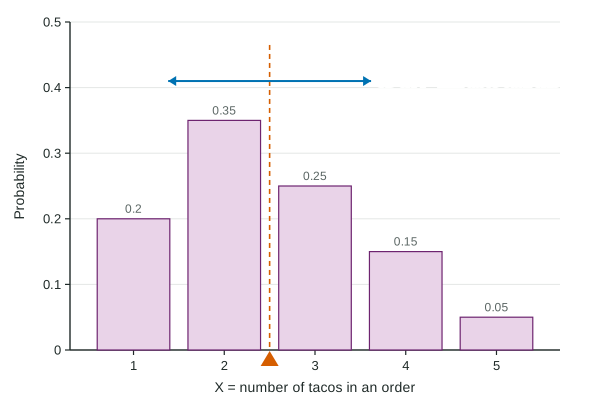
Part 5 · Step by step
How it works, step by step
- Some values of X are more likely than othersa plain average of the values is wrong; each value must count by its probability
- Multiply each value by its probability and addthe mean (expected value) , the long-run average
- Weight the squared distances from the mean the same waythe variance; its square root is the standard deviation
- Interpret both in contextthe mean is the average over many repetitions; the SD is how far values typically land from it
Part 6 · Key ideas
Key ideas
- The mean or expected value of a discrete random variable is : each value times its probability, added up. It is the long-run average and need not be a possible value.
- The standard deviation is
: a typical distance of the values from the mean, in the units of X. - Show the expression, the substitution and the answer:
. - Interpret in context: "Over many orders, the average number of tacos per order is about 2.5."
Part 7 · Misconception
A common mistake
The wrong idea: The mean of X is the average of its possible values:
What actually happens: Each value counts by its probability. Small orders are more likely, so tacos.
Part 8 · Check yourself
Check yourself
Exam-style questions. Anything you miss goes into your review queue.
Table
Tacos per order at a food truck
| 1 | 2 | 3 | 4 | 5 | |
|---|---|---|---|---|---|
| 0.20 | 0.35 | 0.25 | 0.15 | 0.05 |
1. What is the mean (expected value) of X?
- 3 tacos
- 2 tacos
- 2.5 tacos
- 0.2 tacos
Show the answer
- 3 tacos: That averages 1 to 5 without the probabilities.
- 2 tacos: That is the most likely value, not the mean.
- Correct: 2.5 tacos: Right: each value weighted by its probability.
- 0.2 tacos: That averages the probabilities, which always gives 1 divided by the number of values.
2. What is the standard deviation of X, to two decimal places?
- 1.25 tacos
- 1.58 tacos
- 0.25 tacos
- 1.12 tacos
Show the answer
- 1.25 tacos: That is the variance. Take its square root.
- 1.58 tacos: That treats 1 to 5 as a data set with no probabilities.
- 0.25 tacos: That is the squared deviation of 2 or 3 from the mean, not the whole sum.
- Correct: 1.12 tacos: Right: the square root of the weighted squared deviations, 1.25.
3. Which is the best interpretation of the mean of X in context?
- Over many orders, the average number of tacos per order is about 2.5
- Most orders contain 2.5 tacos, the most common order size
- Half of the orders have more than 2.5 tacos and half have fewer
- The next order will contain about 2 or 3 tacos
Show the answer
An expected value is a long-run average: over many randomly chosen orders, the average number of tacos per order is about 2.5.
- Correct: Over many orders, the average number of tacos per order is about 2.5: Right: a long-run average over many orders.
- Most orders contain 2.5 tacos, the most common order size: No order contains 2.5 tacos; the most common is 2.
- Half of the orders have more than 2.5 tacos and half have fewer: That would describe a median; here 55% of orders have fewer than 2.5.
- The next order will contain about 2 or 3 tacos: The mean does not predict one order; it describes the long run.
Table
A fundraiser game
| (dollars) | 8 | 3 | −2 |
|---|---|---|---|
| 0.10 | 0.15 | 0.75 |
4. Write the expression for the expected value of W.
Type the expression as on the exam, with the values substituted.
Show the answer
- Answer:
5. The expected value of W is −$0.25. Build an interpretation in context.
Write the conclusion in context.
Show the answer
An expected value is a long-run average. A negative mean net gain means players lose money on average, which is how the school raises money.
- A full-credit answer: If many people play the game, players lose an average of about $0.25 per play, so in the long run the school raises about 25 cents for each play.
6. For a randomly chosen family in a town, the expected number of children is 1.8. A student says this is impossible, since no family has 1.8 children. How should you respond?
- The student is right: it should be rounded to 2 children
- The expected value is probably a mistake, since it is not a whole number of children
- It is an average over many families, so it need not be a possible value
- It means most families in the town have 1 or 2 children
Show the answer
An expected value is a long-run average over many families. It need not be one of the possible values.
- The student is right: it should be rounded to 2 children: Rounding throws away information; the average is 1.8.
- The expected value is probably a mistake, since it is not a whole number of children: Means of counts are often not whole numbers.
- Correct: It is an average over many families, so it need not be a possible value: Right: the long-run mean can fall between whole numbers.
- It means most families in the town have 1 or 2 children: The mean alone does not say what most families have.
Part 9 · Summary
Summary
Part 10 · Up next
What comes next
Part 11 · Connections