Public Policy and Economic Growth
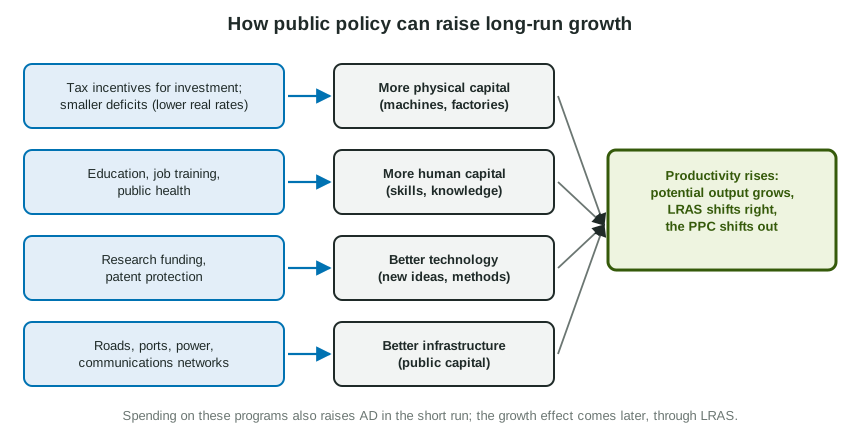
Public policy can raise long-run growth by adding to physical capital, human capital, technology and infrastructure, or by strengthening incentives to work, save and invest (supply-side fiscal policy).
Part 1 · Hook
Why this matters
Part 2 · Before you start
What this builds on
Part 3 · Prerequisite check
Quick check before you start
1. Which change raises an economy's potential output?
- More human capital from education and training
- A rise in consumer confidence
- A rise in the price level
- A fall in the policy rate
Show the answer
Skills raise productivity and so potential output; the others change spending or prices.
- Correct: More human capital from education and training:
- A rise in consumer confidence:
- A rise in the price level:
- A fall in the policy rate:
2. Government borrowing at full employment raises the real interest rate. What happens to private investment?
- It falls: crowding out
- It rises: crowding in
- It is unchanged
- It becomes government spending
Show the answer
A higher real rate makes investment costlier, so private investment falls.
- Correct: It falls: crowding out:
- It rises: crowding in:
- It is unchanged:
- It becomes government spending:
Part 4 · See it
See it first
Part 5 · Step by step
How it works, step by step
- The government funds job trainingworkers gain skills: human capital rises
- Human capital risesproductivity rises
- Productivity risespotential output rises, so LRAS shifts right and the PPC shifts out
- Potential output keeps risingreal GDP per capita grows over time
Part 6 · Key ideas
Key ideas
- Growth policy aims at the sources of growth: physical capital (investment incentives, smaller deficits that lower real interest rates), human capital (education, training, health), technology (research funding, patents) and infrastructure (roads, ports, power, networks).
- Supply-side fiscal policy uses taxes and spending to raise incentives to work, save and invest. It aims at LRAS; how large the effect is remains debated among economists.
- Many policies work on both sides: spending on schools or roads raises AD now and, once finished, can shift LRAS right later.
- Spending that adds no capital, skills or technology, such as a cash transfer, shifts AD only. Deficit-financed programs can be partly offset by crowding out.
Part 7 · Misconception
A common mistake
The wrong idea: Any rise in government spending raises long-run growth.
What actually happens: Any spending raises AD in the short run. Only spending, or incentives, that add to physical capital, human capital, technology or infrastructure can shift LRAS right, and borrowing to pay for it can crowd out private investment.
Part 8 · Check yourself
Check yourself
Exam-style questions. Anything you miss goes into your review queue.
Scenario
Four programs in Navar (invented country)
The government of Navar, an invented country, is choosing among four programs of about the same cost:
- a tax credit for firms that buy new equipment;
- grants that pay for apprenticeships in skilled trades;
- a one-time cash payment to every household;
- funding for university research on cheaper batteries.
1. Which program mainly raises AD in the short run without directly adding to Navar's productive capacity?
- The tax credit for firms that buy new equipment
- The apprenticeship grants
- The battery research funding
- The one-time cash payment to households
Show the answer
Spending that adds capital, skills or technology can shift LRAS; a cash transfer shifts AD.
- The tax credit for firms that buy new equipment: Equipment is physical capital, which raises future capacity.
- The apprenticeship grants: Apprenticeships build human capital, which raises what workers can produce.
- The battery research funding: Research can improve technology, which raises capacity.
- Correct: The one-time cash payment to households: Right: the payment raises disposable income and consumption (AD), but it adds no capital, skills or technology.
2. Through which channel do the apprenticeship grants promote growth?
- More human capital: workers gain skills that raise productivity
- More physical capital: firms buy more machines
- Higher AD: apprentices spend the wages they earn, which shifts AD right
- A lower price level: skilled workers accept lower wages
Show the answer
Human capital channel: education and training raise output per worker.
- Correct: More human capital: workers gain skills that raise productivity: Right: training and education build human capital.
- More physical capital: firms buy more machines: That is the equipment tax credit's channel.
- Higher AD: apprentices spend the wages they earn, which shifts AD right: Their spending raises AD in the short run, but growth comes from their higher productivity.
- A lower price level: skilled workers accept lower wages: The growth channel is what workers can produce, not their wages.
3. Which of these policies aim to shift Navar's LRAS to the right? Select all that apply.
- The tax credit for new equipment
- The apprenticeship grants
- The one-time cash payment to households
- The battery research funding
- A new tax on business investment
- A cut in funding for public universities
Show the answer
Policies aimed at physical capital, human capital and technology aim at LRAS.
- Correct: The tax credit for new equipment: Right: it encourages investment in physical capital.
- Correct: The apprenticeship grants: Right: they build human capital.
- The one-time cash payment to households: It raises spending (AD), not capacity.
- Correct: The battery research funding: Right: it aims at better technology.
- A new tax on business investment: Taxing investment discourages building physical capital, which works against LRAS.
- A cut in funding for public universities: Less funding for higher education works against human capital and research.
4. A government cuts tax rates on wages and on business investment. What effects are expected in the short run and the long run?
- Short run: AD shifts right. Long run: if work and investment rise, LRAS shifts right too
- Short run: LRAS shifts left. Long run: AD shifts left
- Short run: nothing changes. Long run: the price level falls
- Short run: SRAS shifts left. Long run: the deficit closes the gap by itself
Show the answer
Many policies work on both sides: AD in the short run, LRAS in the long run.
- Correct: Short run: AD shifts right. Long run: if work and investment rise, LRAS shifts right too: Right: lower taxes raise disposable income and spending now; stronger incentives to work and invest can raise capacity later. How large that second effect is remains debated.
- Short run: LRAS shifts left. Long run: AD shifts left: Lower taxes raise spending and, if anything, capacity; neither curve shifts left.
- Short run: nothing changes. Long run: the price level falls: Tax cuts raise disposable income right away, so AD shifts right in the short run.
- Short run: SRAS shifts left. Long run: the deficit closes the gap by itself: A tax cut does not raise firms' costs, and a deficit does not close a gap by itself.
5. A government at full employment begins building a large network of highways. Show the short-run effect of the construction spending itself, and mark the new short-run equilibrium.
Work on the graph (it needs JavaScript), then check.
Show the answer
Government spending is part of AD, so AD shifts right; in the short run real output and the price level rise.
- Key: aggregate demand shifts right
6. How can reducing government budget deficits promote long-run growth?
- Smaller deficits raise AD, which raises potential output
- Smaller deficits raise the money supply, which raises real output
- Smaller deficits raise the price level, which raises nominal GDP
- Less government borrowing lowers real interest rates, so private investment and the capital stock grow faster
Show the answer
Deficit reduction can support growth by freeing saving for private investment.
- Smaller deficits raise AD, which raises potential output: Cutting a deficit lowers AD in the short run; the growth effect works through investment.
- Smaller deficits raise the money supply, which raises real output: The budget does not set the money supply, and money is neutral in the long run.
- Smaller deficits raise the price level, which raises nominal GDP: Growth is about real capacity, not nominal values.
- Correct: Less government borrowing lowers real interest rates, so private investment and the capital stock grow faster: Right: smaller deficits reduce crowding out.
Part 9 · Summary
Summary
Part 10 · Up next
What comes next
Part 11 · Connections