Balance of Payments Accounts
The balance of payments has two halves.
Part 1 · Hook
Why this matters
Part 2 · Before you start
What this builds on
Part 3 · Prerequisite check
Quick check before you start
1. In GDP = C + I + G + (X - M), what does X - M stand for?
- Net exports
- Total exports
- Government purchases from abroad
- Investment by foreign firms
Show the answer
X is exports and M is imports, so X - M is net exports: what a country sells abroad minus what it buys from abroad.
- Correct: Net exports:
- Total exports:
- Government purchases from abroad:
- Investment by foreign firms:
2. Which of these is a financial asset?
- A government bond
- A haircut
- A loaf of bread bought for dinner
- An hour of a worker's time
Show the answer
A bond is a claim to future payments, a financial asset. The others are goods, services or labor.
- Correct: A government bond:
- A haircut:
- A loaf of bread bought for dinner:
- An hour of a worker's time:
Part 4 · See it
See it first
Part 5 · Step by step
How it works, step by step
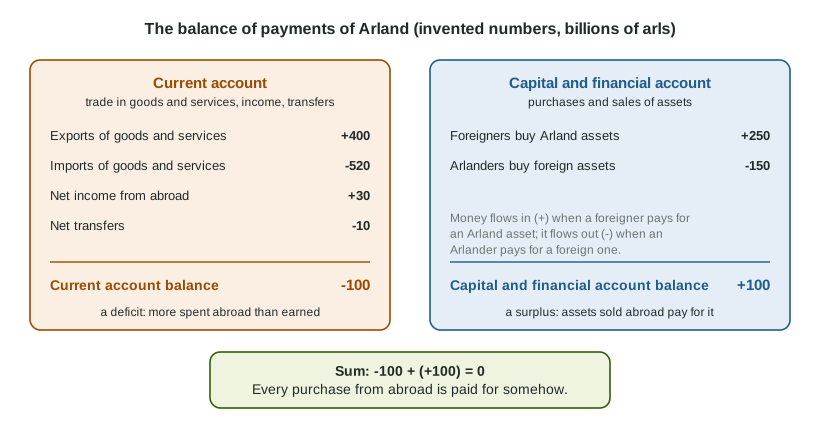
- A country pays the rest of the world more for goods, services, income and transfers than it receives from itits current account balance is negative, a current account deficit
- Those extra purchases still have to be paid forthe country sells assets (bonds, stocks, land, firms) to foreigners or borrows from them
- Foreigners buy more of its assets than it buys of theirsits capital and financial account is in surplus by exactly the size of the current account deficit
- Every payment has a matching entrycurrent account + capital and financial account = 0
Part 6 · Key ideas
Key ideas
- The balance of payments records every transaction between a country's residents and the rest of the world over a period. Money coming in is a credit (+); money going out is a debit (-).
- The current account holds the balance of trade in goods and services (net exports), net income from abroad (interest, dividends, wages) and net transfers (gifts, aid, money sent home).
- The capital and financial account records purchases and sales of assets: bonds, stocks, bank deposits, real estate and whole firms. A foreigner buying a domestic asset is a credit; a resident buying a foreign asset is a debit.
- Current account + capital and financial account = 0. A current account deficit is matched by a capital and financial account surplus of the same size.
- A government budget deficit (outlays above revenue) is not a trade deficit or a current account deficit.
Part 7 · Misconception
A common mistake
The wrong idea: The capital and financial account has nothing to do with trade, so a current account deficit tells you nothing about it.
What actually happens: They are two sides of the same payments. A country that buys more from abroad than it sells pays the difference by selling assets or borrowing abroad, so a current account deficit of 60 means a capital and financial account surplus of 60.
Part 8 · Check yourself
Check yourself
Exam-style questions. Anything you miss goes into your review queue.
Data
Arland's international transactions in one year
| Transaction | Amount |
|---|---|
| Exports of goods | 300 |
| Imports of goods | 380 |
| Exports of services | 120 |
| Imports of services | 90 |
| Income received from abroad (interest, dividends, wages) | 45 |
| Income paid to foreigners | 30 |
| Net transfers sent abroad (gifts, aid, money sent home) | 25 |
| Arland residents' purchases of foreign assets | 90 |
1. Use the table. What is Arland's balance of trade in goods and services, in billions of arls? Write a deficit as a negative number.
Type a number. A four-function calculator is allowed, as on the exam.
Show the answer
Exports minus imports, goods and services together:
- Answer: -50
2. Use the table. What is Arland's current account balance, in billions of arls? Write a deficit as a negative number.
Type a number. A four-function calculator is allowed, as on the exam.
Show the answer
The current account adds the balance of trade, net income and net transfers:
- Answer: -60
3. Use the table. What is Arland's capital and financial account balance, in billions of arls? Write a deficit as a negative number.
Type a number. A four-function calculator is allowed, as on the exam.
Show the answer
The two accounts sum to zero: current account + capital and financial account = 0, so the capital and financial account is , a surplus. Arland paid for its extra purchases by selling 60 billion arls more of assets to foreigners than it bought from them.
- Answer: 60
4. What does a country's balance of payments record?
- The government's tax revenue minus its spending in a year
- The market value of the final goods and services produced in a year
- Every transaction between the country's residents and the rest of the world
- The total amount the country owes to foreign lenders
Show the answer
The balance of payments is the record of all transactions between a country's residents and the rest of the world during a period.
- The government's tax revenue minus its spending in a year: That is the budget balance, a measure of government finances, not of transactions with other countries.
- The market value of the final goods and services produced in a year: That is GDP. The balance of payments records transactions with the rest of the world.
- Correct: Every transaction between the country's residents and the rest of the world: Right: trade in goods and services, income, transfers and purchases of assets, over a period such as a year.
- The total amount the country owes to foreign lenders: That is a stock of debt built up over many years. The balance of payments records the flows during one period.
5. Belvia has a current account surplus of 35 billion bels this year. What is its capital and financial account balance?
- A surplus of 35 billion bels
- A deficit of 35 billion bels
- Zero, because asset trades are not counted
- It depends on the government budget balance
Show the answer
Current account + capital and financial account = 0, so +35 is matched by -35.
- A surplus of 35 billion bels: The two balances sum to zero, so they have opposite signs: a current account surplus means a capital and financial account deficit.
- Correct: A deficit of 35 billion bels: Right: 35 + (-35) = 0. Belvia earns more from the rest of the world than it spends there and uses the extra to buy foreign assets (or lend abroad).
- Zero, because asset trades are not counted: The capital and financial account records asset purchases and is not zero here; the two accounts together sum to zero.
- It depends on the government budget balance: The budget balance is not part of the balance of payments; the current account balance alone gives the answer.
6. A headline reads "Arland's government deficit hits a record." A classmate says this means Arland imported more than it exported. Which response is best?
- Correct: a government deficit and a trade deficit are the same number
- Correct, because a government deficit is recorded in the current account
- Not necessarily: a budget deficit is outlays above tax revenue, not imports above exports
- Not necessarily, because a deficit is recorded in the capital and financial account
Show the answer
A budget deficit (government outlays exceed revenue) is not a trade deficit (imports exceed exports).
- Correct: a government deficit and a trade deficit are the same number: They are different measures: one compares government outlays with revenue, the other compares exports with imports.
- Correct, because a government deficit is recorded in the current account: Government budgets are not entries in the current account; only the government's own transactions with foreigners, such as aid, appear there.
- Correct: Not necessarily: a budget deficit is outlays above tax revenue, not imports above exports: Right: a budget deficit is about the government's finances. A trade or current account deficit is about transactions with the rest of the world. One does not tell you the other.
- Not necessarily, because a deficit is recorded in the capital and financial account: The headline is about the government budget, which is not part of the balance of payments at all.
Part 9 · Summary
Summary
Part 10 · Up next
What comes next
Part 11 · Connections