Impacts of Agricultural Practices
Tilling, slash-and-burn and heavy fertilizer use each raise harvests in the short run and harm the land or water in the long run.
Part 1 · Hook
Why this matters
Part 2 · Before you start
What this builds on
Part 3 · Prerequisite check
Quick check before you start
1. What is humus?
- Dark, decomposed organic matter in soil
- The rock that soil forms from
- The deepest soil horizon
- A kind of clay mineral
Show the answer
Humus is decomposed organic matter; it holds water and nutrients.
- Correct: Dark, decomposed organic matter in soil:
- The rock that soil forms from:
- The deepest soil horizon:
- A kind of clay mineral:
2. What does leaching do to soil?
- Water carries dissolved nutrients down and out of reach of roots
- Wind blows the top layer of soil away
- Rock breaks into smaller pieces in place
- Bacteria turn nitrogen gas into ammonium
Show the answer
Leaching moves dissolved substances such as nitrate downward with water.
- Correct: Water carries dissolved nutrients down and out of reach of roots:
- Wind blows the top layer of soil away:
- Rock breaks into smaller pieces in place:
- Bacteria turn nitrogen gas into ammonium:
Part 4 · See it
See it first
Part 5 · Step by step
How it works, step by step
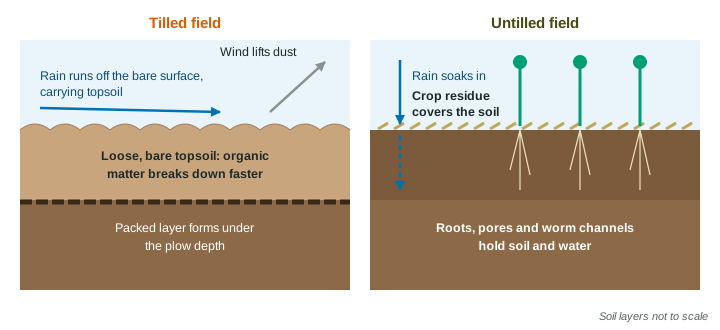
- A field is plowed (tilled) every yearthe soil surface is bare and loose
- Wind and rain hit bare, loose soiltopsoil blows or washes away (erosion)
- Mixing air into the soil speeds decompositionsoil organic matter falls and its carbon enters the air as carbon dioxide
- Topsoil and organic matter are lostthe soil holds less water and fewer nutrients, so yields fall
Part 6 · Key ideas
Key ideas
- Tilling buries weeds and loosens the seedbed, but leaves soil bare, so wind and water erode it; it also speeds the loss of organic matter.
- Slash-and-burn clears tropical forest by cutting and burning. Ash fertilizes the poor soil for a few seasons, then the plot is left and more forest is cleared.
- Burning releases carbon dioxide and smoke; clearing removes habitat and carbon storage. With long fallow periods and few people, plots can regrow forest.
- Fertilizer the crop does not take up runs off or leaches into rivers, lakes and groundwater, where nitrate and phosphate become pollutants.
Part 7 · Misconception
A common mistake
The wrong idea: Plowing improves the soil, because loose soil is healthy soil.
What actually happens: Plowing loosens the soil for planting, but year after year it leaves the surface bare, speeds erosion, burns off organic matter and can pack a hard layer just below the plow depth.
Part 8 · Check yourself
Check yourself
Exam-style questions. Anything you miss goes into your review queue.
1. What is tilling?
- Turning over and breaking up the soil before planting
- Adding crushed limestone to a field to raise the soil pH
- Planting rows of trees along the edges of a field
- Spreading animal manure on a field after harvest
Show the answer
Tilling (plowing or disking) turns over and loosens the soil to bury weeds and prepare a seedbed.
- Correct: Turning over and breaking up the soil before planting: Right: tilling is mechanical turning of the soil.
- Adding crushed limestone to a field to raise the soil pH: Liming changes soil chemistry; it is not tilling.
- Planting rows of trees along the edges of a field: Tree rows protect a field from wind; they are not tilling.
- Spreading animal manure on a field after harvest: Spreading manure adds nutrients; it does not turn the soil.
2. In slash-and-burn farming, what provides the nutrients for the first crops?
- The ash left after the cut plants are burned
- Synthetic fertilizer bought before clearing the plot
- Deep, rich soil built up under the forest
- Manure from cattle grazing in the forest
Show the answer
Burning releases the nutrients stored in the plants as ash, which fertilizes the poor soil for a short time.
- Correct: The ash left after the cut plants are burned: Right: ash carries the nutrients from the burned plants.
- Synthetic fertilizer bought before clearing the plot: Slash-and-burn farmers usually do not buy fertilizer.
- Deep, rich soil built up under the forest: Tropical rainforest soils are thin and poor; most nutrients are in the plants.
- Manure from cattle grazing in the forest: The method does not rely on grazing cattle.
Data
Soil loss and organic matter in tilled and untilled plots
| Plot | Tilling | Soil lost (metric tons per ha per year) | Soil organic matter after 10 years (%) |
|---|---|---|---|
| 1 | Plowed every spring and fall | 18 | 2.1 |
| 2 | Plowed every spring | 12 | 2.6 |
| 3 | Plowed every third spring | 5 | 3.2 |
| 4 | Never plowed | 1 | 3.8 |
3. What relationship between tilling and soil loss does the table show?
- The more often a plot was plowed, the more soil it lost each year
- The less often a plot was plowed, the more soil it lost each year
- Plowing more often lowered soil loss until it was done twice a year
- Soil loss was about the same on each of the plots, plowed or not
Show the answer
Soil lost: 18, 12, 5 and 1 metric tons per ha per year as plowing went from twice a year to never.
- Correct: The more often a plot was plowed, the more soil it lost each year: Right: soil loss rose with how often the plot was plowed.
- The less often a plot was plowed, the more soil it lost each year: This reverses the pattern in the table.
- Plowing more often lowered soil loss until it was done twice a year: The plot plowed twice a year lost the most soil.
- Soil loss was about the same on each of the plots, plowed or not: Losses ranged from 1 to 18, a big difference.
4. Plot 1 covers 25 hectares. How much soil does it lose in one year?
Type a number, then its unit (metric tons). Scale words (2.5 million) and powers of ten (2.5 × 10^6) are read.
Show the answer
- Answer: 450 metric tons
5. Write the setup for the percent change in soil organic matter from plot 4 (never plowed) to plot 1 (plowed twice a year), then give the answer.
Type the setup as on the exam, with brackets and units, then the answer.
Show the answer
- Setup: ; answer -44.7 %
6. A student predicted that plowing does not affect soil organic matter. Do the data support the prediction?
- No: organic matter fell from 3.8% to 2.1% as plowing increased
- Yes: organic matter was about the same in each of the four plots
- No: organic matter rose from 2.1% to 3.8% as plowing increased
- Yes: organic matter changed just on the plot that was not plowed
Show the answer
Organic matter was highest where the soil was never plowed and lowest where it was plowed most.
- Correct: No: organic matter fell from 3.8% to 2.1% as plowing increased: Right: organic matter fell steadily with more plowing.
- Yes: organic matter was about the same in each of the four plots: Values ranged from 2.1% to 3.8%, not about the same.
- No: organic matter rose from 2.1% to 3.8% as plowing increased: The direction is reversed: more plowing went with less organic matter.
- Yes: organic matter changed just on the plot that was not plowed: Each plot had a different value.
7. A farmer applies 150 kg of nitrogen per hectare to a 60-hectare field. The crop takes up 90 kg per hectare. Write the setup for the total mass of nitrogen not taken up by the crop, then give the answer with its unit.
Type the setup as on the exam, with brackets and units, then the answer.
Show the answer
Excess per hectare: kg/ha. Total:
- Setup: ; answer 3600 kg
Part 9 · Summary
Summary
Part 10 · Up next
What comes next
Part 11 · Connections