Irrigation Methods
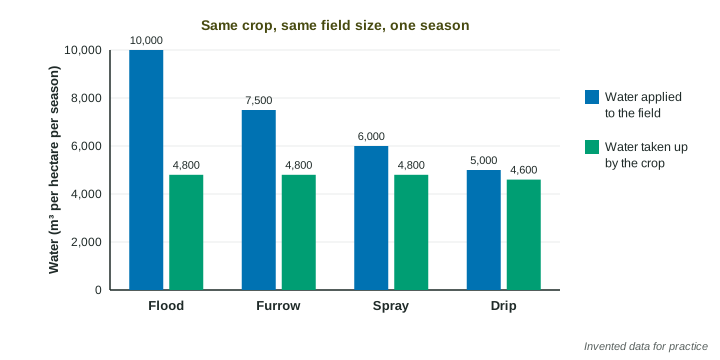
Irrigation methods differ in how much of the water reaches the roots: flood and furrow are cheap but lose much of it to evaporation and runoff, spray loses less, and drip loses the least but costs the most.
Part 1 · Hook
Why this matters
Part 2 · Before you start
What this builds on
Part 3 · Prerequisite check
Quick check before you start
1. What is an aquifer?
- A layer of rock or sediment underground that holds and transmits groundwater
- The land area that drains into one river
- A lake that forms behind a dam
- The boundary between fresh and salt water in a river mouth
Show the answer
An aquifer is porous rock or sediment that stores groundwater; a watershed is a drainage area.
- Correct: A layer of rock or sediment underground that holds and transmits groundwater:
- The land area that drains into one river:
- A lake that forms behind a dam:
- The boundary between fresh and salt water in a river mouth:
2. A process uses 600 units of input to give 450 units of useful output. What is its efficiency?
- 75%
- 133%
- 45%
- 25%
Show the answer
Efficiency is output divided by input, times 100: (450 / 600) × 100 = 75%.
- Correct: 75%:
- 133%:
- 45%:
- 25%:
3. What happens to dissolved salts when water evaporates?
- They stay behind
- They evaporate with the water
- They turn into gas
- They become fresh water
Show the answer
Only the water evaporates; salts are left behind.
- Correct: They stay behind:
- They evaporate with the water:
- They turn into gas:
- They become fresh water:
Part 4 · See it
See it first
Part 5 · Step by step
How it works, step by step
- A field is flooded with more water than the crop can usemuch of the water evaporates from the surface or soaks below the roots
- Irrigation water carries small amounts of dissolved salt and the water evaporatessalt is left behind in the topsoil
- Salt builds up over years (salinization)roots struggle to take up water, so yields fall
- Wells pump an aquifer faster than it rechargesthe water table drops and shallow wells go dry
Part 6 · Key ideas
Key ideas
- About 70% of the fresh water people withdraw worldwide goes to agriculture, most of it for irrigation.
- Drip is the most efficient (only about 5% of the water lost) and spray comes next (about a quarter or less lost). Flood and furrow are cheap surface methods that lose the most (furrow often about a third). Drip also costs the most to install.
- Overirrigation causes waterlogging (roots without oxygen) and salinization (salt left behind when water evaporates).
- Pumping groundwater faster than it recharges causes aquifer depletion: a falling water table, a cone of depression around wells, and dry shallow wells.
Part 7 · Misconception
A common mistake
The wrong idea: Salinization happens when farmers irrigate with seawater.
What actually happens: Fresh river and well water carries small amounts of dissolved salt. Each time irrigation water evaporates from a field it leaves that salt behind, and over years it builds up in the topsoil.
Part 8 · Check yourself
Check yourself
Exam-style questions. Anything you miss goes into your review queue.
1. Which irrigation method delivers water slowly through tubes to the base of each plant?
- Drip irrigation
- Furrow irrigation
- Flood irrigation
- Spray irrigation
Show the answer
Drip irrigation runs tubes with small holes along the rows, so water goes straight to the roots.
- Correct: Drip irrigation: Right: drip puts water at the roots.
- Furrow irrigation: Furrow irrigation runs water down trenches between rows.
- Flood irrigation: Flood irrigation covers the whole field.
- Spray irrigation: Spray irrigation sprinkles water over the crop from above.
2. Why is drip irrigation more efficient than furrow irrigation?
- Water goes to the roots, so less evaporates from the surface or runs off the field
- Drip water contains more nutrients, so the plants need less of it to grow
- Drip tubes cool the soil around the roots, so plants take up water at a slower rate
- Drip systems pump water faster, so it reaches the roots before evaporating
Show the answer
Efficiency is the share of water applied that the crop uses. Drip loses little to evaporation and runoff because it wets only the soil around each plant.
- Correct: Water goes to the roots, so less evaporates from the surface or runs off the field: Right: little water is lost before it reaches the roots.
- Drip water contains more nutrients, so the plants need less of it to grow: The water is the same; the difference is where it goes.
- Drip tubes cool the soil around the roots, so plants take up water at a slower rate: Drip does not work by cooling the soil.
- Drip systems pump water faster, so it reaches the roots before evaporating: Drip delivers water slowly, not fast.
Data
Water used by four irrigation methods
| Method | Water applied (m³ per ha) | Water taken up by the crop (m³ per ha) | Cost to install (dollars per ha) |
|---|---|---|---|
| Flood | 10,000 | 4,800 | 150 |
| Furrow | 7,500 | 4,800 | 300 |
| Spray | 6,000 | 4,800 | 1,800 |
| Drip | 5,000 | 4,600 | 3,200 |
3. Which method in the table delivered the most water that the crop did not take up?
- Flood, with 5,200 m³ per ha not taken up
- Furrow, with 2,700 m³ per ha not taken up
- Spray, with 1,200 m³ per ha not taken up
- Drip, with 400 m³ per ha not taken up
Show the answer
Applied minus taken up: flood
- Correct: Flood, with 5,200 m³ per ha not taken up: Right: flood lost 5,200 m³ per ha.
- Furrow, with 2,700 m³ per ha not taken up: Furrow lost 2,700, less than flood.
- Spray, with 1,200 m³ per ha not taken up: Spray lost 1,200.
- Drip, with 400 m³ per ha not taken up: Drip lost the least, 400.
4. Write the setup for the efficiency of furrow irrigation (the percent of water applied that the crop takes up), then give the answer.
Type the setup as on the exam, with brackets and units, then the answer.
Show the answer
Efficiency = useful output / input × 100:
- Setup: ; answer 64 %
5. Write the setup for the percent change in water applied when a farm switches from flood to drip irrigation, then give the answer.
Type the setup as on the exam, with brackets and units, then the answer.
Show the answer
- Setup: ; answer -50 %
6. A 50-hectare farm switches from flood to spray irrigation. Using the table, how many cubic meters of water does it save in one season?
Type a number, then its unit (m3). Scale words (2.5 million) and powers of ten (2.5 × 10^6) are read.
Show the answer
Saving per hectare:
- Answer: 200,000 m3
7. Using the cost column, which statement best explains why many farmers keep using flood or furrow irrigation?
- They cost far less to install, so farmers who pay little for water save money
- They waste less water than the others, so farmers save on both water and equipment
- They let crops take up more water, so the crops grow faster than with drip
- They use the newest equipment, so they are easier to repair than drip
Show the answer
Flood costs 150 dollars per ha to install and drip 3,200. Where water is cheap, the water savings may not pay back the equipment.
- Correct: They cost far less to install, so farmers who pay little for water save money: Right: low cost to install is their main advantage.
- They waste less water than the others, so farmers save on both water and equipment: They waste more water, not less.
- They let crops take up more water, so the crops grow faster than with drip: The crop took up 4,800 m³ under flood and furrow, about the same as under the other methods.
- They use the newest equipment, so they are easier to repair than drip: Flood and furrow use simple ditches, not new equipment.
Part 9 · Summary
Summary
Part 10 · Up next
What comes next
Part 11 · Connections