Differentiability and Continuity
A function is differentiable at a when f′(a) exists.
Part 1 · Hook
Why this matters
Part 2 · Before you start
What this builds on
Part 3 · Prerequisite check
Quick check before you start
1. A function is continuous at when
- is defined
- exists
Show the answer
All three conditions at once: is defined, the limit exists, and they are equal.
- Correct:
: - is defined:
- exists:
- :
2. For , the definition of the derivative gives
Show the answer
The difference quotient simplifies to , whose limit as is .
- Correct: :
- :
- :
- :
3. If and , then
- does not exist
- is 4
- is 3
- is 5
Show the answer
A two-sided limit exists only when the one-sided limits are equal.
- Correct: does not exist:
- is 4:
- is 3:
- is 5:
Part 4 · See it
See it first
Part 5 · Step by step
How it works, step by step
- exists
tends to - as
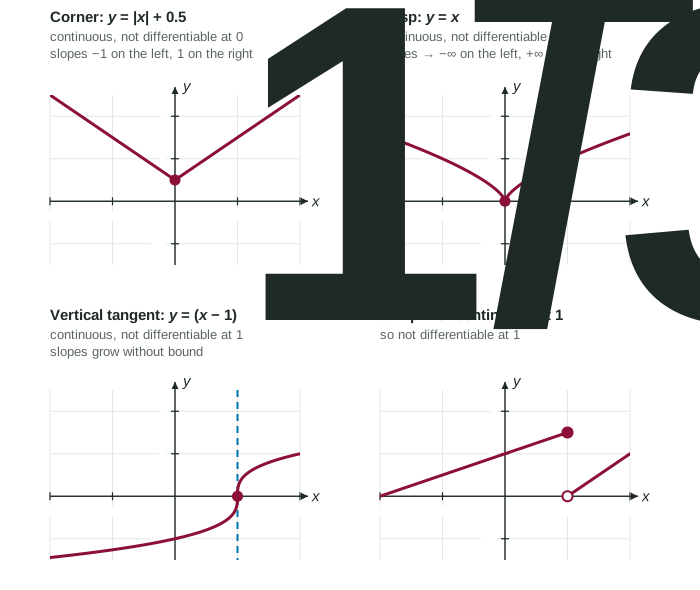
: is continuous at - The left and right difference quotients approach different numbers (a corner)the two-sided limit does not exist and does not exist, even though may be continuous
- The difference quotients grow without bound (a cusp or a vertical tangent)there is no finite slope, so does not exist
Part 6 · Key ideas
Key ideas
- is differentiable at when exists: the limit of the difference quotient is a finite number.
- Differentiable implies continuous. In a justification, say it: " is differentiable at , so is continuous at ."
- Continuous does NOT imply differentiable. A continuous graph fails to have a derivative at a corner (one-sided slopes differ), a cusp (slopes become infinite in opposite directions) or a vertical tangent line.
- Not continuous implies not differentiable: a jump, hole or asymptote rules out a derivative.
- For a piecewise function at the break: check continuity first, then compare the left and right slopes.
Part 7 · Misconception
A common mistake
The wrong idea: The graph of has no break at , so it has a derivative there.
What actually happens: No break means continuous, which is necessary but not enough. At the slope is from the left and 1 from the right, so the difference quotient has no limit: is continuous but not differentiable at 3.
Part 8 · Check yourself
Check yourself
Exam-style questions. Anything you miss goes into your review queue.
Graph
The graph of a function on
1. At which values of in the open interval is not differentiable? Select every one.
Show the answer
A corner at , a jump at and a vertical tangent at . Everywhere else the graph is smooth.
- : The graph is a straight line here, with slope .
- Correct: : A corner: slope on the left, 0 on the right.
- : The parabola is smooth here, with slope 1.
- Correct: : A jump: is not continuous at 2, so it is not differentiable there.
- Correct: : The curve is vertical at : the difference quotients grow without bound.
- : The curve is smooth here, with a finite slope.
2. Which is true of at ?
- It is neither continuous nor differentiable.
- It is continuous but not differentiable.
- It is differentiable at 2 but not continuous at 2.
- It is both continuous and differentiable.
Show the answer
and , so is not continuous at 2, and a function that is not continuous cannot be differentiable.
- Correct: It is neither continuous nor differentiable.: A jump breaks continuity, and with it differentiability.
- It is continuous but not differentiable.: The one-sided limits are 2 and 0, so is not continuous at 2.
- It is differentiable at 2 but not continuous at 2.: Differentiable implies continuous, so this combination is impossible.
- It is both continuous and differentiable.: There is a jump at .
3. Why is not differentiable at ?
- The tangent line at is vertical: the slopes grow without bound.
- is not defined, so there is no point to take a slope at.
- is not continuous at .
- The graph has a corner at , with two different finite slopes.
Show the answer
Near the curve is steeper and steeper; the slopes have no finite limit.
- Correct: The tangent line at is vertical: the slopes grow without bound.: A vertical tangent line has no finite slope.
- is not defined, so there is no point to take a slope at.: ; the point is on the graph.
- is not continuous at .: The curve passes through without a break, so is continuous there.
- The graph has a corner at , with two different finite slopes.: Both sides become infinitely steep in the same direction; there are no two finite slopes.
4. Which statement best explains why is not differentiable at ?
- is continuous at 0, but the difference quotient approaches from the left and 0 from the right.
- is not continuous at 0, because two different formulas meet there.
- , and a function has no derivative where its value is 0.
- The graph is level at , so does not exist.
Show the answer
On the left the graph is the line (slope ); on the right the parabola has slope , which is 0 at . Two different one-sided slopes make a corner.
- Correct: is continuous at 0, but the difference quotient approaches from the left and 0 from the right.: Continuous, but the one-sided slopes differ: a corner.
- is not continuous at 0, because two different formulas meet there.: Both formulas give 0 at , so is continuous; a change of formula alone breaks nothing.
- , and a function has no derivative where its value is 0.: A function can be 0 and still have a derivative; does at .
- The graph is level at , so does not exist.: A level tangent line would mean , which exists; here no single tangent line exists.
5. Which statement is true for every function ?
- If is differentiable at , then is continuous at .
- If is continuous at , then is differentiable at .
- If is not differentiable at , then is not continuous at .
- If is defined, then is differentiable at .
Show the answer
Differentiability implies continuity.
- Correct: If is differentiable at , then is continuous at .: The theorem: a derivative at forces continuity at .
- If is continuous at , then is differentiable at .: The converse is false: is continuous at 0 but not differentiable there.
- If is not differentiable at , then is not continuous at .: False: is not differentiable at 0 yet is continuous there.
- If is defined, then is differentiable at .: A value at does not even guarantee continuity, let alone a derivative.
6. A function is continuous at . What can you conclude about ?
- may or may not exist.
- exists, because continuity guarantees a slope.
- does not exist.
- .
Show the answer
Continuity is necessary for a derivative but not sufficient: (differentiable at 0) and (not differentiable at 0) are both continuous at 0.
- Correct: may or may not exist.: Continuity alone does not decide it.
- exists, because continuity guarantees a slope.: A corner, cusp or vertical tangent can be continuous with no derivative.
- does not exist.: Many continuous functions, such as , do have derivatives.
- .: A slope and a height are different quantities.
7. A student writes: " is not differentiable at , so is not continuous at ." Which response is correct?
- The reasoning is wrong: is continuous at 2 but not differentiable there.
- The reasoning is right: differentiability and continuity mean the same thing.
- The reasoning is right: it is the theorem that differentiable functions are continuous.
- The reasoning is wrong: a function that is not differentiable is continuous.
Show the answer
The theorem runs one way: differentiable implies continuous. Its converse, and the student's statement, can fail.
- Correct: The reasoning is wrong: is continuous at 2 but not differentiable there.: One counterexample shows the claim is false.
- The reasoning is right: differentiability and continuity mean the same thing.: They differ: corners, cusps and vertical tangents are continuous points with no derivative.
- The reasoning is right: it is the theorem that differentiable functions are continuous.: The student reversed the theorem; "not differentiable" says nothing about continuity.
- The reasoning is wrong: a function that is not differentiable is continuous.: A jump is not differentiable and not continuous either; no conclusion either way.
Part 9 · Summary
Summary
Part 10 · Up next
What comes next
Part 11 · Connections