The Power Rule
The power rule says d/dx (x^r) = rx^(r − 1) for every real exponent r .
Part 1 · Hook
Why this matters
Part 2 · Before you start
What this builds on
Part 3 · Prerequisite check
Quick check before you start
1. written as a power of is
Show the answer
A power in the denominator moves up with its sign changed: .
- Correct: :
- :
- :
- :
2. written as a power of is
Show the answer
The root is the denominator of the exponent: .
- Correct: :
- :
- :
- :
3. By the definition of the derivative, is
Show the answer
- Correct: :
- :
- :
- :
Part 4 · See it
See it first
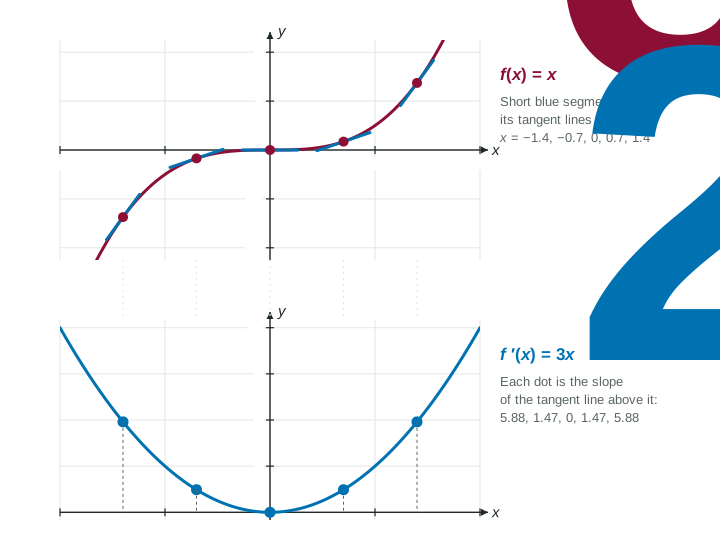
Part 5 · Step by step
How it works, step by step
- The definition gives , and in each case the exponent comes down in front and the new exponent is one less
- That pattern holds for every real exponent the power rule:
- A root or a power in a denominator is still a power of rewrite it with a fractional or negative exponent before using the rule
- A variable sits in the exponent, as in it is not a power of , and the power rule does not apply
Part 6 · Key ideas
Key ideas
- The power rule: for any real number . Bring the exponent down, then subtract 1 from it.
- Rewrite first: , , .
- With negative exponents, "one less" means more negative: .
- Special cases: , and the slope of at is .
- The rule needs the variable in the base and a fixed number in the exponent.
Part 7 · Misconception
A common mistake
The wrong idea: : differentiate the denominator.
What actually happens: Rewrite first: . The power rule gives . The new exponent is , not , and the sign is negative because the graph falls for .
Part 8 · Check yourself
Check yourself
Exam-style questions. Anything you miss goes into your review queue.
Graph
The graph of and its tangent line at
1. Use the power rule to find for .
No calculator. Type the exact value (a fraction, π, e or a root is fine).
Show the answer
, so .
- Answer: 12
2. The cubic passes through . Using the power rule for the slope there, which line touches the cubic at that point?
Show the answer
Point and slope . It is , crossing the -axis at as in the graph.
- Correct: : Height 1, slope 3.
- : The height and the slope are swapped.
- : The slope of a line is a number: evaluate at .
- : Point-slope form uses .
3. At which values of is the slope of the graph of equal to 12?
- and
- and
Show the answer
Solve : , so . The graph is equally steep at and 2.
- Correct: and : Both square roots of 4.
- : works too: .
- and : From , ; take the square root.
- : That solves , a height of 12, not a slope of 12.
4. How do the slopes of the graph of at and compare?
- They are equal: both are 3.
- They are opposites: and 3.
- The slope at is less, because the graph is lower there.
- They are equal: both are 1.
Show the answer
gives and . The heights and 1 are opposites; the slopes are not.
- Correct: They are equal: both are 3.: Squaring removes the sign of .
- They are opposites: and 3.: The heights are opposites; squares , so the slopes match.
- The slope at is less, because the graph is lower there.: Height does not set slope; the graph rises at both points with slope 3.
- They are equal: both are 1.: That is at ; the power rule also brings down the 3.
5. A student writes . What is the correct derivative?
Show the answer
Rewrite ; the power rule gives . The student differentiated the denominator instead.
- Correct: : Coefficient , exponent .
- : , not .
- : The coefficient is the exponent, , so the derivative is negative.
- : The exponent comes down as a factor: , not .
6. Let for . Find .
Type an expression for .
Show the answer
Exponent rules first: . Then .
- Answer:
Part 9 · Summary
Summary
Part 10 · Up next
What comes next
Part 11 · Connections