Introduction to Signal Transduction
Cell signaling runs in three stages.
Part 1 · Hook
Why this matters
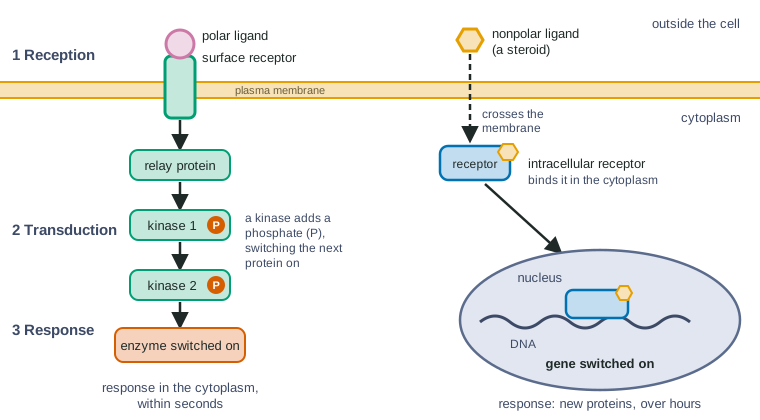
Insulin is a protein far too large and too polar to cross a cell membrane, yet within seconds of binding a muscle cell it changes what happens deep inside that cell. Testosterone, a steroid, slips straight through the membrane and goes to work in the nucleus. Two very different hormones, and two different routes, but both follow the same three-stage plan: a receptor receives the signal, a relay inside the cell passes it on, and the cell responds.
Part 2 · Before you start
What this builds on
Part 3 · Prerequisite check
Quick check before you start
1. Which molecule can diffuse straight across the lipid bilayer of a membrane?
- A small nonpolar molecule such as a steroid
- A large polar protein such as insulin
- A charged ion such as Na⁺
Show the answer
The bilayer's core is nonpolar, so small nonpolar molecules dissolve through it. Large, polar or charged molecules need a protein to cross, or cannot cross at all.
- Correct: A small nonpolar molecule such as a steroid:
- A large polar protein such as insulin:
- A charged ion such as Na⁺:
2. Phosphorylating a protein means
- adding a phosphate group to it, which can change its shape and activity
- breaking its peptide bonds with water
- removing it from the cell by exocytosis
Show the answer
A phosphate group carries negative charges; adding it changes how the protein folds, which can switch the protein on or off.
- Correct: adding a phosphate group to it, which can change its shape and activity:
- breaking its peptide bonds with water:
- removing it from the cell by exocytosis:
3. Only cells with the matching receptor respond to a hormone. Why?
- The hormone must bind a receptor to change the cell's activity
- The hormone is carried only to the organs that need it
- Cells without the receptor destroy the hormone before it arrives
Show the answer
A hormone reaches nearly every cell in the blood, but it changes a cell only by binding a receptor; cells without that receptor are not affected.
- Correct: The hormone must bind a receptor to change the cell's activity:
- The hormone is carried only to the organs that need it:
- Cells without the receptor destroy the hormone before it arrives:
Part 4 · See it
See it first
Part 5 · Step by step
How it works, step by step
- A ligand fits the binding site of its receptor and binds it.The receptor protein changes shape (reception).
- The receptor's new shape lets its inside part switch on a relay protein.The signal is now inside the cell, carried by proteins rather than by the ligand.
- Relay proteins that are protein kinases add phosphate groups from ATP to the next proteins in the chain.Each phosphorylated protein changes shape and switches on (transduction).
- Each active enzyme in the chain switches on many molecules of the next step, and some steps release small second messenger molecules in large numbers.The signal is amplified: one bound receptor can lead to millions of product molecules.
- The last proteins in the chain act on their targets.The cell responds: an enzyme turns on or off, a channel opens, genes switch on, or the cell dies by apoptosis (response).
- When the ligand leaves the receptor, phosphatases remove the phosphate groups and second messengers are broken down.The relay proteins switch back off, so the response stops soon after the signal does.
Part 6 · Key ideas
Key ideas
- Every signaling pathway has three stages: reception (ligand binds receptor), transduction (a relay of shape changes inside the cell) and response.
- Where the receptor sits depends on the ligand: polar or large ligands bind cell-surface receptors; small nonpolar ligands such as steroids cross the membrane and bind intracellular receptors, which often switch genes on.
- Protein kinases switch proteins on (or off) by adding phosphate from ATP; phosphatases remove it. Phosphorylation is the most common switch in transduction.
- Second messengers are small molecules or ions made or released in large amounts inside the cell; they spread the signal quickly through the cytoplasm.
- Because each active enzyme switches on many copies of the next protein, the signal is amplified, so a few ligand molecules can produce a large response.
Part 7 · Misconception
A common mistake
The wrong idea: The ligand enters the cell and travels along the pathway, delivering the message to the nucleus.
What actually happens: For a cell-surface receptor, the ligand never enters the cell. What travels is a series of shape changes: each protein switches the next one on. Only small nonpolar ligands, which bind intracellular receptors, go inside.
Part 8 · Check yourself
Check yourself
Exam-style questions. Anything you miss goes into your review queue.
Data table
Two hormones, two receptors
Researchers studied two hormones that act on the same kind of cultured cell. Hormone X is a small protein; hormone Y is a steroid. To find where each binds, they added radioactively labeled hormone, broke the cells open and measured how much label was bound to plasma membranes and how much to the nucleus. In other dishes they attached each hormone to plastic beads far too large to enter cells, or added a drug that stops cells from making new mRNA. Responses are given as a percentage of the response to the free hormone with no drug (means of 4 dishes).
| Measurement | Hormone X | Hormone Y |
|---|---|---|
| Bound label found on plasma membranes (% of total bound) | 92 | 6 |
| Bound label found in the nucleus (% of total bound) | 2 | 81 |
| Time to first measurable response | 30 seconds | 45 minutes |
| Response to hormone attached to large beads (% of normal) | 95 | 3 |
| Response with drug that blocks mRNA synthesis (% of normal) | 90 | 4 |
1. Which statement is best supported by the binding data?
- X binds mainly at the plasma membrane and Y mainly in the nucleus.
- X and Y both bind mainly at the plasma membrane, but Y also enters the nucleus.
- X binds mainly in the nucleus and Y mainly at the plasma membrane of the cell.
- Neither hormone binds the cells strongly, since less than 100% of the label is found.
Show the answer
92% of bound X is on membranes; 81% of bound Y is in the nucleus.
- Correct: X binds mainly at the plasma membrane and Y mainly in the nucleus.: The first two rows show exactly this split.
- X and Y both bind mainly at the plasma membrane, but Y also enters the nucleus.: Only 6% of bound Y is on membranes, so Y does not bind mainly there.
- X binds mainly in the nucleus and Y mainly at the plasma membrane of the cell.: This reverses the two hormones.
- Neither hormone binds the cells strongly, since less than 100% of the label is found.: The percentages describe where the bound label is, not how much hormone bound overall.
2. Which result most directly shows that hormone Y must get inside the cell to act?
- Y attached to beads too large to enter cells gives 3% of the normal response.
- Y's first response takes 45 minutes, compared with 30 seconds for hormone X.
- With the drug that blocks mRNA synthesis, Y gives just 4% of the normal response.
- Hormone Y is a steroid, while hormone X is a small protein.
Show the answer
The bead experiment keeps Y outside the cell and nothing else changes; Y then fails to act. That tests the question directly.
- Correct: Y attached to beads too large to enter cells gives 3% of the normal response.: Trapped outside, Y does almost nothing, so it has to enter.
- Y's first response takes 45 minutes, compared with 30 seconds for hormone X.: A slow response fits an inside receptor but could have other causes, so it is indirect evidence.
- With the drug that blocks mRNA synthesis, Y gives just 4% of the normal response.: This shows Y's response needs new mRNA, which says what the response is, not where Y binds.
- Hormone Y is a steroid, while hormone X is a small protein.: This predicts the result from chemistry but is not itself an experimental result.
Model
Counting molecules down a pathway
A model of a pathway in a liver cell, built from measurements on purified proteins. It gives, for each step, how many molecules one active molecule of the step above switches on, and the total number active when a single receptor has bound its ligand for one minute.
| Step | Switched on by each active molecule of the step above | Total active molecules |
|---|---|---|
| Receptor bound to ligand | — | 1 |
| Relay protein | 20 | 20 |
| Second messenger | 1,000 | 20,000 |
| Kinase 1 (needs 4 second messengers to switch on) | 0.25 | 5,000 |
| Kinase 2 | 100 | 500,000 |
| Product made by the target enzyme (per minute) | 1,000 | 500,000,000 |
3. By what factor does the number of active molecules increase from the relay protein step to the kinase 2 step? Give a whole number.
Type a number.
Show the answer
Kinase 2 total ÷ relay protein total = 500,000 ÷ 20 = 25,000. Equivalently 1,000 × 0.25 × 100 = 25,000.
- Answer: 25000
4. A drug halves the number of relay proteins each bound receptor switches on, from 20 to 10. Predict the product made per minute per receptor.
- 250,000,000, half the original, because each later step multiplies whatever it receives
- 499,999,990, almost unchanged, because just 10 relay proteins out of the whole chain are lost
- 500,000,000, unchanged, because the later steps make up for the loss
- 5,000,000, a hundredth of the original, because the loss is amplified at each step
Show the answer
The total is the product of the factors: 10 × 1,000 × 0.25 × 100 × 1,000 = 2.5 × 10⁸. Halving one factor halves the output.
- Correct: 250,000,000, half the original, because each later step multiplies whatever it receives: Halving any one factor halves the final product.
- 499,999,990, almost unchanged, because just 10 relay proteins out of the whole chain are lost: The 10 missing relay proteins would each have led to 25 million product molecules, so the loss is large.
- 500,000,000, unchanged, because the later steps make up for the loss: Later steps do not adjust to fill a gap; they multiply what they receive.
- 5,000,000, a hundredth of the original, because the loss is amplified at each step: Amplification multiplies the change by the same factors as the signal, so the output halves, it does not shrink a hundredfold.
5. In liver cells, one hormone causes glycogen breakdown within 20 seconds and, over the next 3 hours, an increase in the amount of an enzyme that makes glucose. The fast response is unaffected by a drug that blocks mRNA synthesis, but the slow response is prevented. Which explanation best fits?
- The pathway branches: one branch switches on enzymes already present, another switches genes on.
- The hormone binds a surface receptor for the fast response, then enters the nucleus for the slow one.
- The fast response uses up the hormone, so the slow response begins after a second dose arrives.
- The drug slows the cell's metabolism, which delays the slow response but does not reach the fast one.
Show the answer
A response that needs no new mRNA must act on existing proteins; a response that needs new mRNA is gene expression. One signal can drive both through branches of the pathway.
- Correct: The pathway branches: one branch switches on enzymes already present, another switches genes on.: Two responses with different speeds and different needs for mRNA fit two branches.
- The hormone binds a surface receptor for the fast response, then enters the nucleus for the slow one.: A ligand that acts at the surface stays outside; the gene response can be reached through relay proteins.
- The fast response uses up the hormone, so the slow response begins after a second dose arrives.: Nothing suggests the hormone is used up; receptors bind and release ligands without consuming them.
- The drug slows the cell's metabolism, which delays the slow response but does not reach the fast one.: The drug blocks the slow response completely, not just delays it, and it does not affect the fast one, which a general slowing would.
6. Select the two statements that correctly describe second messengers.
- They are small non-protein molecules or ions that diffuse quickly through the cytoplasm.
- They are made or released in large numbers inside the cell when a receptor is activated.
- They are the ligands that bind cell-surface receptors from outside the cell.
- They travel in the blood to carry the signal from one organ to another.
- They are enzymes that add phosphate groups to relay proteins.
Show the answer
Second messengers are small, made in bulk inside the cell after reception, and spread the signal through the cytoplasm.
- Correct: They are small non-protein molecules or ions that diffuse quickly through the cytoplasm.: Their small size lets them spread through the cell in a fraction of a second.
- Correct: They are made or released in large numbers inside the cell when a receptor is activated.: An activated relay protein makes or releases many of them, which helps amplify the signal.
- They are the ligands that bind cell-surface receptors from outside the cell.: The ligand outside is the first messenger; second messengers act inside the cell.
- They travel in the blood to carry the signal from one organ to another.: That describes hormones; second messengers stay inside the cell.
- They are enzymes that add phosphate groups to relay proteins.: That describes protein kinases; second messengers are not proteins.
7. Put the steps of a steroid hormone's action in order.
- The hormone diffuses across the plasma membrane.
- The hormone binds a receptor protein in the cytoplasm.
- The hormone-receptor complex moves into the nucleus.
- The complex binds DNA and switches particular genes on.
- New mRNA is made and new proteins are built from it.
- The cell's behavior changes.
Show the answer
Crossing the membrane must come first; binding the receptor changes its shape so the complex can enter the nucleus and bind DNA; gene expression then makes the proteins that change the cell.
- Correct order: 1. The hormone diffuses across the plasma membrane. 2. The hormone binds a receptor protein in the cytoplasm. 3. The hormone-receptor complex moves into the nucleus. 4. The complex binds DNA and switches particular genes on. 5. New mRNA is made and new proteins are built from it. 6. The cell's behavior changes.
Part 9 · Summary
Summary
Cell signaling runs in three stages. In reception, a ligand binds a receptor and changes its shape: polar and large ligands bind cell-surface receptors, while small nonpolar ones such as steroid hormones cross the membrane and bind intracellular receptors that switch genes on. In transduction, relay molecules pass the signal along, often by protein kinases adding phosphate groups and by second messengers spreading through the cytoplasm; because each step switches on many molecules of the next, the signal is amplified. The response can be a change in enzyme activity, gene expression or even cell death. Phosphatases and the breakdown of second messengers switch the pathway back off when the ligand leaves.
Part 10 · Up next
What comes next
Part 11 · Connections