Mutations
A mutation is a permanent change in DNA's base sequence.
Part 1 · Hook
Why this matters
Sickle cell disease, which affects millions of people, comes down to one letter. In the gene for one hemoglobin chain, a single A in the DNA has been replaced by a T, so one codon now calls for valine instead of glutamic acid. One amino acid out of 146 changes, and red blood cells bend into stiff sickles when oxygen runs low. Yet the same allele also protects carriers against malaria. Mutations are where new versions of genes come from, and whether one helps or harms depends on where its carrier lives.
Part 2 · Before you start
What this builds on
Part 3 · Prerequisite check
Quick check before you start
1. The start codon AUG also sets
- the reading frame for every later codon
- which strand of DNA is the template
- where the poly-A tail is added
Show the answer
Codons are read in threes from the start codon, so it fixes how later bases are grouped.
- Correct: the reading frame for every later codon:
- which strand of DNA is the template:
- where the poly-A tail is added:
2. Nondisjunction in meiosis produces
- gametes with an extra or a missing chromosome
- gametes with an extra set of genes on one chromosome
- gametes with no DNA
Show the answer
When homologs or sister chromatids fail to separate, gametes get one chromosome too many or too few.
- Correct: gametes with an extra or a missing chromosome:
- gametes with an extra set of genes on one chromosome:
- gametes with no DNA:
3. How do proofreading and mismatch repair affect mutations?
- They catch most copying errors, so few become permanent
- They cause most mutations
- They have no effect on copying errors
Show the answer
Errors that escape both systems become permanent changes in the sequence.
- Correct: They catch most copying errors, so few become permanent:
- They cause most mutations:
- They have no effect on copying errors:
Part 4 · See it
See it first
Part 5 · Step by step
How it works, step by step
- A copying error escapes proofreading and repair, or a mutagen such as UV radiation or a chemical damages DNA.The base sequence changes permanently: a mutation, passed to every cell that descends from this one.
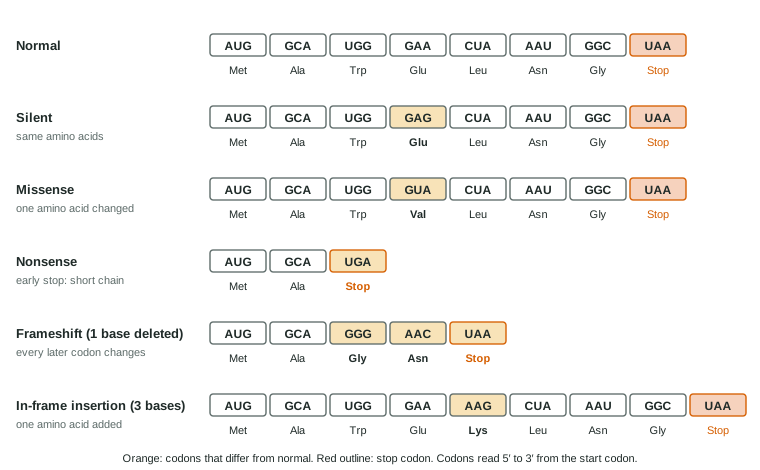
- A single base is replaced in a gene's coding sequence (a point mutation).The codon may still mean the same amino acid (silent), a different one (missense) or stop (nonsense).
- Bases are inserted or deleted in a number that is not a multiple of three.The reading frame shifts, so every codon after the change is different and a stop codon often appears early (frameshift).
- The protein's amino acid sequence changes.Its folding and function may change, which can change the phenotype, as in sickle cell disease.
- Mutations arise at random, not in response to what the organism needs.A mutation can be harmful, neutral or helpful depending on the environment, and mutations in gametes add to the variety in a population.
Part 6 · Key ideas
Key ideas
- Point mutations: silent (same amino acid), missense (different amino acid), nonsense (stop codon). Insertions and deletions not in multiples of three cause frameshifts.
- Causes: copying errors, and mutagens such as UV radiation and some chemicals (many are carcinogens). Mutations are random: not directed by need or by the environment.
- Effects depend on context: neutral, harmful or beneficial. The same sickle-cell allele harms in two copies but protects carriers against malaria.
- Chromosomal mutations: deletion, duplication, inversion, translocation; errors in number include nondisjunction and polyploidy.
- Bacteria gain genes by horizontal gene transfer: transformation, transduction, conjugation. Transposons move within genomes; viruses vary through high mutation rates and reassortment.
Part 7 · Misconception
A common mistake
The wrong idea: Bacteria exposed to a drug mutate in order to survive it.
What actually happens: Mutations arise at random, before and regardless of exposure. The drug does not create useful mutations; it kills the cells without one, so the few that already had one survive and multiply.
Part 8 · Check yourself
Check yourself
Exam-style questions. Anything you miss goes into your review queue.
Model
Normal and mutant mRNAs with a codon table
The normal mRNA, from its 5′ end, is shown with a space after every third base from the start codon. Each mutant strain's mRNA differs by the change listed.
| Strain | mRNA | Change from normal |
|---|---|---|
| Normal | AUG GCA UGG GAA CUA AAU GGC UAA GC | — |
| A | AUGGCAGGGAACUAAAUGGCUAAGC | U at position 7 deleted |
| B | AUGGCAUGGGAGCUAAAUGGCUAAGC | A at position 12 replaced by G |
| C | AUGGCAUGAGAACUAAAUGGCUAAGC | G at position 9 replaced by A |
| D | AUGGCAUGGGUACUAAAUGGCUAAGC | A at position 11 replaced by U |
| E | AUGGCAUGGGAAAAGCUAAAUGGCUAAGC | AAG inserted after position 12 |
| Amino acid | Codons |
|---|---|
| Alanine (Ala) | GCU, GCC, GCA, GCG |
| Arginine (Arg) | CGU, CGC, CGA, CGG, AGA, AGG |
| Asparagine (Asn) | AAU, AAC |
| Aspartic acid (Asp) | GAU, GAC |
| Cysteine (Cys) | UGU, UGC |
| Glutamine (Gln) | CAA, CAG |
| Glutamic acid (Glu) | GAA, GAG |
| Glycine (Gly) | GGU, GGC, GGA, GGG |
| Histidine (His) | CAU, CAC |
| Isoleucine (Ile) | AUU, AUC, AUA |
| Leucine (Leu) | UUA, UUG, CUU, CUC, CUA, CUG |
| Lysine (Lys) | AAA, AAG |
| Methionine (Met), also the start signal | AUG |
| Phenylalanine (Phe) | UUU, UUC |
| Proline (Pro) | CCU, CCC, CCA, CCG |
| Serine (Ser) | UCU, UCC, UCA, UCG, AGU, AGC |
| Threonine (Thr) | ACU, ACC, ACA, ACG |
| Tryptophan (Trp) | UGG |
| Tyrosine (Tyr) | UAU, UAC |
| Valine (Val) | GUU, GUC, GUA, GUG |
| Stop (no amino acid) | UAA, UAG, UGA |
1. Which strain makes a polypeptide identical to the normal one?
- Strain A
- Strain B
- Strain C
- Strain D
- Strain E
Show the answer
In strain B the fourth codon changes from GAA to GAG. Both code for glutamic acid, so the amino acid sequence is unchanged: a silent mutation.
- Strain A: Strain A's deleted base shifts the reading frame, so the chain changes after alanine and stops early.
- Correct: Strain B: Correct: GAA and GAG both code for glutamic acid.
- Strain C: Strain C's third codon becomes UGA, a stop codon, so the chain ends after two amino acids.
- Strain D: Strain D's fourth codon becomes GUA, valine instead of glutamic acid.
- Strain E: Strain E gains a codon, AAG, so its polypeptide has an extra lysine.
2. What polypeptide does strain A make?
- Met-Ala-Gly-Asn
- Met-Ala-Trp-Glu-Leu-Asn-Gly
- Met-Ala-Glu-Leu-Asn-Gly
- Met-Ala
Show the answer
Deleting U7 shifts the reading frame: AUG GCA GGG AAC UAA… gives Met-Ala-Gly-Asn, then UAA, a stop codon that was not in frame before.
- Correct: Met-Ala-Gly-Asn: Correct: a frameshift changes every codon after it and here reaches a stop early.
- Met-Ala-Trp-Glu-Leu-Asn-Gly: This is the normal polypeptide; one deleted base changes the codons after it.
- Met-Ala-Glu-Leu-Asn-Gly: Removing one base does not remove one whole codon; it regroups the rest.
- Met-Ala: The frame shifts at codon 3, but the stop codon comes two codons later, not at once.
3. Strain E gained three bases and strain A lost only one, yet strain E's polypeptide is far closer to normal. Why?
- Three added bases add a codon and keep the frame; one lost base shifts each later codon.
- Added bases are cut out of the mRNA by spliceosomes, but lost bases are not put back by the cell.
- Insertions change just the DNA, while deletions also change the mRNA and the protein made from it.
- A change near the start of an mRNA has a larger effect than one farther along, whatever its size.
Show the answer
Codons are read in threes. Inserting AAG adds one lysine and leaves every later codon in its original frame. Deleting one base regroups all later bases into new codons, which here also creates an early stop.
- Correct: Three added bases add a codon and keep the frame; one lost base shifts each later codon.: Correct: a multiple of three keeps the frame.
- Added bases are cut out of the mRNA by spliceosomes, but lost bases are not put back by the cell.: Spliceosomes remove introns, recognized by sequences at their ends; they do not remove inserted bases.
- Insertions change just the DNA, while deletions also change the mRNA and the protein made from it.: Both insertions and deletions in DNA are copied into the mRNA.
- A change near the start of an mRNA has a larger effect than one farther along, whatever its size.: The two changes are close together (positions 7 and 12); position does not explain the difference.
Experimental setup
Testing chemicals for their ability to cause mutations
A strain of Salmonella bacteria has a mutation in a gene needed to make the amino acid histidine, so it cannot grow without histidine. On plates with no histidine, only cells in which a new mutation has restored the gene can grow into colonies (revertants). Equal numbers of cells were spread on each plate with a test substance. Some plates also got an extract of liver enzymes, which chemically change many substances the way a person's liver does. Values are means of three plates.
| Added to the plate | Revertant colonies per plate |
|---|---|
| Solvent only | 22 |
| Liver extract only | 25 |
| Chemical P | 24 |
| Chemical P + liver extract | 410 |
| Chemical Q | 380 |
| Chemical Q + liver extract | 395 |
4. Which claim is best supported by the colony counts?
- Chemical Q causes mutations by itself; chemical P causes them after liver enzymes change it.
- Chemical P causes mutations by itself; chemical Q causes them after liver enzymes change it.
- Neither chemical causes mutations, because some revertant colonies appear on each plate.
- The liver extract causes the mutations, and the chemicals simply help the cells to grow.
Show the answer
Chemical Q raises revertants from 22 to 380 with or without the extract. Chemical P has no effect alone (24) but raises them to 410 with liver extract, so a product the liver enzymes make from P is the mutagen.
- Correct: Chemical Q causes mutations by itself; chemical P causes them after liver enzymes change it.: Correct: Q acts directly; P must be converted first.
- Chemical P causes mutations by itself; chemical Q causes them after liver enzymes change it.: This reverses the two chemicals.
- Neither chemical causes mutations, because some revertant colonies appear on each plate.: The background of about 22 is the spontaneous rate; the treated plates are 17-19 times higher.
- The liver extract causes the mutations, and the chemicals simply help the cells to grow.: The extract alone gives 25, the same as solvent alone.
5. Why do the plates with solvent only still have about 22 revertant colonies?
- Mutations also arise with no mutagen, from rare copying errors and everyday DNA damage.
- The solvent itself is a weak mutagen, which caused a few of the spread cells to mutate.
- Some cells sensed the lack of histidine and changed their gene so they could grow.
- Some cells were contaminants from the air, carrying a working histidine gene.
Show the answer
Spontaneous mutations happen at a low rate in every population: errors that escape proofreading and mismatch repair, and damage from normal chemistry. Among millions of cells, a few happen to restore the gene.
- Correct: Mutations also arise with no mutagen, from rare copying errors and everyday DNA damage.: Correct: the background is the spontaneous mutation rate.
- The solvent itself is a weak mutagen, which caused a few of the spread cells to mutate.: Nothing suggests the solvent is mutagenic; a spontaneous background is expected.
- Some cells sensed the lack of histidine and changed their gene so they could grow.: Mutations are not directed by need; cells cannot choose to change a gene.
- Some cells were contaminants from the air, carrying a working histidine gene.: The plates are kept sterile and lack histidine for exactly this reason; the counts are steady across plates.
Data table
Counting phage-resistant cells in many cultures
Some E. coli cells carry a mutation that makes them resistant to a phage that kills normal cells. Researchers compared two hypotheses. Hypothesis 1: contact with the phage causes a few cells to become resistant. Hypothesis 2: resistance mutations arise at random while the cells grow, before any phage is present. Set 1: ten separate small cultures, each started from about 1,000 normal cells and grown to about 2 × 10⁸ cells, were each spread on a plate covered with phage. Set 2: ten samples of the same size were taken from one large culture grown the same way and spread on phage plates. Only resistant cells form colonies.
| Plate | 1 | 2 | 3 | 4 | 5 | 6 | 7 | 8 | 9 | 10 |
|---|---|---|---|---|---|---|---|---|---|---|
| Set 1 (separate cultures) | 1 | 0 | 3 | 0 | 0 | 107 | 0 | 5 | 0 | 64 |
| Set 2 (samples of one culture) | 14 | 15 | 13 | 21 | 15 | 14 | 26 | 16 | 20 | 13 |
6. Which hypothesis do the data support, and why?
- Hypothesis 2: an early mutation in one culture leaves many resistant descendants, spreading set 1's counts.
- Hypothesis 1: each plate's phage turned a similar share of cells resistant, which explains the even counts of set 2.
- Hypothesis 1: the cultures in set 1 met different amounts of phage, so their counts differed widely from one another.
- Hypothesis 2: the cells in set 2 grew in one culture, so they could share their resistance with each other.
Show the answer
If contact with phage caused resistance, every plate would show a similar small share, as in set 2. Separate cultures vary hugely because mutations happen at random times during growth: an early one gives a jackpot of resistant offspring, a late one a few, and often none happens at all. Set 2's samples share one history, so they are similar.
- Correct: Hypothesis 2: an early mutation in one culture leaves many resistant descendants, spreading set 1's counts.: Correct: random mutations before exposure predict jackpots between independent cultures.
- Hypothesis 1: each plate's phage turned a similar share of cells resistant, which explains the even counts of set 2.: Set 2's steady counts are expected under both hypotheses; set 1's spread is what tells them apart.
- Hypothesis 1: the cultures in set 1 met different amounts of phage, so their counts differed widely from one another.: Each plate was covered with phage in the same way; only the cultures' separate histories differ.
- Hypothesis 2: the cells in set 2 grew in one culture, so they could share their resistance with each other.: Resistance came from mutations inside cells; the spread in set 1, not sharing in set 2, is the evidence.
7. In sickle cell disease, one base change replaces glutamic acid (charged) with valine (nonpolar) at position 6 of the β chain of hemoglobin. Which chain of effects explains the disease?
- Nonpolar valine on the surface makes hemoglobin stick into fibers at low oxygen, bending red blood cells.
- Valine changes the code for each later amino acid, so the β chain is shortened and hemoglobin fails to form.
- Valine stops the hemoglobin gene from being transcribed, so red blood cells contain little hemoglobin.
- Valine makes hemoglobin hold oxygen so tightly that little of it is released to the body's tissues.
Show the answer
A missense mutation changes one amino acid. The new nonpolar side chain on the outside of the protein makes deoxygenated hemoglobin clump into fibers, which deform red blood cells into sickles that block small vessels and break down early.
- Correct: Nonpolar valine on the surface makes hemoglobin stick into fibers at low oxygen, bending red blood cells.: Correct: one changed side chain, a changed protein shape and interactions, a changed cell.
- Valine changes the code for each later amino acid, so the β chain is shortened and hemoglobin fails to form.: A base replacement does not shift the reading frame; the chain is full length.
- Valine stops the hemoglobin gene from being transcribed, so red blood cells contain little hemoglobin.: The change is in the coding sequence, and the gene is transcribed normally.
- Valine makes hemoglobin hold oxygen so tightly that little of it is released to the body's tissues.: The problem is clumping into fibers at low oxygen, not oxygen being held too tightly.
8. The most common cystic fibrosis allele lacks three bases, so the CFTR channel protein is missing one amino acid out of 1,480 and the rest of its sequence is normal. Most of the protein never reaches the cell membrane. Which explanation is best?
- The missing amino acid makes the protein fold wrongly, so quality control breaks it down.
- Losing three bases shifts the reading frame, so each amino acid after the deletion is wrong.
- The deletion removes the start codon, so the protein is made from a different starting point.
- One amino acid out of 1,480 is too few to affect a protein, so the disease comes from another gene.
Show the answer
Deleting three bases removes one codon and keeps the frame, so only one amino acid is lost. But that one change disturbs folding; misfolded CFTR is held in the ER and destroyed by the proteasome, so little reaches the membrane.
- Correct: The missing amino acid makes the protein fold wrongly, so quality control breaks it down.: Correct: one missing amino acid, wrong shape, protein destroyed.
- Losing three bases shifts the reading frame, so each amino acid after the deletion is wrong.: Three bases are one codon, so the frame is kept; the stem says the rest of the sequence is normal.
- The deletion removes the start codon, so the protein is made from a different starting point.: The stem says one amino acid is missing and the rest is normal, so the start is intact.
- One amino acid out of 1,480 is too few to affect a protein, so the disease comes from another gene.: Protein shape depends on its sequence; one change in a key place can wreck folding.
Part 9 · Summary
Summary
A mutation is a permanent change in DNA's base sequence. It arises from copying errors that escape repair or from damage by mutagens such as UV radiation and some chemicals, many of which are carcinogens, and it arises at random rather than in response to need. Point mutations replace one base and can be silent, missense or nonsense. Insertions and deletions that are not multiples of three shift the reading frame, changing every later codon. Changes to the amino acid sequence can change a protein's shape and function and so the phenotype, as in sickle cell disease. Whether a mutation is harmful, neutral or beneficial depends on the environment. Chromosomes can lose, repeat, flip or move segments, and whole sets can be added (polyploidy). Bacteria also gain genes by transformation, transduction and conjugation; transposons move within genomes; and viruses vary quickly through mutation and reassortment.
Part 10 · Up next
What comes next
Part 11 · Connections