Biotechnology
Biotechnology uses the cell's own enzymes as tools.
Part 1 · Hook
Why this matters
In 2020, labs around the world tested hundreds of millions of nose swabs for a new coronavirus. Each test found a few copies of the virus's genes among millions of human cells by copying one short stretch of genetic material over and over until a machine could see it glow. The same copying trick lets a detective build a DNA profile from a single hair, and it rests on an enzyme you already know: DNA polymerase, borrowed from a bacterium that lives in hot springs.
Part 2 · Before you start
What this builds on
Part 3 · Prerequisite check
Quick check before you start
1. DNA polymerase needs a primer because it
- can only add nucleotides to an existing 3′ end
- cannot read the template strand
- builds DNA in the 3′ to 5′ direction
Show the answer
A primer supplies the 3′ end; PCR uses short DNA primers for the same reason.
- Correct: can only add nucleotides to an existing 3′ end:
- cannot read the template strand:
- builds DNA in the 3′ to 5′ direction:
2. DNA ligase
- seals nicks in the DNA backbone
- unwinds the double helix
- adds RNA primers
Show the answer
Ligase joins Okazaki fragments, and in the lab it joins pieces of DNA.
- Correct: seals nicks in the DNA backbone:
- unwinds the double helix:
- adds RNA primers:
3. In bacterial transformation, a cell
- takes up DNA from its surroundings and gains new traits
- divides into two identical cells
- is infected by a phage
Show the answer
Griffith's R cells took up DNA from dead S cells; labs use the same process with plasmids.
- Correct: takes up DNA from its surroundings and gains new traits:
- divides into two identical cells:
- is infected by a phage:
Part 4 · See it
See it first
Part 5 · Step by step
How it works, step by step
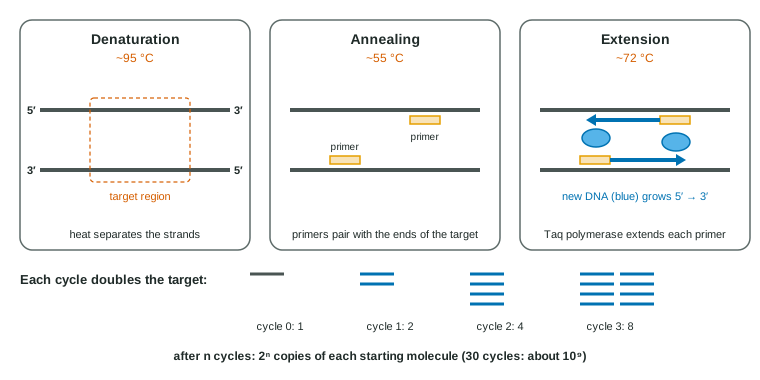
- DNA is heated to about 95 °C.The hydrogen bonds between bases break and the two strands separate (denaturation).
- The mixture is cooled to about 55 °C with an excess of two primers that match the ends of the target.The primers pair with their matching sequences on the single strands (annealing).
- At about 72 °C, heat-stable Taq polymerase adds nucleotides to each primer's 3′ end.Each strand gets a new partner, so every target molecule becomes two; 30 cycles make about a billion copies.
- The copies, or DNA cut by restriction enzymes, are loaded into an agarose gel and an electric current is applied.Negatively charged DNA moves toward the positive electrode, small fragments fastest, so fragments separate by size and can be compared with a DNA ladder.
- A gene is cut and joined into a plasmid with the same restriction enzyme and ligase, and bacteria take up the plasmid.Bacteria that grow on a selective plate carry the recombinant plasmid and make the gene's product, such as human insulin.
Part 6 · Key ideas
Key ideas
- PCR copies a chosen stretch of DNA: denature, anneal primers, extend with Taq polymerase; copies double each cycle (2n).
- Gel electrophoresis separates DNA by size: DNA is negative and runs toward +, small fragments farthest; a DNA ladder gives the sizes.
- Restriction enzymes cut specific sequences, often leaving sticky ends; with ligase they make recombinant DNA. A plasmid carrying a gene and a selectable marker is put into bacteria by transformation (gene cloning).
- DNA sequencing reads the order of bases. DNA fingerprinting compares short tandem repeats.
- CRISPR-Cas9 cuts DNA where a guide RNA pairs, for gene editing. Gene therapy adds working genes to a patient's cells. These tools make genetically modified organisms.
Part 7 · Misconception
A common mistake
The wrong idea: In gel electrophoresis, the biggest DNA fragments travel farthest because they are pulled hardest.
What actually happens: Every fragment has about the same charge per base pair, so the pull per unit length is the same; the gel's mesh slows big fragments most. Small fragments travel farthest.
Part 8 · Check yourself
Check yourself
Exam-style questions. Anything you miss goes into your review queue.
Model
Cutting a plasmid with two restriction enzymes
A circular plasmid was cut with restriction enzyme E, with restriction enzyme B, or with both, and the fragments were separated by gel electrophoresis next to a DNA ladder of known fragment sizes. The cuts were complete.
1. How long is the plasmid, in base pairs? Give a whole number.
Type a number in bp.
Show the answer
Enzyme E gives one band at 6,000 bp: one cut opens the circle into a single linear piece as long as the plasmid. The other lanes agree: 4,500 + 1,500 = 6,000 and 3,500 + 1,500 + 1,000 = 6,000.
- Answer: 6000 bp
2. How many sites does enzyme B cut in the plasmid?
- One
- Two
- Three
- Four
Show the answer
Cutting a circle at n sites gives n pieces. Enzyme B gives two fragments (4,500 and 1,500 bp), so it cuts twice.
- One: One cut in a circle gives a single linear piece, as enzyme E shows.
- Correct: Two: Correct: two cuts in a circle give two pieces.
- Three: Three cuts would give three fragments; lane B has two bands.
- Four: Four cuts would give four fragments.
3. Taking enzyme E's site as position 0 on the 6,000 bp circle, which map fits all three lanes?
- B sites at 500 and 2,000
- B sites at 1,000 and 2,500
- B sites at 1,500 and 3,000
- B sites at 2,000 and 3,500
Show the answer
B sites at 1,000 and 2,500 give B fragments of 1,500 (1,000 to 2,500) and 4,500 (the rest). Adding E's cut at 0 splits the 4,500 piece into 1,000 (0 to 1,000) and 3,500 (2,500 to 6,000): the 3,500, 1,500 and 1,000 bands of the double digest. (The mirror-image map, B sites at 3,500 and 5,000, fits equally well; the gel cannot tell the two directions around the circle apart.)
- B sites at 500 and 2,000: B fragments would be 1,500 and 4,500, but the double digest would give 500, 1,500 and 4,000.
- Correct: B sites at 1,000 and 2,500: Correct: it reproduces the enzyme B lane and the double digest.
- B sites at 1,500 and 3,000: B fragments would be 1,500 and 4,500, but the double digest would give 1,500, 1,500 and 3,000.
- B sites at 2,000 and 3,500: B fragments would be 1,500 and 4,500, but the double digest would give 2,000, 1,500 and 2,500.
Graph
Watching PCR as it runs
The same stretch of a virus's DNA was copied by PCR from two patient samples, A and B, in tubes containing a dye that glows only when bound to double-stranded DNA. Glow was measured after every cycle. A third tube had everything except template DNA. The researchers record the cycle at which each curve first crosses a glow of 20 units.
Sample ASample BNo template
Data table
| PCR cycle (cycle number) | Sample A | Sample B | No template |
|---|---|---|---|
| 0 | 1 | 1 | 1 |
| 2 | 1 | 1 | — |
| 4 | 1 | 1 | 1 |
| 6 | 1 | 1 | — |
| 8 | 1 | 1 | 1 |
| 10 | 1 | 1 | — |
| 12 | 1.2 | 1 | 1 |
| 14 | 1.9 | 1 | — |
| 16 | 5.5 | 1 | 1 |
| 18 | 20.8 | 1.2 | — |
| 20 | 57.5 | 1.9 | 1 |
| 22 | 87.7 | 5.5 | — |
| 24 | 97.4 | 20.8 | 1.1 |
| 26 | 99.5 | 57.5 | — |
| 28 | 99.9 | 87.7 | 1.1 |
| 30 | 100 | 97.4 | — |
| 32 | 100 | 99.5 | 1.2 |
| 34 | 100 | 99.9 | — |
| 36 | 100 | 100 | 1.2 |
4. At about which cycles do samples A and B first cross a glow of 20 units?
- A at about cycle 18, B at about cycle 24
- A at about cycle 24, B at about cycle 18
- Both at about cycle 20, where the curves rise most steeply
- A at about cycle 18, B at no cycle shown on the graph
Show the answer
Sample A's glow is 20.8 at cycle 18 and sample B's is 20.8 at cycle 24.
- Correct: A at about cycle 18, B at about cycle 24: Correct: A crosses six cycles before B.
- A at about cycle 24, B at about cycle 18: This swaps the samples; A rises first.
- Both at about cycle 20, where the curves rise most steeply: At cycle 20, A is at 57.5 and B at 1.9.
- A at about cycle 18, B at no cycle shown on the graph: B crosses 20 at about cycle 24 and reaches 100 by cycle 36.
5. Assume the target doubles every cycle. How many times more target DNA did sample A start with than sample B? Give a whole number.
Type a number in times.
Show the answer
A reaches the same glow 24 − 18 = 6 cycles sooner. Each cycle doubles the DNA, so A started with 26 = 64 times as much target.
- Answer: 64 times
6. A gene and a plasmid are each cut with the same restriction enzyme, which leaves single-stranded sticky ends. Why can they then be joined into recombinant DNA?
- Their sticky ends are complementary and pair; ligase then seals the backbones.
- The enzyme recognizes the plasmid and attaches the gene to it once both are cut.
- Cut DNA ends tend to join each other on their own, whichever enzymes made the cuts.
- The gene's bases bond covalently to the plasmid's bases at the sticky ends without any help.
Show the answer
A restriction enzyme cuts a specific sequence the same way every time, leaving matching single-stranded overhangs. Overhangs from the same enzyme pair with each other, and DNA ligase forms the backbone bonds that make the joint permanent.
- Correct: Their sticky ends are complementary and pair; ligase then seals the backbones.: Correct: complementary overhangs plus ligase.
- The enzyme recognizes the plasmid and attaches the gene to it once both are cut.: Restriction enzymes cut; ligase joins.
- Cut DNA ends tend to join each other on their own, whichever enzymes made the cuts.: Ends from different enzymes usually do not match; the same enzyme makes matching ends.
- The gene's bases bond covalently to the plasmid's bases at the sticky ends without any help.: Base pairing between sticky ends is by hydrogen bonds; ligase makes the covalent backbone bonds.
7. To make human growth hormone in bacteria, researchers insert a DNA copy made from the hormone's mature mRNA, not the gene cut from a human chromosome. Predict what would happen if they used the chromosomal gene instead.
- The introns would be transcribed too and, with no spliceosomes, no working hormone would be made.
- The bacteria would make the hormone normally, since humans and bacteria share the genetic code.
- The bacteria would splice out the introns but be unable to add a 5′ cap, so no hormone would form.
- The bacteria would refuse to take up a plasmid containing human DNA, so no colonies would grow.
Show the answer
Human genes contain introns. Bacteria have no spliceosomes, so the introns would stay in the mRNA and the protein made from it would be wrong. A DNA copy of the mature mRNA (made with reverse transcriptase) has no introns.
- Correct: The introns would be transcribed too and, with no spliceosomes, no working hormone would be made.: Correct: the code is shared, but splicing is not.
- The bacteria would make the hormone normally, since humans and bacteria share the genetic code.: The code is shared, but the introns would still be read into the protein.
- The bacteria would splice out the introns but be unable to add a 5′ cap, so no hormone would form.: Bacteria cannot splice; the problem is the introns, not the cap.
- The bacteria would refuse to take up a plasmid containing human DNA, so no colonies would grow.: Bacteria take up plasmids whatever genes they carry.
Part 9 · Summary
Summary
Biotechnology uses the cell's own enzymes as tools. PCR copies a chosen stretch of DNA by repeating denaturation, primer annealing and extension with heat-stable Taq polymerase, doubling the target each cycle. Gel electrophoresis separates DNA fragments by size: DNA is negatively charged and moves toward the positive electrode, small fragments farthest, and a DNA ladder gives the sizes. Restriction enzymes cut specific sequences, often leaving sticky ends; joined with ligase, a gene and a plasmid make recombinant DNA, which bacteria take up by transformation and keep when a selectable marker lets only them grow. DNA sequencing reads the order of bases; DNA profiles compare short tandem repeats. CRISPR-Cas9 cuts DNA where its guide RNA pairs, allowing gene editing, and gene therapy adds working genes to a patient's cells. These tools are used in medicine, forensics, farming and research.
Part 10 · Up next
What comes next
Part 11 · Connections