Replication
DNA replication is semiconservative: each parental strand is the template for a new partner, so each daughter helix has one old and one new strand, as Meselson and Stahl's density bands showed.
Part 1 · Hook
Why this matters
Before one of your cells divides, it copies about 6 billion base pairs of DNA in a few hours, and leaves behind roughly one uncorrected mistake per billion bases. A bacterium copies its whole chromosome in about 40 minutes, with its copying enzymes racing along at around a thousand nucleotides per second. The trick behind both is the double helix itself: each strand already holds the information needed to rebuild its partner.
Part 2 · Before you start
What this builds on
Part 3 · Prerequisite check
Quick check before you start
1. The two strands of a DNA double helix are antiparallel. This means that
- one strand runs 5′ to 3′ and its partner runs 3′ to 5′ alongside it
- the strands are identical copies of each other
- the strands are joined by covalent bonds between bases
Show the answer
The strands run in opposite directions; they are complementary, not identical, and held by hydrogen bonds.
- Correct: one strand runs 5′ to 3′ and its partner runs 3′ to 5′ alongside it:
- the strands are identical copies of each other:
- the strands are joined by covalent bonds between bases:
2. In which phase of the cell cycle is DNA copied?
- S phase
- G1 phase
- Mitosis
Show the answer
DNA is copied in S (synthesis) phase, so each chromosome has two sister chromatids in G2.
- Correct: S phase:
- G1 phase:
- Mitosis:
3. In double-stranded DNA, each base pair joins
- a purine to a pyrimidine
- two purines
- two pyrimidines
Show the answer
A (purine) pairs with T (pyrimidine) and G (purine) with C (pyrimidine).
- Correct: a purine to a pyrimidine:
- two purines:
- two pyrimidines:
Part 4 · See it
See it first
Part 5 · Step by step
How it works, step by step
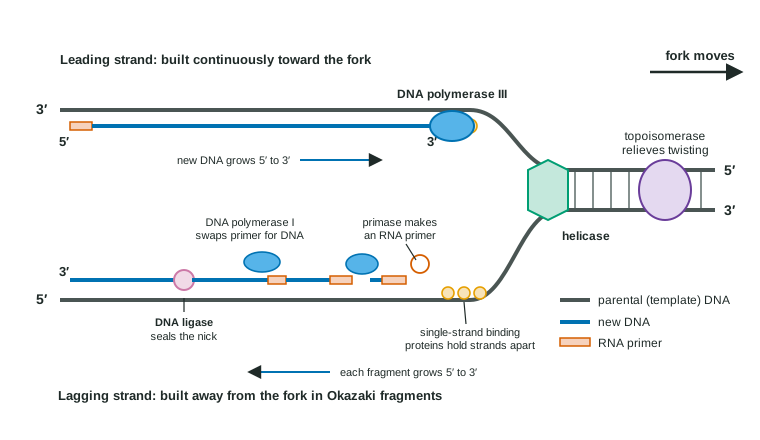
- Copying starts at an origin of replication, where proteins open the helix.Two replication forks form and move away from each other, opening a replication bubble.
- At each fork, helicase breaks the hydrogen bonds between the parental strands.The strands separate; single-strand binding proteins keep them apart, and topoisomerase relieves the twisting that builds up ahead of the fork.
- DNA polymerase can only add nucleotides to an existing 3′ end.Primase first lays down a short RNA primer, and DNA polymerase III extends it, always building 5′ to 3′ and pairing each new base with the template.
- The two templates are antiparallel, but both new strands must grow 5′ to 3′.One new strand (leading) grows continuously toward the fork; the other (lagging) grows away from it in Okazaki fragments, each with its own primer.
- DNA polymerase I replaces each RNA primer with DNA, leaving a nick.DNA ligase seals the nicks, joining the fragments into one continuous strand.
- Each parent strand serves as the template for a new partner.Each daughter molecule has one old strand and one new strand: replication is semiconservative, as Meselson and Stahl showed.
Part 6 · Key ideas
Key ideas
- Semiconservative replication: each new double helix keeps one parental strand. Meselson and Stahl's 15N/14N density bands ruled out the conservative and dispersive models.
- Origins of replication open into bubbles with two replication forks. Bacteria have one origin; each eukaryotic chromosome has thousands.
- Enzymes at the fork: helicase (unwinds), topoisomerase (relieves twisting), single-strand binding proteins, primase (RNA primer), DNA polymerase (adds to the 3′ end, 5′ → 3′), DNA ligase (seals nicks).
- The leading strand is continuous; the lagging strand is made in Okazaki fragments because new DNA can only grow 5′ to 3′.
- Proofreading by DNA polymerase and later mismatch repair keep errors rare. Telomeres buffer linear chromosome ends, which shorten each round unless telomerase rebuilds them.
Part 7 · Misconception
A common mistake
The wrong idea: DNA polymerase builds the lagging strand in the 3′ to 5′ direction, since it runs the opposite way to the leading strand.
What actually happens: DNA polymerase only builds 5′ to 3′. The lagging strand is made in short 5′-to-3′ pieces that point away from the fork, and ligase joins them; that is why it is discontinuous.
Part 8 · Check yourself
Check yourself
Exam-style questions. Anything you miss goes into your review queue.
Model
DNA density bands after a shift from heavy to light nitrogen
Bacteria were grown for many generations in a medium whose only nitrogen was heavy 15N, then moved to a medium with ordinary light 14N. Every cell divided once each generation. DNA was extracted at each generation and spun in a salt solution that forms a density gradient, so each DNA molecule settles where its density matches the solution's. The more 15N a molecule contains, the lower it settles.
1. Which model of DNA copying does the result in tube B, by itself, rule out?
- The conservative model, which predicts a fully heavy band and a fully light band
- The semiconservative model, which predicts one band at the intermediate position after one generation
- The dispersive model, which predicts one band at the intermediate position after one generation
- No model is ruled out, since tube B shows the intermediate band that the three models predict
Show the answer
In the conservative model the parent molecule stays whole (heavy) and the copy is entirely new (light), so generation 1 would show heavy and light bands. Tube B has a single intermediate band.
- Correct: The conservative model, which predicts a fully heavy band and a fully light band: Correct: there is no heavy band and no light band in tube B.
- The semiconservative model, which predicts one band at the intermediate position after one generation: The semiconservative model predicts exactly tube B's single intermediate band, so tube B fits it.
- The dispersive model, which predicts one band at the intermediate position after one generation: The dispersive model also predicts one intermediate band after one generation, so tube B cannot rule it out.
- No model is ruled out, since tube B shows the intermediate band that the three models predict: The conservative model predicts two bands, not an intermediate one, so tube B does rule it out.
2. Which tubes give evidence against the dispersive model? Select all that apply.
- Tube A
- Tube B
- Tube C
- Tube D
- Tube E
Show the answer
In the dispersive model every strand is a patchwork of old and new DNA. After two generations all molecules would be one quarter heavy (one band, between intermediate and light), and separated generation-1 strands would all be half heavy (one band). Tube C shows a fully light band, and tube D shows separate heavy and light strands.
- Tube A: Tube A is the starting DNA; every model starts with it.
- Tube B: One intermediate band after one generation is predicted by the dispersive model too.
- Correct: Tube C: Correct: a fully light band at generation 2 means some molecules have no old DNA at all, which dispersal cannot produce.
- Correct: Tube D: Correct: generation-1 molecules contain one whole heavy strand and one whole light strand, not two half-heavy strands.
- Tube E: Tube E is a reference that marks the heavy and light positions; it tests no model.
3. The bacteria continue in 14N until generation 4. What percentage of their DNA molecules will be at the intermediate position? Give one decimal place.
Type a number in %.
Show the answer
Each original molecule gives 24 = 16 molecules after four generations. Its two heavy strands survive intact, one in each of 2 hybrid molecules; the other 14 are fully light. 2 ÷ 16 = 12.5%.
- Answer: 12.5 %
Data table
Where newly made DNA ends up after a short pulse of label
Growing E. coli cells were given radioactive thymidine (a DNA building block) for 5 seconds, then a large excess of unlabeled thymidine. At several times after the pulse, the DNA was extracted, its strands were separated, and the label was measured in short pieces (under 2,000 nucleotides) and in long DNA. A mutant strain whose cells copy DNA normally at 30 °C but have one enzyme that stops working at 42 °C was tested the same way. Both strains were tested at 42 °C; each value is the mean of three cultures.
| Time after the pulse (s) | Normal strain (%) | Mutant strain (%) |
|---|---|---|
| 5 | 51 | 53 |
| 15 | 34 | 52 |
| 30 | 18 | 50 |
| 60 | 7 | 49 |
| 120 | 3 | 48 |
4. Why is about half, rather than nearly all, of the label in short pieces at 5 seconds in both strains?
- One template is copied continuously into long DNA, and the other is copied in short fragments.
- Half the cells in each culture were copying DNA during the pulse, and the other half were not copying.
- Short pieces break off long DNA when the strands are separated, so half of each long strand is lost.
- DNA polymerase copies each template in short pieces, and half of them have already been joined by 5 s.
Show the answer
Because the strands are antiparallel and DNA polymerase adds only to a 3′ end, one new strand (leading) grows continuously toward the fork while the other (lagging) is made in short Okazaki fragments. So roughly half of the new DNA starts out in short pieces.
- Correct: One template is copied continuously into long DNA, and the other is copied in short fragments.: Correct: leading strand long, lagging strand in fragments.
- Half the cells in each culture were copying DNA during the pulse, and the other half were not copying.: Cells that were not copying DNA would take up no label at all, so they would not add unlabeled long DNA to the count.
- Short pieces break off long DNA when the strands are separated, so half of each long strand is lost.: If separation broke strands, the mutant would lose label from long DNA as well, and its numbers would not stay steady.
- DNA polymerase copies each template in short pieces, and half of them have already been joined by 5 s.: If both strands were made in pieces, nearly all label would start in short pieces; in the mutant it stays near half, so the other half was never short.
5. Which enzyme is most likely the one that stops working in the mutant at 42 °C?
- DNA ligase
- Helicase
- Primase
- Topoisomerase
Show the answer
The mutant still makes short pieces and long DNA, but the short pieces are never joined. Ligase seals the nicks between Okazaki fragments, so a failed ligase leaves them separate.
- Correct: DNA ligase: Correct: fragments are made but not joined.
- Helicase: Without helicase the strands would not open, and almost no new DNA would be labeled at all.
- Primase: Without primase no new fragments could start, so the mutant would have fewer short pieces, not a steady half.
- Topoisomerase: Without topoisomerase twisting would stall the forks; the problem here is joining, not unwinding.
6. The template for a stretch of new DNA reads 3′-TACCGGAT-5′. Which new strand will DNA polymerase build on it?
- 5′-ATGGCCTA-3′
- 3′-ATGGCCTA-5′
- 5′-TAGGCCAT-3′
- 5′-AUGGCCUA-3′
Show the answer
Pair each base (T–A, A–T, C–G, G–C) and make the new strand antiparallel: the template's 3′ end lines up with the new strand's 5′ end, so the new strand reads 5′-ATGGCCTA-3′, built from 5′ to 3′.
- Correct: 5′-ATGGCCTA-3′: Correct: complementary bases, antiparallel, written 5′ to 3′.
- 3′-ATGGCCTA-5′: The bases are right, but the ends are labeled as if the strands ran parallel; they run in opposite directions.
- 5′-TAGGCCAT-3′: This is the template itself, rewritten from 5′ to 3′; the new strand is its complement.
- 5′-AUGGCCUA-3′: U belongs in RNA; DNA polymerase builds DNA, which uses T.
7. Why do the ends of linear eukaryotic chromosomes get shorter with each round of copying, while a circular bacterial chromosome does not?
- When the last RNA primer at an end is removed, no DNA lies beyond it to supply a 3′ end, so the gap stays unfilled.
- Helicase is unable to open the DNA at the end of a linear chromosome, so the last part is left uncopied.
- DNA ligase cuts off the end of each linear chromosome to remove the leftover RNA primers after copying.
- Linear chromosomes have no origins near their ends, so the forks run out of time before they arrive there.
Show the answer
DNA polymerase I fills a primer's gap by extending the DNA behind it. At the very end of a lagging strand there is nothing behind the last primer, so that stretch stays single-stranded and is lost. A circle has no ends, so every primer gap has DNA behind it.
- Correct: When the last RNA primer at an end is removed, no DNA lies beyond it to supply a 3′ end, so the gap stays unfilled.: Correct: the end-replication problem comes from primers plus 5′-to-3′ synthesis.
- Helicase is unable to open the DNA at the end of a linear chromosome, so the last part is left uncopied.: The ends are opened and mostly copied; only the last primer's stretch on the lagging strand is lost.
- DNA ligase cuts off the end of each linear chromosome to remove the leftover RNA primers after copying.: Ligase joins DNA; it does not cut chromosome ends.
- Linear chromosomes have no origins near their ends, so the forks run out of time before they arrive there.: Forks reach the ends; the problem is filling the last primer's gap, not timing.
Part 9 · Summary
Summary
DNA replication is semiconservative: each parental strand is the template for a new partner, so each daughter helix has one old and one new strand, as Meselson and Stahl's density bands showed. Copying begins at origins of replication, which open into bubbles with two forks. Helicase unwinds the helix, single-strand binding proteins hold the strands apart, and topoisomerase relieves the twisting ahead. Primase makes a short RNA primer, and DNA polymerase III adds nucleotides to its 3′ end, building 5′ to 3′. Because the strands are antiparallel, the leading strand is made continuously and the lagging strand in Okazaki fragments; DNA polymerase I replaces the primers with DNA and ligase seals the nicks. Proofreading and mismatch repair keep errors rare. Linear chromosome ends shorten each round; telomeres buffer them, and telomerase can rebuild them.
Part 10 · Up next
What comes next
Part 11 · Connections