Introduction to Random Variables and Probability Distributions
A random variable is a number from a chance process, defined in context.
Part 1 · Hook
Why this matters
Part 2 · Before you start
What this builds on
Part 3 · Prerequisite check
Quick check before you start
1. A die is rolled. What is P(roll is at least 5)?
Show the answer
5 and 6: 2 of 6 outcomes.
- Correct: :
- :
- :
- :
2. Which variable is discrete?
- The number of siblings a student has
- A student's height
- The time to finish a test
- The weight of a backpack
Show the answer
Siblings are counted, with gaps between the values.
- Correct: The number of siblings a student has:
- A student's height:
- The time to finish a test:
- The weight of a backpack:
Part 4 · See it
See it first
Part 5 · Step by step
How it works, step by step
- A chance process produces a numberthat number is a random variable, named with a capital letter and defined in context
- List every value with its probabilitythe probability distribution, a table or a probability histogram
- Every outcome gives exactly one valuethe probabilities are from 0 to 1 and add to 1, which finds a missing value
- Add the probabilities up to a boundarya cumulative probability such as ; translate "fewer than 3" as
Part 6 · Key ideas
Key ideas
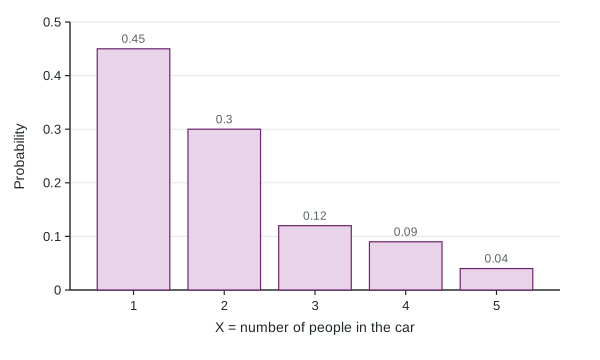
- A random variable is a number that comes from a chance process. Define it in context: "Let X = the number of people in a randomly chosen car."
- A probability distribution gives every value of the random variable and its probability, as a table or a probability histogram. The probabilities are from 0 to 1 and add to 1.
- A discrete random variable has separate values (counts); a continuous one can take any value in an interval.
- A cumulative probability adds up to a boundary: . "Fewer than 3" is ; "at least 3" is .
Part 7 · Misconception
A common mistake
The wrong idea: "Let X = rock songs" defines the random variable.
What actually happens: A random variable is a number. Say what is counted and out of what: "Let X = the number of rock songs among the 12 songs on the playlist."
Part 8 · Check yourself
Check yourself
Exam-style questions. Anything you miss goes into your review queue.
Table
People in a car at a toll booth
| 1 | 2 | 3 | 4 | 5 | |
|---|---|---|---|---|---|
| 0.45 | 0.30 | 0.12 | 0.09 | ? |
1. What probability belongs in the blank, ?
Type a number. A table answer and a calculator answer are both accepted.
Show the answer
The probabilities of a distribution add to 1:
- Answer: 0.04
2. What is the probability that a randomly chosen car has at least 3 people?
Type a number. A table answer and a calculator answer are both accepted.
Show the answer
"At least 3" is 3, 4 or 5:
- Answer: 0.25
3. What is the probability that a car has fewer than 3 people?
Type a number. A table answer and a calculator answer are both accepted.
Show the answer
"Fewer than 3" means 1 or 2, that is :
- Answer: 0.75
4. Which is a complete definition of the random variable in this context?
- X = the people in the cars at the toll booth
- X = the number of people in a randomly chosen car at the toll booth
- X = the probability that a car has more than one person
- X = the cars that pass through the toll booth on a randomly chosen day
Show the answer
A random variable is a number that comes from a chance process, defined in context: what is counted, and for which randomly chosen individual.
- X = the people in the cars at the toll booth: People are not a number. Say what is counted: the number of people.
- Correct: X = the number of people in a randomly chosen car at the toll booth: Right: a count, in context, for one random car.
- X = the probability that a car has more than one person: X takes values like 1 to 5; probabilities describe how likely each value is.
- X = the cars that pass through the toll booth on a randomly chosen day: Cars are the individuals, not the numerical value being recorded.
Graph
Goals scored by a soccer team
5. What is the probability that the team scores at least 2 goals in a game?
Type a number. A table answer and a calculator answer are both accepted.
Show the answer
- Answer: 0.4
6. What kind of random variable is G?
- Continuous, because a game lasts for 90 minutes of playing time
- Discrete, because it takes separate whole-number values
- Categorical, because each bar is a category
- Continuous, because it can be any number from 0 to 4
Show the answer
G takes a list of separate values (0, 1, 2, 3, 4), so it is a discrete random variable.
- Continuous, because a game lasts for 90 minutes of playing time: The variable is goals, not time.
- Correct: Discrete, because it takes separate whole-number values: Right: goals are counted.
- Categorical, because each bar is a category: G is a number from a chance process; the bars are its values.
- Continuous, because it can be any number from 0 to 4: It cannot be 2.5 goals; only whole numbers are possible.
Part 9 · Summary
Summary
Part 10 · Up next
What comes next
Part 11 · Connections