Unit 2 · Topic 2.10

Inverses of Exponential Functions

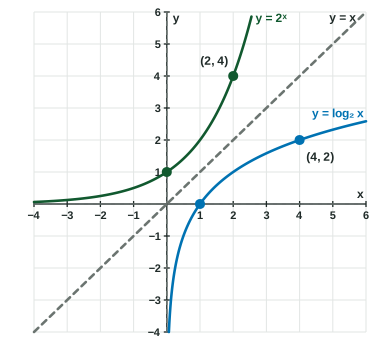
With the same base, f(x) = b^x and g(x) = log_b x are inverses: each undoes the other, their graphs reflect across y = x , and their domains, ranges and asymptotes trade places.

Practice 2: Multiple RepresentationsPractice 3: Communication and Reasoning

Part 1 · Hook

Why this matters

A savings balance doubles every 77 years. Asking "how much after 2121 years?" uses an exponential function. Asking "when will it reach 88 times what I put in?" runs the same rule backward. That backward rule is a logarithm with the same base: exponentials and logarithms undo each other.

Part 2 · Before you start

What this builds on

Part 3 · Prerequisite check

Quick check before you start

1. What is log2⁡32\log_2 32?

  1. 55
  2. 1616
  3. 66
  4. 15\frac{1}{5}
Show the answer

25=322^5 = 32, so log2⁡32=5\log_2 32 = 5.

  • Correct: 55:
  • 1616:
  • 66:
  • 15\frac{1}{5}:

2. The point (3,7)(3, 7) is on the graph of an invertible function ff. Which point is on the graph of f−1f^{-1}?

  1. (7,3)(7, 3)
  2. (3,7)(3, 7)
  3. (−3,−7)(-3, -7)
  4. (3,17)\left(3, \frac{1}{7}\right)
Show the answer

An inverse swaps inputs and outputs.

  • Correct: (7,3)(7, 3):
  • (3,7)(3, 7):
  • (−3,−7)(-3, -7):
  • (3,17)\left(3, \frac{1}{7}\right):

Part 4 · See it

See it first

Graphs of y = 2 to the x and y = log base 2 of x, mirror images across the dashed line y = x, with (2, 4) matching (4, 2) and (0, 1) matching (1, 0).
y=2xy = 2^x and y=log2⁡xy = \log_2 x reflect across y=xy = x: (2,4)(2, 4) matches (4,2)(4, 2), and the horizontal asymptote y=0y = 0 matches the vertical asymptote x=0x = 0. LevlPrep original diagram.

Part 5 · Step by step

How it works, step by step

  1. f(x)=bxf(x) = b^x sends the exponent aa to bab^ag(x)=logb⁡xg(x) = \log_b x sends bab^a back to aa: they are inverses
  2. Compose themlogb⁡(bx)=x\log_b(b^x) = x for every xx, and blogb⁡x=xb^{\log_b x} = x for x>0x > 0
  3. Swap coordinatesthe domain (−∞,∞)(-\infty, \infty) and range (0,∞)(0, \infty) of bxb^x trade places, and y=0y = 0 becomes x=0x = 0
  4. Add to the input of bxb^xthe output is multiplied
  5. Multiply the input of logb⁡x\log_b xthe output increases by a fixed amount

Part 6 · Key ideas

Key ideas

  • y=bxy = b^x and y=logb⁡xy = \log_b x (same base) are inverse functions: logb⁡(bx)=x\log_b(b^x) = x and blogb⁡x=xb^{\log_b x} = x for x>0x > 0.
  • Their graphs reflect across y=xy = x; ln⁡x\ln x and exe^x are the most used pair.
  • bxb^x: domain all real numbers, range y>0y > 0, asymptote y=0y = 0. logb⁡x\log_b x: domain x>0x > 0, range all real numbers, asymptote x=0x = 0.
  • Exponential: equal additions to the input multiply the output. Logarithmic: equal factors on the input add to the output.

Part 7 · Misconception

A common mistake

The wrong idea: The inverse of f(x)=5xf(x) = 5^x is the fifth root, x5\sqrt[5]{x}.

What actually happens: A fifth root undoes the power x5x^5, where the variable is the base. In 5x5^x the variable is the exponent, so the inverse is log5⁡x\log_5 x.

Part 8 · Check yourself

Check yourself

Exam-style questions. Anything you miss goes into your review queue.

Table

Values of h(x)=log4⁡xh(x) = \log_4 x

Values of h(x) = log base 4 of x at six inputs, each 4 times the one before
xx116\frac{1}{16}14\frac{1}{4}141664
h(x)h(x)-2-10123

1. In the table, each input is 44 times the one before it. What happens to h(x)h(x) at each step?

  1. It increases by 11
  2. It is multiplied by 44
  3. It increases by 44
  4. It is multiplied by 14\frac{1}{4}
Show the answer

Multiplying the input of log4⁡\log_4 by 44 adds 11 to the output: the outputs go −2,−1,0,1,2,3-2, -1, 0, 1, 2, 3.

  • Correct: It increases by 11: Equal factors in the input give equal differences in the output: +1+1 each time.
  • It is multiplied by 44: Multiplying by 44 is what happens to the inputs, not the outputs.
  • It increases by 44: The outputs go up by 11, from 00 to 11 to 22, not by 44.
  • It is multiplied by 14\frac{1}{4}: The outputs rise, from 00 to 11 to 22; they are not divided by 44.

2. The inverse of hh is k(x)=4xk(x) = 4^x. Find k(2.5)k(2.5).

No calculator. Type the exact value (a fraction, π, e or a root is fine).

Show the answer

k(2.5)k(2.5)=45/2= 4^{5/2}=(4)5= (\sqrt{4})^5=25= 2^5=32= 32. It lies between k(2)=16k(2) = 16 and k(3)=64k(3) = 64, but not halfway: equal input steps multiply outputs.

  • Answer: 32

3. The inverse of hh is k(x)=4xk(x) = 4^x. Which range does kk have?

  1. (0,∞)(0, \infty)
  2. (−∞,∞)(-\infty, \infty)
  3. [1,∞)[1, \infty)
  4. (−∞,0)(-\infty, 0)
Show the answer

The range of the inverse is the domain of hh. A base-44 logarithm takes only positive inputs, so kk has only positive outputs.

  • Correct: (0,∞)(0, \infty): Domain of hh, x>0x > 0, becomes the range of kk.
  • (−∞,∞)(-\infty, \infty): That is the range of hh, which becomes the domain of kk.
  • [1,∞)[1, \infty): k(−1)=14k(-1) = \frac{1}{4}, an output less than 11.
  • (−∞,0)(-\infty, 0): Powers of 44 are positive, never negative.

Graph

The graph of f(x)=3xf(x) = 3^x

gg is the inverse of f(x)=3xf(x) = 3^x, so g(x)=log3⁡xg(x) = \log_3 x.
−4−3−2−1123−1123456789xyf

4. The point (1,3)(1, 3) is on the graph of ff. Which point is on the graph of gg?

  1. (3,1)(3, 1)
  2. (1,3)(1, 3)
  3. (1,13)\left(1, \frac{1}{3}\right)
  4. (−1,−3)(-1, -3)
Show the answer

gg swaps inputs and outputs of ff: f(1)=3f(1) = 3, so g(3)=1g(3) = 1.

  • Correct: (3,1)(3, 1): log3⁡3=1\log_3 3 = 1.
  • (1,3)(1, 3): This point is on ff itself.
  • (1,13)\left(1, \frac{1}{3}\right): 13\frac{1}{3} is a reciprocal, not a swap of coordinates.
  • (−1,−3)(-1, -3): That reflects across the origin, not across y=xy = x.

5. The graph of ff has the horizontal asymptote y=0y = 0. Which statement describes gg near its asymptote?

  1. limx→0+g(x)=−∞\lim_{x \to 0^+} g(x) = -\infty
  2. limx→−∞g(x)=0\lim_{x \to -\infty} g(x) = 0
  3. limx→0+g(x)=0\lim_{x \to 0^+} g(x) = 0
  4. limx→∞g(x)=0\lim_{x \to \infty} g(x) = 0
Show the answer

Reflecting across y=xy = x turns the horizontal asymptote y=0y = 0 into the vertical asymptote x=0x = 0. As xx approaches 00 from the right, log3⁡x\log_3 x decreases without bound.

  • Correct: limx→0+g(x)=−∞\lim_{x \to 0^+} g(x) = -\infty: Small positive inputs, such as 19\frac{1}{9}, give large negative outputs, such as −2-2.
  • limx→−∞g(x)=0\lim_{x \to -\infty} g(x) = 0: That describes ff: limx→−∞3x=0\lim_{x \to -\infty} 3^x = 0.
  • limx→0+g(x)=0\lim_{x \to 0^+} g(x) = 0: g(1)=0g(1) = 0; near x=0x = 0 the outputs fall without bound.
  • limx→∞g(x)=0\lim_{x \to \infty} g(x) = 0: gg keeps growing, slowly: g(81)=4g(81) = 4.

6. Write the inverse of f(x)=5xf(x) = 5^x.

Type an expression for f−1(x)=f^{-1}(x) =.

Show the answer

The base-55 logarithm undoes the base-55 exponential: f−1(x)=log5⁡xf^{-1}(x) = \log_5 x.

  • Answer: f−1(x)=f^{-1}(x) = log5⁡(x)\log_{5}(x)

7. Let f(x)=2xf(x) = 2^x. When xx increases by 33, what happens to f(x)f(x)?

  1. It is multiplied by 88
  2. It increases by 88
  3. It is multiplied by 66
  4. It increases by 33
Show the answer

f(x+3)f(x + 3)=2x+3= 2^{x + 3}=2x⋅23= 2^x \cdot 2^3=8f(x)= 8 f(x). Adding to the input multiplies the output.

  • Correct: It is multiplied by 88: 2x+3=8⋅2x2^{x + 3} = 8 \cdot 2^x.
  • It increases by 88: From x=0x = 0 to x=3x = 3 the output goes from 11 to 88, up 77; the change grows with xx. The factor is always 88.
  • It is multiplied by 66: 2⋅3=62 \cdot 3 = 6, but three factors of 22 make 23=82^3 = 8.
  • It increases by 33: That is the change in the input, not in the output.

Part 9 · Summary

Summary

With the same base, f(x)=bxf(x) = b^x and g(x)=logb⁡xg(x) = \log_b x are inverses: each undoes the other, their graphs reflect across y=xy = x, and their domains, ranges and asymptotes trade places. Adding to the input of an exponential multiplies its output; multiplying the input of a logarithm adds to its output. To invert a stretched exponential, undo the outer steps first, then take the logarithm.

Part 10 · Up next

What comes next

Part 11 · Connections

Connections