Torque
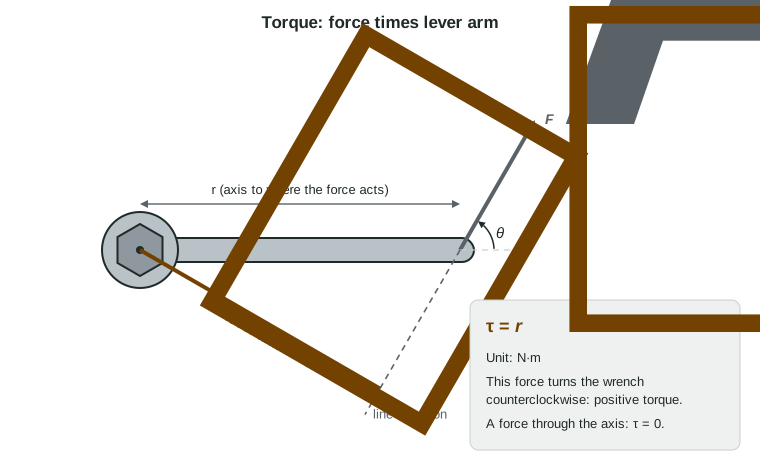
Torque measures how well a force turns an object about an axis: τ = r⊥F = rF sin θ, where the lever arm r⊥ is the perpendicular distance from the axis to the force’s line of action.
Part 1 · Hook
Why this matters
Part 2 · Before you start
What this builds on
Part 3 · Prerequisite check
Quick check before you start
1. In a right triangle, the side opposite angle θ equals
- hypotenuse × sin θ
- hypotenuse × cos θ
- hypotenuse × tan θ
- hypotenuse ÷ sin θ
Show the answer
sin θ = opposite/hypotenuse.
- Correct: hypotenuse × sin θ:
- hypotenuse × cos θ:
- hypotenuse × tan θ:
- hypotenuse ÷ sin θ:
2. A free-body diagram shows
- each force on one object, drawn from a dot
- the net force as an extra arrow
- the velocity of the object
- forces the object exerts on others
Show the answer
An FBD shows only real forces on the object, from a dot.
- Correct: each force on one object, drawn from a dot:
- the net force as an extra arrow:
- the velocity of the object:
- forces the object exerts on others:
3. An object turns counterclockwise and slows down. Counterclockwise is positive. The sign of α is
- negative
- positive
- zero
- undefined
Show the answer
Slowing means α is opposite to ω.
- Correct: negative:
- positive:
- zero:
- undefined:
Part 4 · See it
See it first
Part 5 · Step by step
How it works, step by step
- A force acts on an object that can turn about an axisits line of action may pass the axis at some distance
- The line of action misses the axis by a perpendicular distance r⊥the force has a lever arm r⊥ = r sin θ
- The force has a lever armit exerts a torque τ = r⊥F that tends to turn the object one way
- Several forces acttheir torques add with signs (counterclockwise +, clockwise −) to a net torque
- A force’s line of action passes through the axisits lever arm and its torque are zero
Part 6 · Key ideas
Key ideas
- Torque is the turning effect of a force: τ = r⊥F = rF sin θ, in N·m.
- The lever arm r⊥ is the perpendicular distance from the axis to the line of action, not the distance to the point where the force acts.
- Only the part of a force perpendicular to r turns the object.
- Give each torque a sign: counterclockwise + and clockwise − (or the reverse, stated). Add them for the net torque.
- A force diagram starts each force at its point of application, labeled with type and agent.
Part 7 · Misconception
A common mistake
The wrong idea: The torque of a force is its size times the distance from the axis to where it acts, whatever its direction.
What actually happens: Only the perpendicular distance from the axis to the force’s line of action counts: τ = rF sin θ. A force along the line toward the axis has no torque however far out it acts.
Part 8 · Check yourself
Check yourself
Exam-style questions. Anything you miss goes into your review queue.
Diagram
Four ways to push a door
A door 0.80 m wide is hinged at its left edge. Four separate pushes, each 30 N, are shown; consider each on its own.
1. What is the size of the torque from push 1 about the hinge? Give the value and its unit.
Type a number and its unit.
Show the answer
Push 1 is perpendicular to the door, so its lever arm is the full 0.80 m: τ = r⊥F = (0.80 m)(30 N) = 24 N·m.
- Answer: 24 N·m
2. Rank the sizes of the torques the four pushes exert about the hinge.
- τ₁ > τ₂ = τ₃ > τ₄
- τ₁ = τ₃ > τ₂ > τ₄
- τ₁ = τ₂ = τ₃ = τ₄
- τ₄ > τ₁ > τ₃ > τ₂
Show the answer
Lever arms: push 1, 0.80 m; push 2, 0.40 m; push 3, (0.80 m)(sin 30°) = 0.40 m; push 4, 0. With F = 30 N: 24, 12, 12 and 0 N·m.
- Correct: τ₁ > τ₂ = τ₃ > τ₄: Right: 24, 12, 12 and 0 N·m.
- τ₁ = τ₃ > τ₂ > τ₄: Push 3 acts at the edge but at 30°, so its lever arm is halved to 0.40 m.
- τ₁ = τ₂ = τ₃ = τ₄: Equal forces give equal torques only with equal lever arms.
- τ₄ > τ₁ > τ₃ > τ₂: Push 4 points straight at the hinge, so its lever arm is zero.
3. Why does push 4 produce no torque about the hinge?
- Its line of action passes through the hinge
- It is weaker than the other three pushes
- It acts at the point farthest from the hinge
- The door’s weight cancels it
Show the answer
Torque is r⊥F, where r⊥ is the perpendicular distance from the axis to the force’s line of action. Push 4 points along the door straight at the hinge, so r⊥ = 0 and τ = 0, however hard the push.
- Correct: Its line of action passes through the hinge: Right: the perpendicular distance from the hinge to its line is zero.
- It is weaker than the other three pushes: All four pushes are 30 N; the difference is the lever arm.
- It acts at the point farthest from the hinge: Pushes 1 and 3 act there too and do give torques.
- The door’s weight cancels it: The door’s weight is vertical; push 4 is horizontal along the door. They do not cancel, and neither is the reason.
4. What is the size of the torque from push 3 about the hinge?
Type a number in N·m.
Show the answer
τ = rF sin θ = (0.80 m)(30 N)(sin 30°) = 12 N·m. Equivalently, the lever arm is (0.80 m)(sin 30°) = 0.40 m.
- Answer: 12 N·m
5. The lever arm of a force about an axis is
- the perpendicular distance from the axis to the force’s line of action
- the distance from the axis to where the force acts
- the length of the force arrow
- the distance from the force to the center of mass
Show the answer
Extend the force along its line of action. The lever arm r⊥ is the perpendicular distance from the axis to that line; τ = r⊥F.
- Correct: the perpendicular distance from the axis to the force’s line of action: Right: r⊥, the shortest distance from the axis to the line.
- the distance from the axis to where the force acts: That is r. The lever arm is r⊥ = r sin θ, which equals r for a perpendicular force.
- the length of the force arrow: The arrow’s length shows the force’s size, not a distance.
- the distance from the force to the center of mass: Torque is about the chosen axis, not the center of mass.
6. How does a force diagram of a beam differ from a free-body diagram of the beam?
- Each force is drawn from the point where it acts on the beam
- Each force is drawn from a dot at the center of mass
- Each force is split into parts along and across the beam
- The net torque is drawn as an extra curved arrow
Show the answer
A free-body diagram puts all forces at one dot. For rotation the point of application matters, so a force diagram draws the object and starts each force where it acts, labeled with type and agent.
- Correct: Each force is drawn from the point where it acts on the beam: Right: torques depend on where forces act, so the diagram shows it.
- Each force is drawn from a dot at the center of mass: That is a free-body diagram; it hides where forces act, so it cannot show torques.
- Each force is split into parts along and across the beam: Both diagrams show whole forces; components go beside the diagram.
- The net torque is drawn as an extra curved arrow: Neither diagram shows a net force or net torque as an extra arrow.
7. Counterclockwise is positive. A force that would start a wheel turning clockwise exerts a torque that is
- negative
- positive
- zero
- positive or negative, depending on its size
Show the answer
On this exam a torque is described only as clockwise or counterclockwise. With counterclockwise positive, any torque tending to turn the object clockwise is negative.
- Correct: negative: Right: the sign of a torque says which way it tends to turn the object.
- positive: Positive was chosen as counterclockwise.
- zero: A force that starts the wheel turning has a nonzero torque.
- positive or negative, depending on its size: The sign comes from the direction of turning, not the size.
Part 9 · Summary
Summary
Part 10 · Up next
What comes next
Part 11 · Connections