Two travelers sit side by side on the same flight. One paid $90 because she booked a month ahead; the other paid $260 because he booked the day before. The seat cost the airline exactly the same. Charging different buyers different prices for the same good, when the cost is the same, is price discrimination, and only a firm with market power can do it.
What price discrimination is (and is not)
Price discrimination means selling the same good at different prices to different buyers for reasons other than cost. Student and senior discounts at a cinema, cheaper tickets booked early, coupons that only price-conscious shoppers bother to clip, and lower prices for the same software in poorer countries are all examples. A higher price for a bigger car, or for a delivery to a farther town, is not price discrimination: there the price follows a difference in cost.
Three conditions
- Market power. The firm faces a downward-sloping demand curve and can set its price. A price taker cannot charge anyone more than the market price.
- A way to sort buyers into groups whose demand differs in elasticity: by age, by student ID, by when they book, by where they live.
- A way to stop resale. If buyers who pay the low price could resell to buyers facing the high price, the high price would collapse. Names on airline tickets, ID checks and services that cannot be passed on (a haircut, a medical exam) all block resale.
Who pays more
The firm charges the higher price to the less elastic group (buyers who need the good and have few substitutes, such as business travelers who must fly on a given day) and the lower price to the more elastic group (students, vacation travelers who can switch dates or stay home). Each group is priced the way a monopolist prices its whole market: where MR = MC for that group, reading the price from that group's demand. Raising the price to an inelastic group loses few sales; cutting it for an elastic group gains many.
Worked example: two groups at a cinema. Halloway Cinema (invented) sells 200 student tickets a night at $6 and 300 adult tickets at $10. Students' price elasticity is 2.5, adults' is 1.5 (absolute values). Both groups are priced on the elastic part of their demand, as a profit-maximizing monopolist always is; the students' demand is the more elastic.
- Revenue.
dollars a night. Multiply each group's price by its own quantity; do not use an average price. - Who gets the discount. Students: 2.5 is more elastic than the adults' 1.5, so students are the more price-sensitive group. A $10 price would drive many of them away.
- Why the ID check. It sorts buyers and stops adults from buying the $6 ticket.
Perfect price discrimination
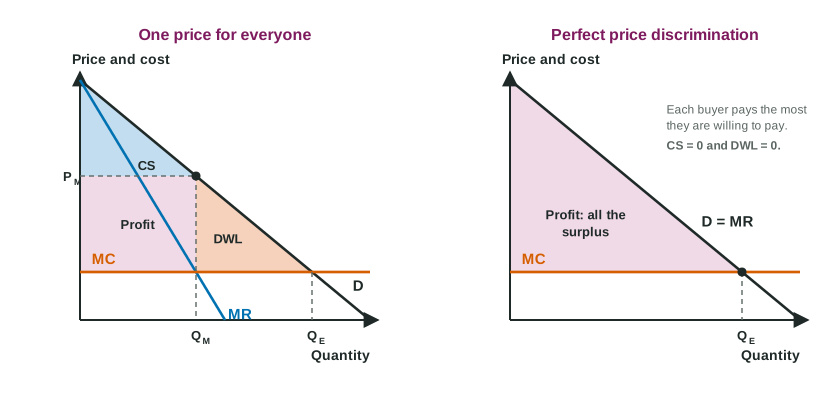
In the extreme case, the firm charges each buyer the most that buyer is willing to pay. Then selling one more unit does not lower the price of any other unit, so each unit adds its own price to revenue: the marginal revenue curve is the demand curve. The firm still produces where MR = MC, and since MR is now demand, that is where demand meets MC.
| One price (single-price monopoly) | Perfect price discrimination | |
|---|---|---|
| MR curve | below demand | the demand curve |
| Quantity | QM, where MR = MC | QE, where D = MC (efficient) |
| Consumer surplus | the triangle above PM | zero |
| Deadweight loss | between D and MC from QM to QE | zero |
| Profit | the rectangle between PM and ATC | all the surplus between D and MC, minus fixed cost |
Worked example: an eye clinic. Oriel Clinic (invented) faces demand (Q in thousands of exams) and a flat marginal cost of $20.
- One price. MR is ; MR = MC at 4 thousand exams, and demand gives $60. Consumer surplus is thousand dollars, and the deadweight loss is
thousand dollars. - Perfect price discrimination. Demand meets MC where : 8 thousand exams. The clinic collects the whole triangle between demand and MC, thousand dollars above the cost of the exams. Consumer surplus and deadweight loss are both zero.
Notice what changed and what did not. Total surplus is as large as it can be, which is why perfect price discrimination is allocatively efficient. But all of it goes to the firm. Efficiency and fairness are separate questions; on the exam, say which one you are answering.
For the exam
- State the conditions in words: market power, sorting buyers, no resale.
- Perfect price discrimination: MR = D, quantity where D = MC, consumer surplus zero, deadweight loss zero.
- Compared with one price, price discrimination usually raises output and always aims to raise profit.