
A baker leaves a $45,000 job to open her own shop. At year end her accountant says the shop made $60,000 in profit, and she smiles. An economist asks a harder question: after you pay yourself what you gave up, how much is left? That second number, economic profit, is the one that decides whether firms are drawn to an industry or leave it.
Two kinds of cost, two kinds of profit
Recall from Topic 1.5 that an explicit cost is a payment of money (rent, wages, materials) and an implicit cost is the value of something the owner already has, used in the business instead of its best other use: her time, her savings, her building.
- Accounting profit = total revenue - explicit costs. This is what a tax form or an income statement shows.
- Economic profit = total revenue - explicit costs - implicit costs, or accounting profit - implicit costs. When it is negative, the firm has an economic loss.
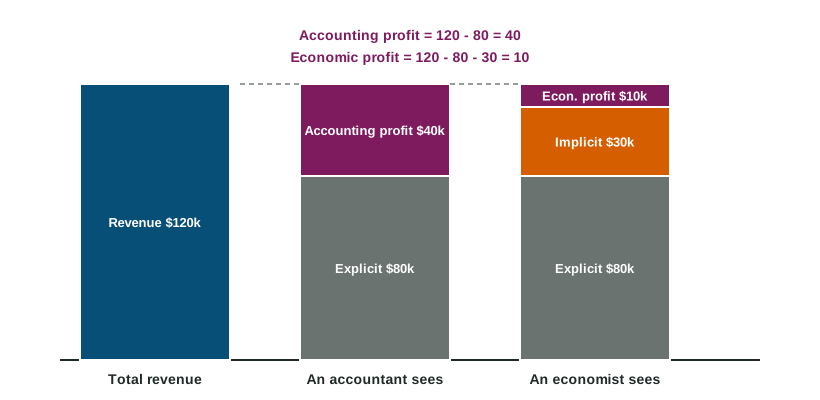
Worked example: the baker's year. Revenue $180,000; rent $30,000, ingredients $50,000, wages $40,000. She gave up a $45,000 salary and $2,000 of interest on the $50,000 of savings she put in.
- Explicit costs:
dollars. - Accounting profit:
dollars. - Implicit costs:
dollars. The forgone interest is $2,000, not the $50,000 she put in: the savings are still hers. - Economic profit:
dollars. The bakery pays her $13,000 more than her best alternatives.
Normal profit
When economic profit is exactly zero, the firm earns a normal profit. That is not "no money". The firm still has an accounting profit, equal to its implicit costs, so the owner earns exactly what her time and money would earn in their next-best use. She has no reason to leave and no reason to wish she had picked something else.
| Accounting profit | Economic profit | |
|---|---|---|
| Subtracts | explicit costs only | explicit and implicit costs |
| Size | larger, or equal if implicit costs are zero | smaller, or equal |
| At normal profit | positive, equal to implicit costs | zero |
| Used for | taxes, reports to owners | deciding whether a business is worth it |
Why economists care about economic profit
Economic profit compares a business with its owner's best alternative, so it is the right signal for choices:
- Positive economic profit: resources earn more here than elsewhere. Other entrepreneurs notice and are drawn to the industry.
- Zero economic profit (normal profit): resources earn just what they would earn elsewhere. There is no pull in or out.
- Economic loss: resources earn less here than elsewhere, even if the books show an accounting profit. In time, owners move their resources to better uses.
Topic 3.6 follows those moves into and out of an industry and shows how they push economic profit toward zero. On the exam, when a question says "profit" in a graph about a firm, it means economic profit, because the cost curves include the owner's opportunity costs.