Rosa is deciding how to spend her summer. She could keep her job at a garden center, which pays $4,000, or run her own lawn-care business, which she expects to bring in $6,500 from customers. The business needs a rented mower ($1,200), gas ($300) and flyers ($100). Subtract those and the business looks $4,900 better. But that comparison leaves something out: if she runs the business, she does not get the $4,000 paycheck. Good decisions count every cost, including the ones nobody sends a bill for.
Explicit and implicit costs
An explicit cost is a money payment: rent, wages paid to workers, materials, a mower rental. An implicit cost is the value of something the decision maker gives up without paying anyone: her own time, which could earn a wage elsewhere, or a building or truck she already owns, which could earn rent. Implicit costs are opportunity costs that do not show up as money spent.
The full economic cost of a choice is the sum:
| Explicit costs | Implicit costs | |
|---|---|---|
| What they are | money paid to others | the value of your own resources or time given up |
| Rosa's business | mower $1,200, gas $300, flyers $100 | garden-center pay $4,000, truck rent forgone $500 |
| Seen on a receipt? | yes | no, but just as real |
Total benefit and net benefit
The total benefit of a choice is everything it gives you. For a consumer, it is the satisfaction of using a good or service, often measured by the most the consumer would pay for it. For a firm, it is the money it takes in from selling its output, its revenue. The net benefit is what is left after the costs:
Worked example: Rosa's summer, every cost counted.
- Explicit costs:
dollars. - Implicit costs: the job's pay plus the truck rent she gives up, dollars.
- Economic cost: dollars.
- Net benefit: dollars. The business is still worth running, but by $400, not $4,900.
- If the job paid $5,000, implicit costs would be $5,500, economic cost $7,100, and net benefit dollars: the job would be the better choice.
The common slip is subtracting only the explicit costs, which makes almost any business look like a good idea.
The best choice has the largest net benefit
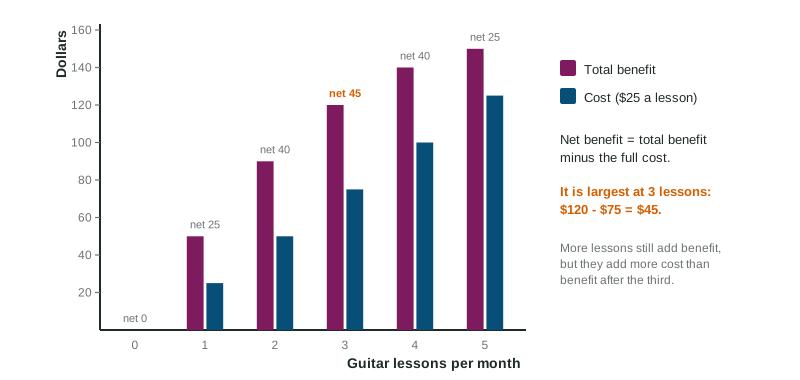
When you can choose how much of something to do, compare the net benefit at each amount. Jamal values guitar lessons at $50 for one a month, $90 for two, $120 for three, $140 for four and $150 for five; each lesson costs $25. His net benefits are $25, $40, $45, $40 and $25. He should take 3 lessons, where net benefit is largest, even though 5 lessons would give the most total benefit. Going from 3 to 5 lessons adds $30 of benefit but $50 of cost. Chasing the largest total benefit, rather than the largest net benefit, is the trap.
Costs and benefits change the answer. If lessons fell to $15, net benefits would be $35, $60, $75, $80 and $75, and 4 lessons would become the best choice.
All-or-nothing choices and how-much choices
Some decisions are all or nothing: run the business or not, build the playground or the skate park. For these, compare the net benefit of each whole option. Others are about how much: how many lessons, how many hours, how many units to make. For those, the totals work, but it is often quicker to ask whether one more unit adds more benefit than cost. The next topic builds that habit, which runs through the rest of the course.