Who decided how many pairs of sneakers were made last year, what they were made from, and who ended up wearing them? In some countries the honest answer is "nobody in particular": millions of shoppers and thousands of firms each made their own choices, and prices tied the choices together. In others, a planning office set the numbers and chose who received the shoes. Both kinds of society face the same scarcity. They differ in who decides and what coordinates the decisions.
Three questions every society answers
Because resources are scarce, every society must answer three questions, whether it says so out loud or not:
- What to produce: which goods and services, and how much of each.
- How to produce it: which mix of land, labor, capital and entrepreneurship, and which methods.
- For whom: who gets the goods and services once they exist.
An economic system is a society's way of answering them. The answers come from its institutions (its laws, its kinds of ownership, its customs) and from a coordinating mechanism that ties millions of separate choices together.
Market, command and mixed economies
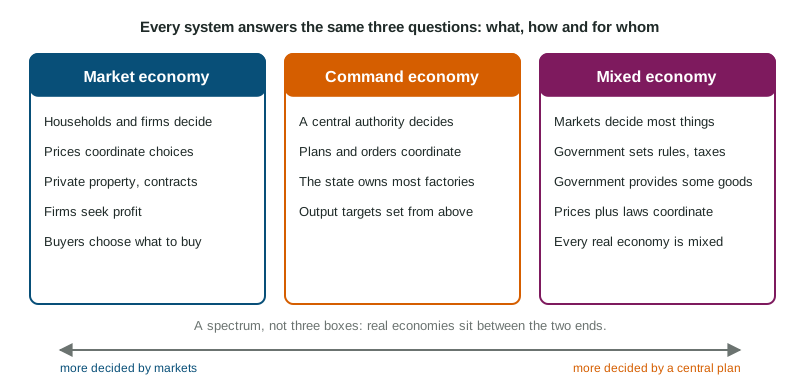
| Market economy | Command economy | Mixed economy | |
|---|---|---|---|
| Who decides | households and firms | a central authority | mostly households and firms, with a government role |
| Who owns most resources | private owners | the state | mostly private owners; the state owns some |
| What coordinates | prices | plans and orders | prices, plus laws, taxes and public services |
| For whom | people willing and able to pay | whoever the plan assigns | mostly by ability to pay, plus some public provision |
In a market economy, households decide what to buy and what work to offer, and firms decide what to make. In a command economy, a central authority sets output targets, assigns resources and often sets prices. A mixed economy combines the two: markets make most decisions, while the government sets rules, collects taxes and provides some goods such as schools and roads. Every real economy is mixed. They differ in how much is left to markets, so it helps to picture a spectrum rather than three separate boxes.
How prices coordinate a market
Nobody runs a market economy, but it is not random. Prices do two jobs at once. They carry information: a rising price says buyers want more of a good than is available. And they create incentives, rewards that motivate choices: a higher price makes a good more rewarding to produce, so firms move workers, machines and materials toward it.
Worked example: coats in two systems. In the invented country of Tessaly, a planning office orders 2 million summer jackets and 1 million winter coats and fixes their prices. By December, jackets pile up in stores while coats sell out within days.
- What went wrong? The plan made too many jackets and too few coats, and the fixed price could not change to show it.
- In a market, the long lines for coats would push the coat price up and unsold jackets would push the jacket price down.
- Incentives follow. Coats become more rewarding to make and jackets less, so firms move resources from jackets to coats.
- Result: production shifts toward what buyers value, without anyone ordering it.
This is a statement about how each system coordinates, not a ranking of countries: planners can also adjust targets, and markets can be slow or leave some needs unmet. The exam asks you to describe the mechanisms, not to judge them.
Institutions markets rely on
Markets work only when people can trust what they own and what they agree to. Property rights give owners the right to use, sell and keep the gains from land, buildings, businesses and ideas. Enforceable contracts let people make deals with strangers. The rule of law means these rules apply to everyone and are enforced by courts. Together they give people incentives to work, save, invest and trade, because the rewards are theirs to keep. Where property rights are weak, people have less reason to build or improve anything that could be taken away.