Your town has one water company, three airlines at the airport and forty coffee shops. Unlike a wheat farm, each of them can raise its price and still keep some customers. That is the line between perfect competition and everything else: the firms in this unit have market power.
Market power: price takers and price makers
A perfectly competitive firm is a price taker. Its product is identical to thousands of others, so if it charged a cent more it would sell nothing, and at the market price it can sell all it wants. Its demand curve is horizontal at the market price, and every unit adds exactly that price to revenue: d = MR = AR = P.
A firm with market power can raise its price without losing every customer. It is a price maker, and it faces a downward-sloping demand curve: to sell more, it must charge less. Market power comes from having few rivals, from a product that buyers see as different, or from rules and costs that keep rivals out. Market power does not mean the firm can charge anything it likes. The demand curve still limits it: a higher price means fewer sales.
Marginal revenue is less than price
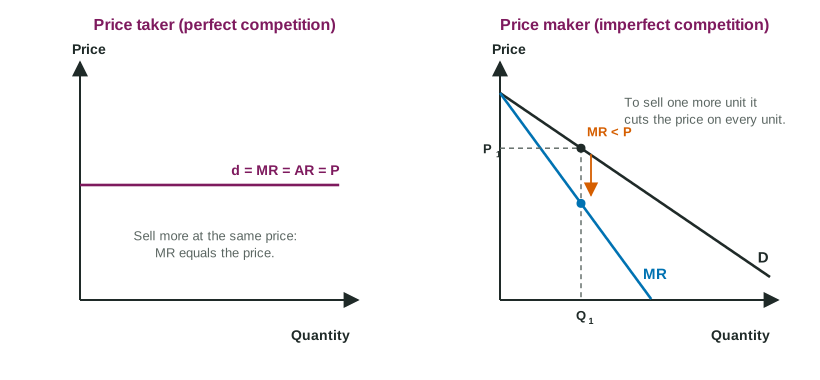
When a price maker charges one price to everyone, selling one more unit means lowering the price on every unit, not just the new one. The new unit brings in its price, but the firm loses a little on each unit it was already selling. So marginal revenue (the change in total revenue from one more unit) is less than the price, and the marginal revenue curve lies below the demand curve. When demand is a straight line, MR starts at the same point on the price axis and falls twice as fast.
Worked example: marginal revenue from a demand schedule. Brisa Water Taxi (invented) is the only water taxi on a lake. It can sell 1 ride an hour at $10, 2 at $9, 3 at $8, 4 at $7 and 5 at $6.
- Total revenue. : 10, 18, 24, 28 and 30 dollars.
- Marginal revenue. . For the third ride, dollars.
- Why less than $8? The third rider pays $8, but the first two riders now pay $8 instead of $9, so Brisa gives up $1 on each: .
- The pattern. MR is 10, 8, 6, 4 and 2 dollars: it falls by $2 for each $1 fall in the price.
Divide the change in total revenue by the change in quantity. Using the price as marginal revenue is the slip to avoid: that is true only for a price taker.
The profit rule does not change. A price maker produces the quantity where MR = MC, then goes straight up to the demand curve to read its price. Because demand lies above MR, the price is above marginal cost. Reading the price off MR or MC instead of demand loses the point on the exam.
Barriers to entry
In perfect competition, economic profit draws in new firms until it is gone. A firm with market power can keep its profit only if something stops rivals from entering. These barriers to entry include:
- Legal barriers: a patent, a copyright or a government license that makes one firm the only seller.
- Control of a key resource: owning every deposit of a mineral, or the only site for a port.
- Economies of scale: when long-run average total cost keeps falling as output grows, one big firm can produce more cheaply than any small newcomer.
- High start-up costs and strong brand loyalty that a newcomer would take years to match.
The higher the barriers, the longer economic profit can last.
The four market structures
Economists sort markets by the number of sellers, how alike their products are and how easy entry is.
| Perfect competition | Monopolistic competition | Oligopoly | Monopoly | |
|---|---|---|---|---|
| Sellers | very many | many | a few large firms | one |
| Product | identical | differentiated | identical or differentiated | no close substitutes |
| Entry | easy | easy | hard (barriers) | blocked |
| Firm's demand | horizontal: d = MR = AR = P | downward sloping | downward sloping | the market demand curve |
| Long-run economic profit | zero | zero | can be positive | can be positive |
| Example | wheat farms | hair salons, restaurants | airlines, phone networks | a local water utility |
In monopolistic competition, each firm's version of the product is a little different (product differentiation: style, location, service), which gives it a small amount of market power. In oligopoly, a few firms are interdependent: each one's best price depends on what its rivals do. In monopoly, one firm faces the whole market demand curve. Each of the next topics takes one structure in turn.
For the exam
- Any firm that is not a price taker faces a downward-sloping demand curve with MR below it.
- The rule is still MR = MC; the price comes from the demand curve at that quantity.
- Name the barrier when you explain why profit lasts: "barriers to entry stop new firms from entering, so economic profit is not competed away."