Fiscal and Monetary Policy Actions in the Short Run
In the short run, fiscal and monetary policy both work by shifting AD.
Part 1 · Hook
Why this matters
Part 2 · Before you start
What this builds on
Part 3 · Prerequisite check
Quick check before you start
1. An economy is in a recessionary gap. Which fiscal action shifts AD to the right?
- Cutting income taxes
- Raising income taxes
- Cutting government spending
- Cutting transfer payments
Show the answer
Lower taxes raise disposable income and consumption, so AD shifts right.
- Correct: Cutting income taxes:
- Raising income taxes:
- Cutting government spending:
- Cutting transfer payments:
2. In the ample-reserves framework, how does a central bank lower its policy rate?
- It lowers the interest rate it pays on reserve balances
- It sells government bonds
- It raises the reserve requirement
- It cuts income taxes
Show the answer
With ample reserves the policy rate follows the administered rates, such as the interest rate on reserve balances.
- Correct: It lowers the interest rate it pays on reserve balances:
- It sells government bonds:
- It raises the reserve requirement:
- It cuts income taxes:
Part 4 · See it
See it first
Part 5 · Step by step
How it works, step by step
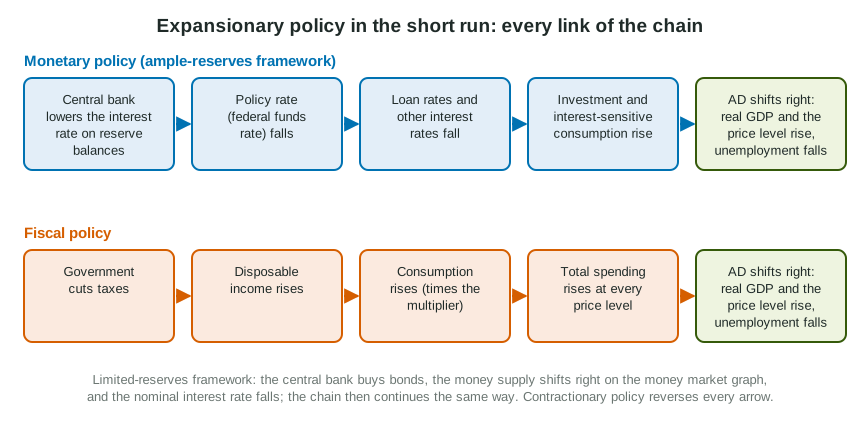
- The central bank lowers the interest rate on reserve balances (ample reserves)the policy rate falls
- The policy rate fallsloan rates and other interest rates fall
- Borrowing is cheaperinvestment and interest-sensitive consumption rise
- Spending rises at each price levelAD shifts right
- AD shifts rightreal GDP and the price level rise, and unemployment falls
Part 6 · Key ideas
Key ideas
- A recessionary gap calls for expansionary policy: more government spending, lower taxes, or a lower policy rate. An inflationary gap calls for contractionary policy, every arrow reversed.
- Name every link: tool, interest rate, interest-sensitive spending, AD, then real output, the price level and unemployment. For a tax change the first links are disposable income and consumption.
- State the framework. Ample reserves: change the administered rates (interest on reserve balances); show it on the reserve market graph. Limited reserves: buy or sell bonds; show it on the money market graph.
- The policy mix: two policies pushing AD the same way give a clear AD effect, but expansionary fiscal policy pushes interest rates up while expansionary monetary policy pulls them down. Policies pushing opposite ways make the AD effect indeterminate.
Part 7 · Misconception
A common mistake
The wrong idea: A lower policy rate raises AD directly.
What actually happens: The policy rate reaches AD only through spending: lower interest rates make borrowing cheaper, so investment and interest-sensitive consumption rise, and that extra spending shifts AD right. Skipping the spending link is a common way to lose the point.
Part 8 · Check yourself
Check yourself
Exam-style questions. Anything you miss goes into your review queue.
Scenario
Sundra in a recession (invented country)
Sundra, an invented country, is in a recession. Real GDP is below full-employment output, and the unemployment rate is 8 percent while the natural rate is 5 percent. Sundra's central bank operates in an ample-reserves framework: it steers its policy rate with the interest rate it pays on reserve balances. Sundra's legislature can also change government spending or taxes.
1. Which action by Sundra's central bank would move real GDP back toward full employment?
- Sell government bonds to drain reserves
- Lower the interest rate it pays on reserve balances
- Raise the interest rate it pays on reserve balances
- Raise the required reserve ratio for banks
Show the answer
In the ample-reserves framework the central bank moves the policy rate with its administered rates. Lowering the interest rate on reserve balances lowers the policy rate, which starts the expansionary chain.
- Sell government bonds to drain reserves: Selling bonds is a limited-reserves tool, and it is contractionary. With ample reserves, a change in the quantity of reserves in the flat part of reserve demand leaves the policy rate where it is.
- Correct: Lower the interest rate it pays on reserve balances: Right: a lower administered rate pulls the policy rate down, loan rates fall, and investment and consumption rise, shifting AD right.
- Raise the interest rate it pays on reserve balances: That raises the policy rate, which lowers investment and shifts AD left: the wrong direction in a recession.
- Raise the required reserve ratio for banks: A reserve requirement belongs to the limited-reserves framework, and raising it would be contractionary anyway.
2. Sundra's central bank lowers the interest rate it pays on reserve balances. Put the links of the chain in order, from the action to the result.
- The interest rate on reserve balances falls
- The policy rate falls
- Loan rates and other interest rates fall
- Investment and interest-sensitive consumption rise
- Aggregate demand shifts right
- Real GDP rises and unemployment falls
Show the answer
Tool, policy rate, other interest rates, interest-sensitive spending, AD, then output and unemployment. Each link causes the next; a written answer that skips one loses the point.
- Correct order: 1. The interest rate on reserve balances falls 2. The policy rate falls 3. Loan rates and other interest rates fall 4. Investment and interest-sensitive consumption rise 5. Aggregate demand shifts right 6. Real GDP rises and unemployment falls
3. Suppose Sundra's legislature cuts personal income taxes instead. What is the first link in the chain from the tax cut to AD?
- Disposable income rises, so households spend more
- The policy rate falls, so firms borrow more
- Production costs fall for firms, so SRAS shifts right
- Potential output rises, so LRAS shifts right
Show the answer
The fiscal chain for taxes runs: taxes fall, disposable income rises, consumption rises (by the MPC times the tax cut), AD shifts right, then output rises and unemployment falls.
- Correct: Disposable income rises, so households spend more: Right: a tax cut leaves households more after-tax income, and part of it is spent (the MPC), which raises consumption and AD.
- The policy rate falls, so firms borrow more: A tax cut is fiscal policy; it does not work through the central bank's policy rate.
- Production costs fall for firms, so SRAS shifts right: A cut in personal income taxes changes what households can spend. It is a demand-side change.
- Potential output rises, so LRAS shifts right: In the short-run model the tax cut works through spending. LRAS depends on resources and technology.
4. An economy has an inflationary gap, and its central bank operates with ample reserves. Build the chain for the right monetary policy.
Build the answer part by part, then write it in your own words.
Show the answer
Raising the administered rate raises the policy rate; higher borrowing costs lower investment, so AD shifts left and the price level and real output fall.
- An answer that earns the point: The central bank raises the interest rate on reserve balances, so the policy rate rises. Borrowing costs more, so investment falls, which shifts AD left, and as a result the price level and real output fall toward full employment.
5. Ruskel, an invented country, has an inflationary gap: AD crosses SRAS to the right of LRAS. Its central bank, which operates with ample reserves, raises the interest rate on reserve balances. Shift the right curve and mark the new short-run equilibrium.
Work on the graph (it needs JavaScript), then check.
Show the answer
The higher policy rate lowers investment, so AD shifts left; at the new equilibrium the price level and real output are lower.
- Key: aggregate demand shifts left
6. A rise in government spending raises real GDP and the price level. On the money market graph, what happens, and why?
- Money supply rises because the government is spending more money, so the nominal interest rate falls
- Money demand rises, as more output at higher prices takes more money, so the nominal rate rises
- Money demand falls because higher prices make money worth less, so the nominal interest rate falls
- Money supply falls because the government borrows from banks, so the nominal interest rate rises
Show the answer
Expansionary fiscal policy raises money demand (more transactions at higher prices), which pushes the nominal interest rate up. That is why the interest rate effect of a policy mix can be unclear.
- Money supply rises because the government is spending more money, so the nominal interest rate falls: The central bank sets the money supply; government spending does not shift it.
- Correct: Money demand rises, as more output at higher prices takes more money, so the nominal rate rises: Right: more nominal spending raises the transaction demand for money; with money supply fixed, the nominal interest rate rises.
- Money demand falls because higher prices make money worth less, so the nominal interest rate falls: Higher prices mean people need more money for the same purchases, not less.
- Money supply falls because the government borrows from banks, so the nominal interest rate rises: Government borrowing shows up in the loanable funds market, not as a shift in the money supply.
Part 9 · Summary
Summary
Part 10 · Up next
What comes next
Part 11 · Connections